





 Português
  Inglês
  Espanhol
  3 min de leitura
  0 comentários


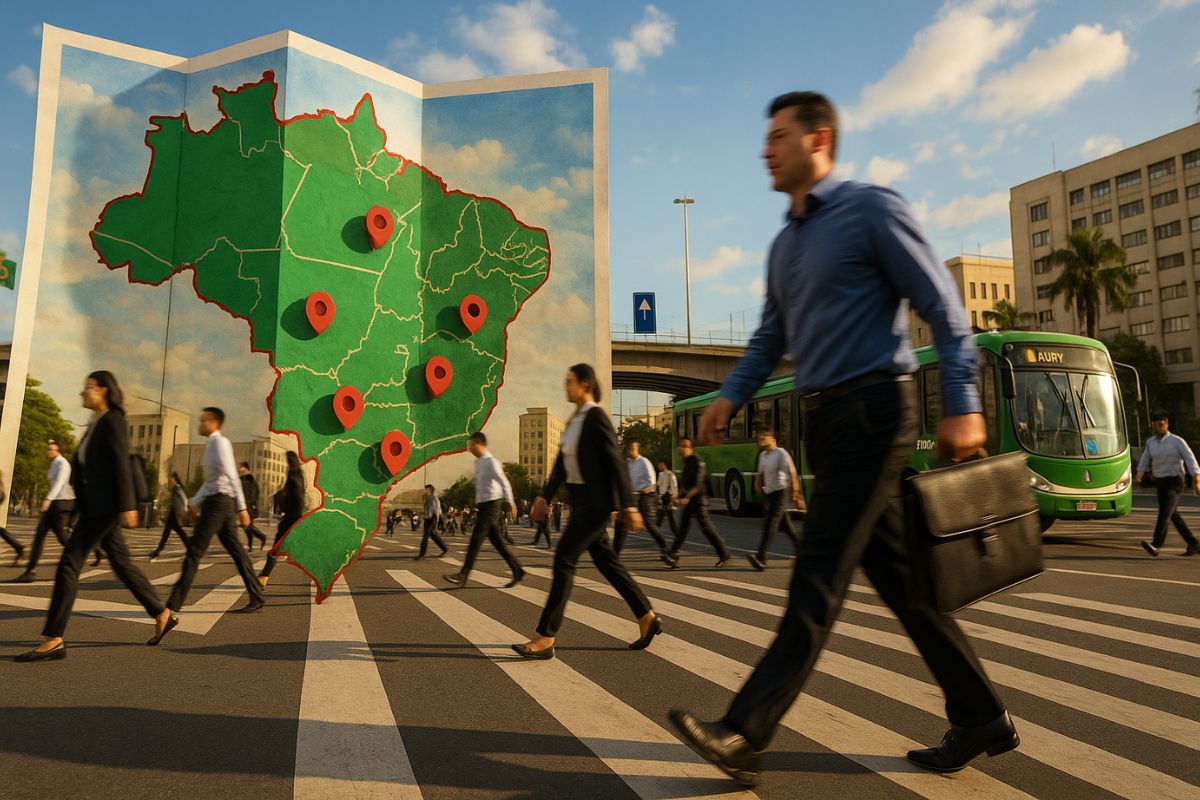
New Survey Shows That Galinhos (RN), Poço Dantas (PB), and Four Other Small Cities Have the Shortest Commute in the Country, While Capitals Concentrate the Longest Journeys.
According to the G1 portal, in only six cities in Brazil, most workers can reach their jobs in up to five minutes. The data, revealed by the 2022 Demographic Census from IBGE, highlights a rare picture in the country: small municipalities, with compact territory and a strong local economy, where living and working in the same place is still a daily reality.
These cities are Galinhos (RN), Poço Dantas (PB), Montauri, Muliterno, and Nova Candelária (RS), and Figueirópolis D’Oeste (MT). In Galinhos and Poço Dantas, 58% of employed residents travel less than five minutes to work. In Montauri, the index is 56%, and in the others, it is 51%.
Where Work and Home Still Mix
These municipalities share a small size and a concentrated community life. None of them exceed 4,000 inhabitants, and they all rank among the smallest territories in their states.
-
The world’s first octopus farm wants to open in the Canary Islands and is already provoking an international reaction: the plan aims to produce 3,000 tons per year.

-
Drought may be creating stronger superbugs in the soil and helping antibiotic resistance reach hospitals, warns a study highlighting a problem that could grow alongside extreme weather.

-
The biggest scam in history: Napoleon’s France deceived the United States by selling them a territory that was Spanish.

-
Why is the Danakil Desert so dangerous? It has unstable terrain and how extreme temperatures and toxic gases turn the region into one of the most hostile environments on Earth.

The compact urban space and economy based on local commerce, agriculture, and public services explain the short distance between home and work.
According to IBGE, the data only consider those who commute at least three times a week to their main job, and the time counted is the direct route between home and workplace, without including intermediate stops, such as dropping children off at school or shopping.
The research reinforces a trend of improving quality of life in rural areas: in small towns, the time spent in traffic is minimal, which enhances the balance between professional and personal routines.
Opposite Reality in Brazilian Capitals
While in Galinhos more than half of the employed population takes five minutes to get to work, in the capitals the scenario is the opposite.
Only Palmas (TO) stands out, with 11% of workers living up to five minutes from their jobs.
In cities like São Paulo, Salvador, and Rio de Janeiro, this figure drops to 4%, reflecting urban concentration and the distance between residential areas and job hubs.
In Goiânia, Florianópolis, Fortaleza, and Vitória, the proportion does not exceed 8%, even with recent investments in urban mobility.
Geographical inequality is also evident in extreme cases: Serranópolis de Minas (MG) leads the ranking of cities with the highest average commute time, where 20% of workers take more than four hours to get to work.
The Routine of the Average Worker in the Country
The survey shows that 57% of Brazilian workers take up to half an hour to reach their jobs, an improvement compared to 2010, when the percentage was 52%. Another 20% spend between 30 minutes and one hour, and 10% face daily commutes of 1 to 2 hours.
In total, 1.3 million people in the country spend more than two hours on their commute, a proportion identical to that recorded in the previous census.
This data reveals that, even with technological advancements and new hybrid work models, transportation remains a structural bottleneck in major metropolitan areas.
When Distance Means Quality of Life
In the small municipalities leading the ranking, the short commute time is linked to factors of proximity and social cohesion.
The economy is more distributed, and a good portion of residents work in their own neighborhood or even at home.
Experts point out that this configuration contributes to lower stress, more free time, and a greater sense of community belonging.
However, the same model is difficult to replicate in large urban centers, where disorderly expansion and land costs push housing further away from work.
While six small cities in Brazil preserve the privilege of living and working just minutes apart, millions of Brazilians still face hours of commuting every day. Do you believe it is possible to regain this quality of life in large cities? Or do you think urban growth inevitably pushes workers away from their jobs?
Leave your opinion in the comments your experience may reveal the true picture of transit and work in today’s Brazil.









Seja o primeiro a reagir!