





 Portuguese
  English
  Spanish
  6 min of reading
  0 comments


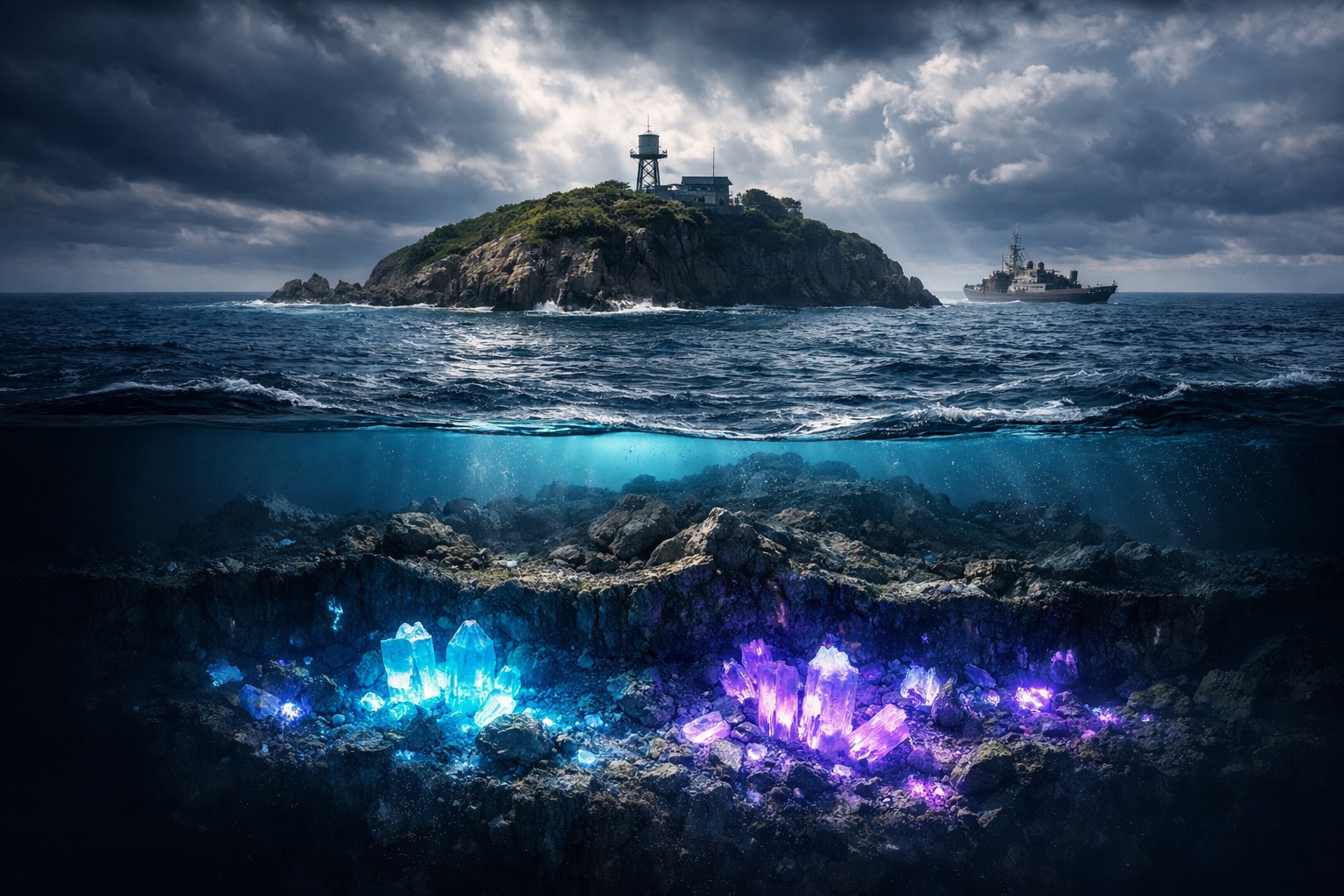
Minamitorishima, Isolated Island of Japan in the Pacific, Houses on the Ocean Floor One of the Largest Rare Earth Deposits in the World and Becomes a Key Piece in the Japanese Mineral Strategy.
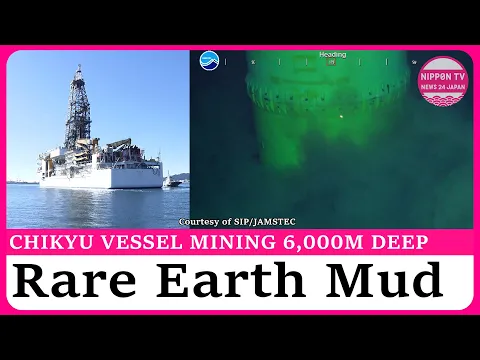
On January 11, 2026, the scientific research vessel Chikyu departed from Yokohama on a mission that no country had undertaken before on a real operational scale: to sink a several-kilometer tube to the bottom of the Pacific Ocean and continuously extract mud from the seabed at 6,000 meters deep — almost double the height of Mount Fuji. The destination was the waters around Minamitorishima, Japan’s easternmost island, located at the edge of Japan’s Exclusive Economic Zone. The Chikyu would remain in the region until February 14.
During the 35 days of the operation, scientists extracted 35 tons of mud rich in rare earths — each ton containing about two kilograms of strategic minerals essential for electric vehicles, wind turbines, semiconductors, military systems, and high-efficiency batteries.
It was the first continuous extraction test of rare earths from the ocean floor in world history.
-
Friends have been building a small “town” for 30 years to grow old together, with compact houses, a common area, nature surrounding it, and a collective life project designed for friendship, coexistence, and simplicity.

-
This small town in Germany created its own currency 24 years ago, today it circulates millions per year, is accepted in over 300 stores, and the German government allowed all of this to happen under one condition.

-
Curitiba is shrinking and is expected to lose 97,000 residents by 2050, while inland cities in Paraná such as Sarandi, Araucária, and Toledo are experiencing accelerated growth that is changing the entire state’s map.

-
Tourists were poisoned on Everest in a million-dollar fraud scheme involving helicopters that diverted over $19 million and shocked international authorities.

Minamitorishima: The Isolated Island That Protects Japan’s Largest Mineral Bet
Minamitorishima is approximately 1,900 kilometers southeast of Tokyo, in the middle of the Pacific. With only 1.2 km² of area and a triangular shape surrounded by coral reefs, the island is smaller than many urban neighborhoods in Japan. There are no civilian residents. There are no hotels, tourist infrastructure, or public access.

Civilians are prohibited from entering. Only employees of the Japan Meteorological Agency, members of the Self-Defense Forces, and researchers authorized by the government have access.
There are no commercial flights or regular maritime routes. The only landmass within a 1,000-kilometer radius is the ocean itself.
Historically, Minamitorishima was used for the extraction of guano and albatross feathers. During World War II, it served as a military base. After the conflict, it was occupied by the United States and returned to Japan in 1968. Since then, it has served as a strategic observation point for scientific and military purposes.
Today, however, its strategic value is not on the surface — but in the deep ocean floor surrounding it.
The Largest Oceanic Deposit of Rare Earths Ever Identified
In 2013, the Japan Agency for Marine-Earth Science and Technology (JAMSTEC) collected samples of marine sediments between 5,600 and 5,800 meters deep, about 250 km south of the island.
The result surprised the international scientific community: a layer of mud between two and four meters beneath the seabed with extremely high concentrations of rare earth elements.
In 2018, expanded surveys confirmed the presence of 15 different types of rare earths, with a total estimated volume of 16 million tons of oxides.
For comparison:
- Estimated terrestrial reserves in China: 44 million tons.
- Japanese oceanic deposit: equivalent to more than one-third of that.
But the differentiator is in the composition.
The mud from Minamitorishima contains approximately:
- 50% heavy rare earths
- 50% light rare earths
Chinese ore contains, on average, 25% heavies. Heavy rare earths — such as dysprosium and terbium — are critical for high-temperature permanent magnets used in electric vehicle motors and offshore wind turbines.
Estimates indicate that:
- The available dysprosium could supply global demand for about 730 years.
- The terbium, for approximately 420 years.
Another decisive factor: Japanese mud exhibits very low concentrations of thorium and uranium, drastically reducing the radiological risks and environmental costs associated with terrestrial mineral processing.
What Are Rare Earths and Why Are They the “Oil of Electrification”
Rare earths are 17 chemical elements with unique magnetic and conductive properties. Among them:
- Neodymium
- Dysprosium
- Terbium
- Lanthanum
- Cerium
They are present in:
- Electric vehicle motors
- Wind turbines
- Solar panels
- Smartphones
- Guided missiles
- Satellites
- Semiconductor chips
- High-density batteries
An electric car uses between 1 and 2 kg of rare earths. An offshore wind turbine can contain hundreds of kilograms. Without these minerals, the global energy transition would simply slow down drastically.
Chinese Dominance in the Global Rare Earth Chain
China controls approximately:
- 60% to 70% of global production
- More than 85% of processing capacity
Even when the ore is extracted in other countries — Australia, the United States, Vietnam — it often needs to be refined in China. The dependence is structural: mining, chemical separation, magnet production, complete industrial chain.
This turns rare earths into a geopolitical tool.
2010: When Rare Earths Became a Diplomatic Weapon
In September 2010, a Chinese vessel collided with Japanese Coast Guard ships near the Senkaku Islands, a disputed territory.
After the detention of the Chinese captain, rare earth exports to Japan faced customs delays and indirect blockages.

At that moment, Japan imported 89% of its rare earths from China. Prices soared globally. The Japanese industry went into high alert.
The episode made it clear: critical minerals could be used as a strategic tool.
2026: China Imposes New Restrictions — Japan Was Already at Sea
On January 6, 2026, China’s Ministry of Commerce announced new restrictions on the export of dual-use items — civilian and military — including heavy rare earths and permanent magnets.
Five days later, the Chikyu departed. The coincidence was strategic. Japan had been investing since 2013 in building mineral autonomy.
Since 2018, about ¥40 billion (US$ 256 million) has been specifically directed toward the deep ocean extraction program.
How Deep Sea Mining Works at 6,000 Meters Depth
Extraction in ultradeep waters is technologically distinct from polymetallic nodule mining. Rare earth mud is a fine sediment, not solid blocks.
The system developed by JAMSTEC uses:
- A multi-kilometer tube
- Cylindrical excavation device on the bottom
- Hydraulic suction system
- Continuous water circulation
The mud is pumped up to the ship. Then transported to Minamitorishima. On the island:
- Centrifuges remove 80% of the seawater
- Sediment is compacted
- Material is sent for refining in mainland Japan
Tested operational goal: 350 tons of sediment per day. Sensors monitor environmental impact on the seabed.
Environmental Impact of Deep Sea Mining
Extraction of terrestrial rare earths generates:
- Deforestation
- Radioactive contamination
- Acid drainage
- Toxic waste
Deep sea mining presents different challenges:
- Bentonic ecosystem disturbance
- Sediment suspension
- Potential impact on deep-sea fauna
Japan monitors the ecosystem to evaluate:
- Turbidity
- Particle dispersion
- Biological impact
The environmental debate is still open in the international scientific community.
2027–2028: The Race for Industrialization
The 2026 test was classified as a success. Upcoming milestones:
- 2027: expanded pilot demonstration
- 2028: start of industrialization
A permanent processing facility will be built on the island by 2027 within the Strategic Innovation Promotion Program (SIP).
Estimated goal: To provide up to 5% of global neodymium demand by 2030. It is not total independence — but it is strategic diversification.
The Geopolitical Dimension: Maritime Sovereignty and Exclusive Economic Zone
Minamitorishima is crucial because it extends Japan’s Exclusive Economic Zone. What’s on the ocean floor is not just a mineral deposit.
It is:
- Economic security
- Industrial independence
- Energy sovereignty
- Military strategy
In June 2025, a Chinese navy ship entered the vicinity of the Japanese research area.
The episode was officially recorded. There was no confrontation. But the message was clear.
The New Frontier of Global Strategic Mining
If the Japanese project successfully scales, the impact could:
- Reduce dependence on China
- Stimulate deep-sea mining in other countries
- Redefine global supply chains
- Reconfigure maritime disputes
The race for critical minerals is no longer just on land.
It is on the ocean floor. At 6,000 meters deep.
And Japan was the first to test continuous extraction at scale. What started as mud could redefine the mineral geopolitics of the 21st century.










-

-

2 pessoas reagiram a isso.