





 English
  Francês
  Alemão
  Italiano
  Japonês
  Norueguês
  Portuguese
  Spanish
  6 min of reading
  0 comments


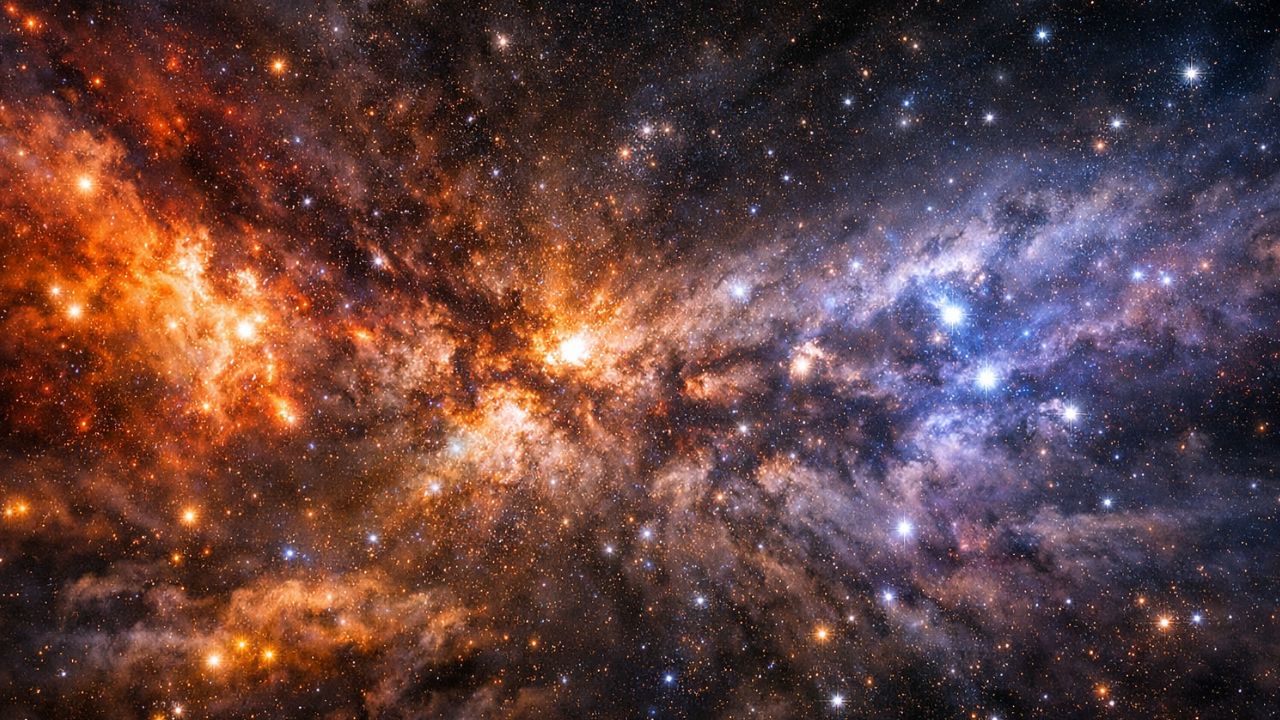
New Galaxy Map Reveals How Stars Are Born and Suggests That the Sun May Have Migrated Before Forming the Solar System.
Astronomers have released the most detailed map ever obtained of the center of the Milky Way galaxy, revealing the distribution of cold gas that gives rise to stars, planets, and systems like our solar system.
The discovery was made by an international team of scientists after four years of observations using the powerful ALMA radio telescope, located in the Atacama Desert in Chile.
The study helps researchers understand how the Sun and other planetary systems arose and also provides new clues that our star may have formed much closer to the galactic core before migrating to its current position.
-
350-year mystery may have been solved: remains of a soldier who inspired the hero of The Three Musketeers found beneath a church in the Netherlands.

-
NASA photographed a nearly perfect square with 3 km sides on Mars, 13 times larger than the Great Pyramid of Giza, but the official explanation is natural erosion; still, no one has explained why the four sides have almost identical lengths.

-
Starlink breaks the barrier of 10,000 satellites in orbit and takes its expansion to an unprecedented level, with a direct impact on global internet, technological competition, and the race for space.

-
Japan finds an alternative to oil amid rising prices by transforming ocean balance into electricity with a new technology that maintains efficiency even when the sea changes.


See More: Meta Acquires Moltbook and Bets on a Social Network Exclusive for AI Agents
See More: Uber Woman: App Allows Rides Only with Female Drivers in Brazilian Capitals
New Galaxy Map Reveals Where Stars Are Born
Scientists have produced an extremely detailed survey of the central region of the galaxy, known as the Central Molecular Zone (CMZ). This area concentrates large amounts of gas and cosmic dust — the fundamental ingredients for the formation of stars and planets.
The study was conducted with the Atacama Large Millimeter/submillimeter Array (ALMA), a set of more than 50 radio antennas that work together to capture extremely weak signals from deep space.
According to Steven Longmore, professor of astrophysics at Liverpool John Moores University and project leader, this level of detail has never been achieved before.
“We have never had an image of what is happening right at the center of our galaxy,” said Steven Longmore. “We have had many detailed studies of small regions, but this is the first time we have a complete map of the cold gas at the center of our galaxy.”
According to the researcher, previous studies worked like isolated photographs of different points in the galaxy. Now, for the first time, scientists have something comparable to a complete aerial view.
“You cannot have the complete story of a city unless you have a complete map of it”, he said.
/i.s3.glbimg.com/v1/AUTH_59edd422c0c84a879bd37670ae4f538a/internal_photos/bs/2026/2/m/SyfqWvRVSjHlkP4ClwmA/thumbnail6.jpg)
The Role of Molecular Gas in the Formation of the Solar System
The scientific survey identified huge clouds of molecular gas, primarily composed of hydrogen and carbon monoxide. These materials are known to give rise to new stars when they undergo gravitational collapse.
Over time, planets and even systems similar to our solar system can emerge around these newly formed stars.
The center of the galaxy is an extremely dynamic region. At its core is Sagittarius A*, a supermassive black hole with a mass about 4 million times greater than the Sun.
The intense gravitational force of this object directly influences the behavior of the gas around it.
Longmore compared the phenomenon to a bathtub drain:
the gas clouds would be like water being pulled toward the center, while the black hole acts like the drain that attracts all the surrounding matter.
How the Telescope Revealed the Movement of Gas in the Galaxy
Despite the colorful images released by scientists, the telescope does not capture colors in the same way as a regular camera.
In fact, researchers use a technique called spectroscopy, which analyzes the frequencies of light emitted by molecules present in the gas.
With this, astronomers can detect the Doppler effect, a phenomenon that also occurs when the siren of an ambulance changes pitch as it approaches or moves away.
This technique allows discovering:
- whether the gas is approaching Earth
- whether it is moving away
- and what its speed in space is
With this information, it was possible to construct a detailed three-dimensional map of the central region of the galaxy.
Astronomer Richard Teague, from the Massachusetts Institute of Technology (MIT), who did not participate in the project, highlighted the importance of this type of survey.
“We are analyzing star-forming material in this extreme environment. It is the first truly detailed analysis of how this gas is distributed in three-dimensional space,” said Richard Teague.
Colors of the Image Reveal Collisions and Calm Regions of the Galaxy
The colors present in the images do not represent what the human eye would see in space.
In fact, they were digitally assigned to indicate different molecules and gas behaviors.
According to Longmore:
- Red regions may indicate violent collisions between gas clouds
- Blue regions indicate more stable and calm areas
The survey detected more than 70 molecular spectral lines, including complex organic molecules like methanol and ethanol.
Some of these substances are considered precursors to amino acids, which are the fundamental building blocks of proteins and life.
Therefore, studying these regions helps scientists better understand how the solar system and other planetary systems may arise.
Study Suggests That the Sun May Have Migrated Through the Galaxy

In addition to the new galactic map, recent research also indicates that the Sun may not have been born where it currently is.
Two studies published in the scientific journal Astronomy & Astrophysics suggest that our star may have emerged much closer to the center of the galaxy.
The discovery was made possible thanks to data from the Gaia satellite, from the European Space Agency (ESA), responsible for mapping billions of stars.
The researchers identified a group known as “solar twins”, stars with characteristics very similar to the Sun, including temperature and chemical composition.
By analyzing 6,594 of these stars, scientists noticed an important pattern: many are aged between 4 and 6 billion years, similar to the Sun.
This indicates that a major stellar migration may have occurred, in which several stars moved from the central regions of the galaxy to more outer areas.
Today, the solar system is located about 26,000 light-years from the center of the Milky Way, but evidence suggests that the Sun may have formed more than 10,000 light-years closer to the galactic core.
Sun Migration May Have Favored the Emergence of Life
If this hypothesis is correct, the repositioning of the Sun within the galaxy could have had significant consequences for the history of life.
The galactic central regions are much more intense and dangerous, with higher density of stars, radiation, and stellar explosions.
On the other hand, outer areas — like where the solar system is located today — tend to be more stable.
This means that the possible migration of the Sun may have led our system to a safer zone of the galaxy, favoring the development of life on Earth.
Global Scientific Collaboration Drives New Discoveries
The project responsible for the map of the center of the galaxy involved about 160 scientists from different countries.
According to the researchers, the scale of the collaboration was essential to gather thousands of individual observations and construct the final survey.
“It is truly a huge effort by scientists and universities, but also by engineers and telescope operators based in Chile, that made this possible,” said Teague.
The research shows how modern scientific projects increasingly rely on international cooperation, advanced technology, and space or ground-based observatories.
And, as new telescopes and satellites continue to explore the cosmos, scientists believe that even more surprising discoveries about the Sun, stars, and the solar system may emerge in the coming years.







-

-

-

7 pessoas reagiram a isso.