





 Portuguese
  English
  Spanish
  6 min of reading
  0 comments


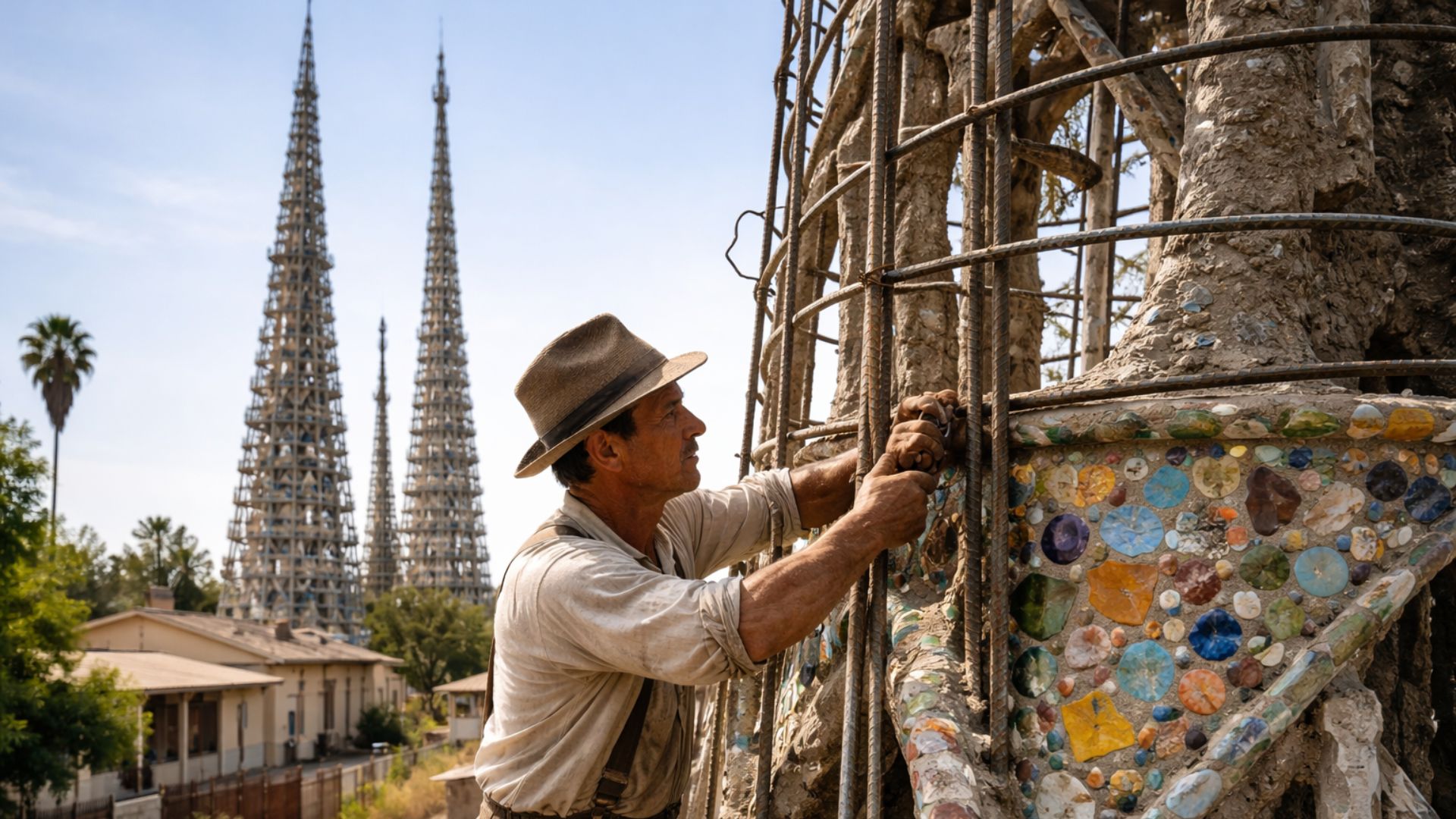
Mosaic Towers Emerging in an Average Neighborhood in Los Angeles Hide a Story of Persistence and Craftsmanship. A Work Created by an Immigrant with Repurposed Materials and Simple Tools Faced Safety Questions, Was Almost Demolished, and Ended Up Being Recognized as a Federal Historic Landmark in the United States.
In South Los Angeles, a set of narrow, intricate towers rises above the houses and avenues as if designed to defy any domestic construction logic.
Known as Watts Towers, these structures became a global reference for being built almost entirely by a single person, with simple tools, on an average neighborhood lot, and for surviving the test of time to receive official recognition for historic preservation in the United States.
The authorship is attributed to the Italian immigrant Simon Rodia, also cited in records as Sabato Rodia, who settled in the Watts area and began transforming the lot into a life project.
-
Friends have been building a small “town” for 30 years to grow old together, with compact houses, a common area, nature surrounding it, and a collective life project designed for friendship, coexistence, and simplicity.

-
This small town in Germany created its own currency 24 years ago, today it circulates millions per year, is accepted in over 300 stores, and the German government allowed all of this to happen under one condition.

-
Curitiba is shrinking and is expected to lose 97,000 residents by 2050, while inland cities in Paraná such as Sarandi, Araucária, and Toledo are experiencing accelerated growth that is changing the entire state’s map.

-
Tourists were poisoned on Everest in a million-dollar fraud scheme involving helicopters that diverted over $19 million and shocked international authorities.


Simon Rodia and the “Nuestro Pueblo” Project
According to information released by the Watts Towers Arts Center, the author worked persistently for decades, erected multiple interconnected structures, and named the ensemble Nuestro Pueblo, a Spanish expression associated with the idea of a “our particular village” built in the middle of the city.
What first draws attention today is the height.

According to the National Park Service, the main towers reach about 99.5 feet, just over 30 meters, and stand out as tall spirals, supported by an internal mesh of metal and coated with a worked plaster surface.
17 Structures and Towers Nearly 30 Meters Tall in Los Angeles
Around these towers, there are other architectural and sculptural pieces that make up the total of 17 structures mentioned in official descriptions, forming arches, passages, walls, and decorative elements that guide the visitor through an environment that seems simultaneously like a square, an engineering work, and an artistic installation.
The technique used did not rely on heavy machinery or a large workforce.
Information from institutions linked to the preservation of the site describes a construction based on rebar and wires molded manually, with layers of cement and details applied as if they were the finishing of a facade, only repeated on a monumental scale.
Glass and Ceramic Mosaics Made with Repurposed Materials
The final result is neither smooth nor uniform: each section appears covered by fragments of glass, ceramics, tiles, broken china, and other repurposed materials, forming mosaics that reflect light and create distinct patterns just a few meters away.
The handcrafted nature becomes more evident when observing how the ornamentation follows the structure, not merely functioning as a superficial decoration.
In various points, the mosaics fit into curves and intersections, following spirals that seem designed to guide the gaze to the top.
The very administration of the space emphasizes that Rodia collected everyday materials and incorporated them into the work, transforming discarded objects into part of a larger design, with repeated shapes and a recognizable visual signature.
The history of the Watts Towers is often associated with the idea of an “impossible work,” but public records give concrete shape to what was done.

Documents from the National Park Service indicate that the project was developed over approximately 33 years, with continuous and progressive work until the completion attributed to the mid-20th century.
This duration helps explain how such tall structures could be erected without the pace of a conventional construction site: rather than a construction with a defined deadline, what existed was an accumulative process, in which each new section paved the way for the next.
The immigrant origin of the author also became a central part of the public narrative.
Cultural institutions and visitor materials emphasize that Rodia was a manual laborer, with construction experience, but without the backing of an engineering office, a project signed by famous architects, or institutional funding.
The work, in this sense, consolidated as a symbol of individual creation on an urban scale, something that attracts both scholars of folk art and curious onlookers who wonder how one person can physically and mentally sustain such a long effort.
Safety Questions and Preservation of Heritage
Beyond the visual impact, there is an element of risk and dispute that marked the preservation of the ensemble.
Reports gathered in documents and institutional pages indicate that after Rodia’s departure from the site, there was a period of questioning about structural safety, with attempts for demolition and technical evaluations.
The National Park Service describes that the towers underwent tests and inspections that contributed to the decision to keep them standing, paving the way for restoration actions and subsequent historic recognition.
From that point on, the work ceased to be merely an individual endeavor and began to be treated as public heritage, with responsibilities for conservation.

The site is associated with educational initiatives, guided visits, and restoration projects, often conducted in partnership with municipal agencies and cultural organizations.
The Watts Towers Arts Center, linked to the cultural programming of the space, presents the ensemble as an artistic and community landmark, emphasizing that maintenance requires specialized interventions due to the combination of metal, plaster, and mosaics exposed to sun, wind, and urban pollution.
The recognition as a National Historic Landmark, a federal category designated for sites of exceptional historical value, consolidated the Watts Towers as a reference outside California.
The National Park Service records the ensemble as a property associated with art and architecture, which includes the uniqueness of authorship, aesthetic language, and relation to the urban history of Los Angeles.
This status also helps explain why the towers frequently appear in tourist itineraries and international reports: it is not merely a “different” monument, but a place officially identified as a relevant part of the country’s cultural heritage.
Visit Experience and Urban Landscape in the Watts Neighborhood
At ground level, the experience is less about “seeing towers” and more about perceiving a landscape built with details.
The visitor walks through arches and low walls, passes through areas that resemble small courtyards, and observes how the mosaics repeat with variations in color and texture.
Up close, the ensemble reveals common objects that have been incorporated as cladding, making the gaze oscillate between the monumental scale and the intimate scale of a piece of pottery fitted by hand.
The permanence of the Watts Towers is also linked to the place where they emerged.
Watts is a neighborhood marked by social and economic transformations, and the work has become a local landmark, often associated with community identity and cultural programs focused on art and education.
This territorial bond helps sustain the importance of the ensemble beyond the architectural aspect, because the monument is not isolated in a monumental park but rooted in a real neighborhood, with streets, houses, and everyday life surrounding it.
Behind the image of the towers, the story has a simple and hard-to-ignore core: an individual decided to build something too large for one person, persevered for decades, and left a result that survived demolition attempts, technical demands, and public disputes until it became a historic reference.
When a work is born without commission, without contract, and without a guaranteed audience, what drives someone to continue day after day, for years, until transforming an ordinary lot into a monument recognized worldwide?









-

-

-

3 pessoas reagiram a isso.