





 Portuguese
  English
  Spanish
  4 min of reading
  17 comments


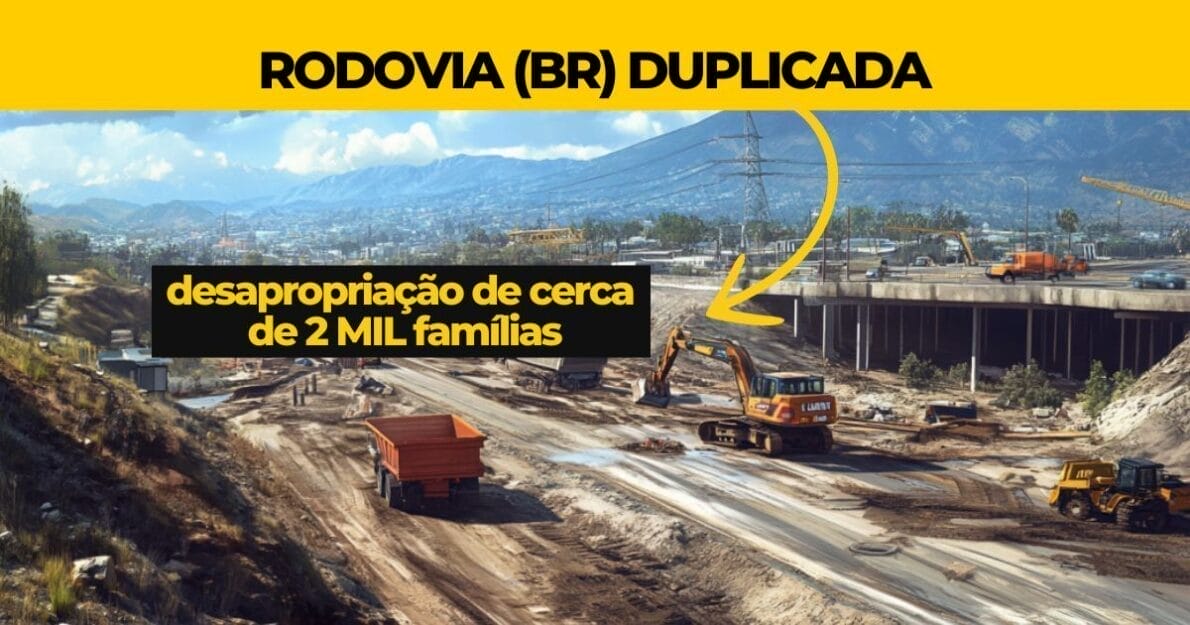

Duplication of BR-381 Will Bring Improvements to Traffic, But at the Cost of Displacing 2,000 Families. The Social Impact of This Project Will Be Significant and Raises Questions About Relocation and Support for Affected People.
One of the most important highways in Minas Gerais is about to undergo a transformation that may affect thousands of people.
The duplication of a crucial stretch of BR-381, which connects Belo Horizonte to cities in the region, has been awaited for years.
However, what many do not know is that this work will directly impact the lives of around 2,000 families, who will be displaced to make way for the new alignment.
-
Unemployment rises again to 5.8% at the beginning of 2026, raising alarms about the end of temporary positions and its impact on the Brazilian job market.

-
Document organization can cut invisible costs in small businesses, a simple step that prevents waste, rework, and losses in daily operations.

-
Chinese giant worth nearly R$ 4 billion that manufactures cables for electric cars, solar energy, and robotics wants to open a factory in SC.
-
Many employers do not know, but the law guarantees domestic workers a 25% increase in salary during trips, 50% for overtime, 20% for night shifts, and 17 additional benefits that can lead to labor lawsuits if not paid.


Amid promises of improvements, safety, and development, unsettling questions arise: what will be the social consequences of this monumental project? And will everyone be relocated fairly?
The Start of Construction and the Billion-Dollar Investment
The contract for the duplication of BR-381, between Caeté and the district of Ravena, was signed, marking the start of an ambitious project.
The investment is R$ 393.7 million, an amount that, according to the federal government, will be used to duplicate, restore, and improve nearly 20 kilometers of the highway.
This area is known for long traffic jams, and therefore, the project is seen as a solution to address infrastructure issues that have lasted for decades.
According to the Official Gazette of the Union, the company responsible for execution, Construtora Luiz Costa Ltda, will have six months to prepare the basic and executive projects.
Only after this stage, which ends in April 2024, will the machines begin to work on-site.
A Promise That Generates Enthusiasm… and Concern
According to the Minister of Mines and Energy, Alexandre Silveira, this project is a “dream” that is finally becoming a reality.
On his social media, he celebrated the contract and highlighted the importance of duplication for the safety of drivers.
Additionally, he praised the role of the Minister of Transportation, Renan Filho, who has once again brought Minas Gerais to the forefront of road investment.
However, alongside the enthusiasm, concerns arise. About 2,000 families will be displaced so that the new alignment of the highway can be constructed.
This means many people will have to leave their homes and wait for a fair relocation, which often ends up being a lengthy and complicated process.
A Critical Stretch and the Division into Lots
The work to be carried out is part of what is called Lot 8A, which encompasses the stretch between Caeté and Ravena.
In September of this year, the announcement for the duplication was finally published, but with a significant change:
the transfer of construction from the exit of Belo Horizonte to the National Department of Transport Infrastructure (Dnit).
This led to the division of the highway into two lots: 8A and 8B, facilitating the organization of the process.
The mayor of Sabará, Wander Borges, expressed his support for the project and offered to contribute to whatever is necessary.
He emphasized the importance of the duplication for the development of the region and the state’s economy, as BR-381 is one of the busiest and most strategic routes in Minas Gerais.
The Auction That Energized the Transport Sector
In August 2024, an important milestone was reached with the auction for the concession of a 303.4-kilometer stretch of BR-381, connecting Belo Horizonte to Governador Valadares.
The winning bidder was 4UM Investimentos, which expressed interest after the federal government made significant changes to the project.
These changes included the removal of the stretch between Belo Horizonte and Caeté, deemed problematic due to geological risks and the legal complexities required to carry out the works.
According to industry experts, this removal was essential to avoid more deserted auctions, as had previously occurred.
Social Impact: Who Will Pay the Price?
The main point of concern in this entire process is the social impact that this project will cause. About 2,000 families will be directly affected, with their properties being expropriated.
The question is: how will these people be relocated? Will there be sufficient support to ensure that they have adequate housing and dignified resettlement?
The experience with other infrastructure projects in Brazil shows that relocating so many people is always a complex process, which can drag on for years and leave many families in vulnerable situations.
Furthermore, the pace of expropriations often does not keep up with the progress of the works, which can generate even more problems.
What Comes Next for BR-381?
The mayor of Sabará and other local political leaders have mobilized to closely monitor the progress of the bidding for Lot 8B, the other stretch of BR-381 that will also be duplicated.
According to government information, a meeting with members of the Office of the Comptroller General is scheduled to discuss the process and the next steps.
This duplication, although necessary to improve traffic and safety, carries a series of logistical and social challenges that need to be addressed.
In the coming years, it will be interesting to see how the federal government, the companies involved, and civil society will handle the demands that arise.
The Future of BR-381: Development at Any Cost?
The duplication works on the BR-381 highway promise to bring benefits to the region’s economy and improve driver safety.
But at the same time, they raise questions about the social cost of this development. Will the 2,000 displaced families receive the attention they deserve?
Do you believe that progress justifies the social impacts caused by large infrastructure projects like this?



É um questionamento muito equivocado, até por que a qualidade de vida e o perigo que essas pessoas passam vivendo à margem (literalmente) dessa rodovia nao carece nem de um comentário infeliz e creio sem noção. Isso sem falar das vidas que podem ser poupadas com a realocação para local mais seguro.
Quem escreveu esta matéria é um hipócrita. Todos sabemos o tanto de vidas que foram ceifadas nesta rodovia. Quantas famílias foram perdidas . Além do que também é do conhecimento de todos que as ocupações ocorreram a partir do momento em que se falou em duplicar. Fora os riscos das famílias que ali moram. Lamentável alguém fazer jornalismo para escrever uma bobagem dessa…
Esta Mais que na hora do governo de Minas acordar para o desenvolvimento de Minas ,estrada com qualidade traz investimentos e progresso para o estado Minas é grande em tamanho e pequena em desenvolvimento.