





 Portuguese
  English
  Spanish
  5 min of reading
  0 comments


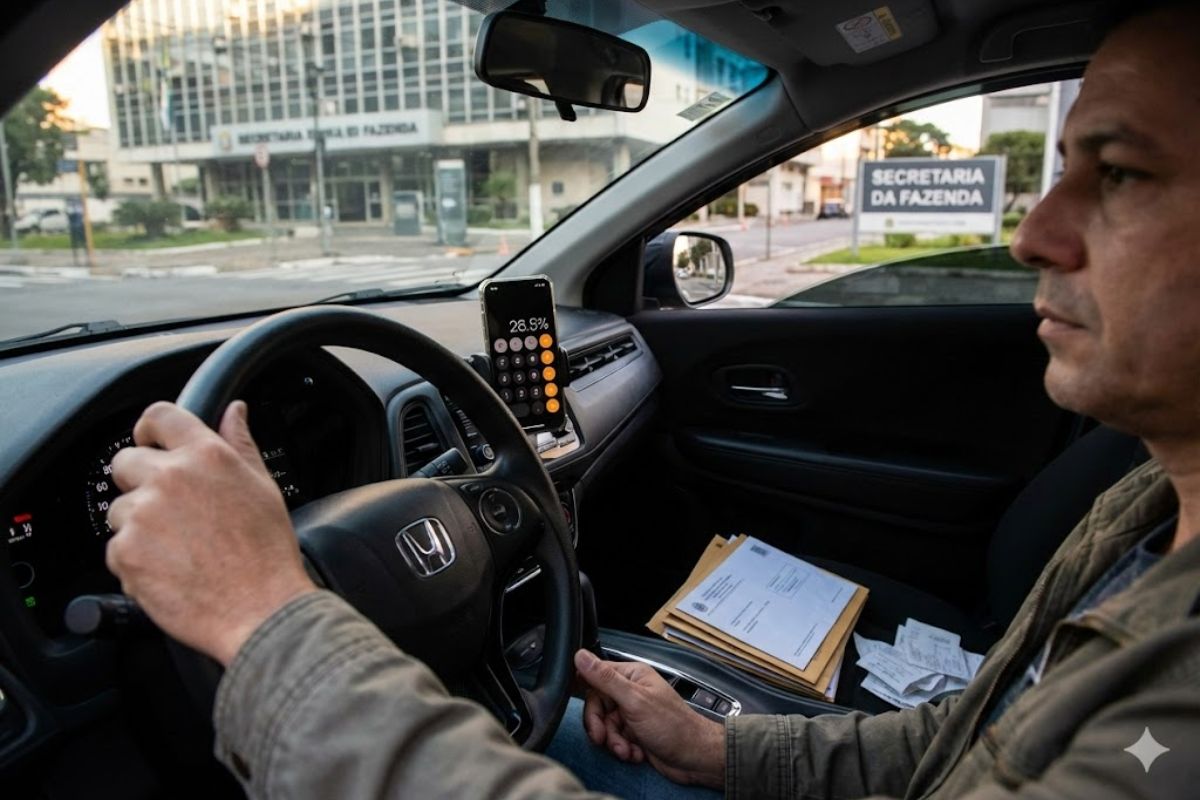
Rumor About 26.5% Tax Made App Drivers Fear a New Hit to Their Wallets in 2026, but the Rate Is the Cap of Dual VAT. Understand Rules, Exemptions, Transition of Tax Reform, Daily Work Routine, and How Small Service Providers and Drivers Registered as MEI Are Affected.
The claim that the Federal Revenue would start charging, from 2026, a 26.5% tax on the income of app drivers gained traction on social media, with a post on X reaching over 928,000 views and spreading fear among workers in the sector.
After checking the tax reform and hearing from experts, it is clear that the 26.5% figure is not a new automatic tax for these professionals, but rather a theoretical cap of dual VAT, used as a reference for the future calculation of the general rates of CBS and IBS.
What the Viral Rumor Said
The chain that circulated on social media stated that the Federal Revenue would start taxing 26.5% of the income of app drivers from 2026.
-
Brazilian city bets on the business environment to generate jobs and attract investments in the energy sector — secretary reveals strategy at Macaé Energy 2026.

-
50 viaducts, 4 tunnels, 28 bridges, and 40 kilometers of bike paths: BR-262 in Espírito Santo will receive 8.6 billion reais for the largest engineering project in the state’s history, inspired by the Immigrant Highway in São Paulo.

-
Brazil produces too much clean energy and doesn’t know what to do with it: over 20% of solar and wind capacity was wasted in 2025 while investors flee and 509 renewable generation projects were abandoned in the last year.

-
Piauí will produce a new fuel that replaces diesel without needing to change anything in the truck’s engine and reduces pollutant gas emissions by half: truck drivers from all over the Northeast are already celebrating the news that will arrive later this decade.


Messages highlighted only the percentage, without explaining the context of the tax reform, leading many professionals to believe that they would have an immediate discount of more than a quarter of their earnings.
The most shared post on X, formerly Twitter, surpassed 928,000 views and ended up triggering concern.
Many readers understood it as a new specific charge for app drivers, when, in fact, the figure was being isolated from technical documents about the new consumption and service tax system.
Where the 26.5% Rate of Dual VAT Comes From
In the texts of the tax reform, the percentage of 26.5% appears as an estimated cap for the sum of the new dual VAT. This model unifies two main taxes: the CBS, Contribution on Goods and Services, under federal responsibility, and the IBS, Tax on Goods and Services, levied by states and municipalities.
These two taxes will replace PIS, Cofins, ICMS, and ISS, simplifying the collection on consumption. The central point is that the 26.5% is not a defined rate nor an automatic charge on app drivers.
It is a projected maximum limit for the economy as a whole, which still depends on detailed regulation to translate into concrete numbers in practice.
How the Transition in 2026 for App Drivers Will Work
In 2026, the reform enters a testing phase with reduced and symbolic rates. The forecast is that the CBS will start at 0.9% and the IBS at 0.1%, percentages that may be offset throughout the system.
This means that there will not be an immediate jump to 26.5% in the taxation of app drivers, contrary to what alarmist publications suggest.
In practice, this transition phase serves to calibrate the model, check the effect of the new charge on the economy, and adjust the distribution among the Union, states, and municipalities.
For those driving for an app, the direct effect in 2026 tends to be limited, especially since many of these workers fall within revenue brackets protected by exemptions or special regimes.
Exemption and Special Regimes Protect the Smaller Ones
The legislation of the reform provides for differentiated treatment for small service providers, precisely the group where many app drivers belong.
Nano-entrepreneurs with annual earnings of up to 40,500 reais will have total exemption from dual VAT, meaning they will not pay the new tax within this revenue limit.
Those earning up to 162,000 reais per year fall under a special rule where only 25% of their revenue is considered as the tax base.
With this, a significant portion of small service providers can practically remain within the exemption range, even after the gradual implementation of the new model.
Drivers registered as MEI, with annual earnings of up to 81,000 reais, continue under a separate regime.
They keep collecting fixed monthly amounts, with a total burden between 1% and 1.3% on their revenue, far from the 26.5% mentioned in the rumor and in line with what was previously being charged before the reform.
Actual Impact on App Drivers’ Wallets
The impact of taxation needs to be viewed along with the income reality of these professionals.
According to the GigU platform, which tracks app workers, the net income of drivers varies according to the city and the hours worked, after deducting costs such as fuel, vehicle maintenance, car taxes, and platform fees.
In São Paulo, for example, a driver working about 60 hours a week has an average monthly profit of R$ 4,252.24 after the main expenses are deducted.
In such scenarios, any tax change needs to be analyzed carefully, but what the data shows so far is that the main challenges remain high operational costs and not a non-existent 26.5% tax on income.
What Is False, What Is True, and What Really Changes
It is false that the Federal Revenue has created a specific 26.5% tax for app drivers starting in 2026.
It is also false that all rides will automatically be taxed at this rate, as if it were a new exclusive charge for those who drive for apps.
It is true that the tax reform provides for an estimated cap of 26.5% for the sum of the CBS and IBS rates within the dual VAT.
It is also true that there will be a transition phase starting in 2026, with much lower rates, along with exemptions for nano-entrepreneurs and special regimes benefiting small providers and many drivers operating as MEI.
In practice, what really changes is the need to monitor the regulation of the reform, understand which revenue bracket each driver fits into, and check whether it is worth remaining as MEI or migrating to another regime in the future.
In your opinion, is this taxation model planned by the reform fair to app drivers, or does it still need to be adjusted to better protect those who live off driving?









-

-

-

4 pessoas reagiram a isso.