





 Portuguese
  English
  Spanish
  7 min of reading
  0 comments


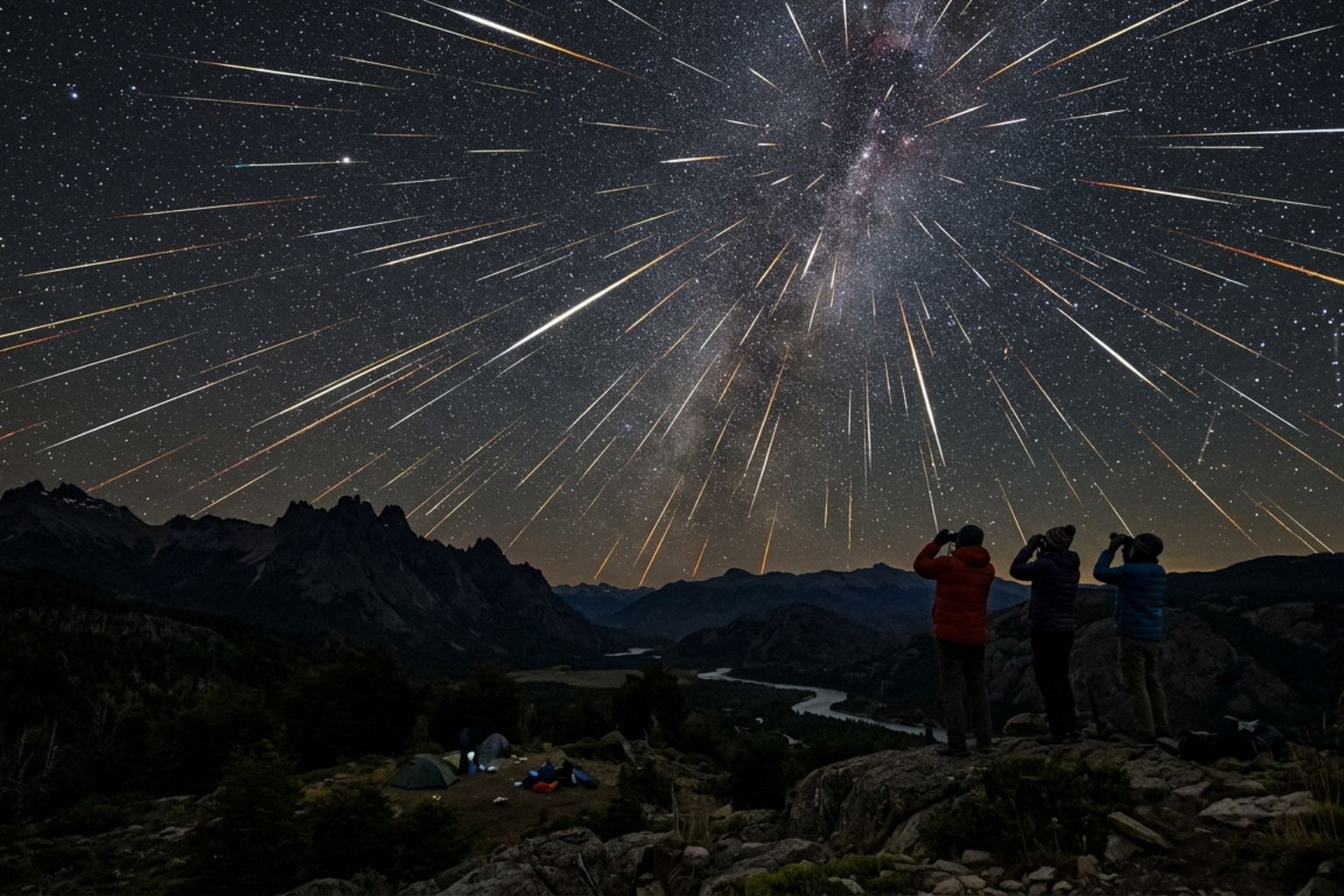
In 2028, Earth will cross debris from the Swift-Tuttle comet, and the meteor shower could turn into a storm with hundreds of shooting stars per hour.
Every August, Earth crosses a cloud of debris spread along the orbit of the Swift-Tuttle comet, resulting in the most reliable spectacle of the astronomical calendar: the Perseids, observed for over 2,000 years and recorded in historical documents since the year 714 of our era. Under normal conditions, the peak of the shower produces between 60 and 100 meteors per hour, visible to the naked eye in the dark sky of the Northern Hemisphere.
On August 12, 2028, conditions will not be normal. That night, Earth will pass within 60,000 kilometers of a filament of dense debris that Swift-Tuttle expelled in 1479 — material that has been traveling through space for nearly 550 years without ever crossing the orbit of our planet before. Finnish astronomer Esko Lyytinen calculated that the result could be a meteor storm with over 1,000 shooting stars per hour.
The comet that makes meteors
The Swift-Tuttle comet was discovered in July 1862, independently, by two American astronomers: Lewis Swift and Horace Tuttle, whose names it carries. But its history is much older than that.
-
China launches the world’s most advanced weather satellite with 6 scientific instruments, a lightning detector, and artificial intelligence capable of predicting storms, tornadoes, and hail with unprecedented accuracy.
-
Scientists drilled 523 meters of ice in Antarctica with water at 75 degrees and found 218 meters of sediments that prove that where there is now half a kilometer of ice, there was an open ocean millions of years ago.

-
The cell phone is present in 99.5% of Brazilian households and has already replaced the alarm clock, the camera, and the GPS; now it is beginning to threaten the last device that resisted: the card reader, which is present in 19 million points of sale in the country.

-
Scientists create a new propulsion system that allows satellites to use the air from Earth’s atmosphere as fuel to operate in space with lower costs and longer operational time.

Swift-Tuttle takes 133 years to complete an orbit around the Sun. With each pass through the inner Solar System, the heat from the star warms the comet’s icy and rocky nucleus and causes the ejection of particles — fragments of dust, stone, and ice that disperse along its entire orbital path.

According to NASA, the nucleus of Swift-Tuttle has a diameter of 26 kilometers. For reference: the asteroid that wiped out the dinosaurs 66 million years ago is estimated to be 10 to 15 kilometers. Swift-Tuttle is more than twice that size — and repeatedly passes close to Earth’s orbit.
The comet’s trajectory intersects Earth’s orbit precisely at the point where Earth will be every August. The result is that, year after year, the planet crosses the trail of debris that the comet has been leaving over hundreds of passes. Italian astronomer Giovanni Schiaparelli identified this relationship in 1865, establishing the first confirmed direct correlation between a comet and a meteor shower.
The filament of 1479
What happens every August is the encounter of Earth with the main body of the Swift-Tuttle debris cloud, material deposited in multiple passes over centuries. But the comet’s orbit is not uniform — each pass produces a slightly distinct filament, with its own concentration of particles and position in space.
In 1479, Swift-Tuttle passed by the Sun and ejected a filament of dust and rock that gradually spread along its orbit. Since then, this material has traveled through the Solar System without ever crossing Earth’s orbit at the exact point it would be in August.
In 2028, that changes. Calculations by Finnish astronomer Esko Lyytinen, confirmed by other researchers, show that Earth will pass just 60,000 kilometers from the center of this filament in the early hours of August 12, 2028, with the peak expected at approximately 5:30 AM UTC. For comparison, the Moon is 384,000 kilometers from Earth. The 1479 filament will pass six times closer than that.
What researchers say about what might happen
There is no consensus on the intensity of the phenomenon — and this needs to be stated clearly. Models agree that something unusual will happen. How exceptional it is depends on who is calculating.
Lyytinen predicted that the encounter with the 1479 filament could produce a real meteor storm, with more than 1,000 shooting stars per hour visible from the Northern Hemisphere. He wrote this in 2000 when he made the calculations. The prediction was published and referenced in multiple subsequent studies.

French scientist Jérémie Vaubaillon, from the Institute of Celestial Mechanics and Ephemeris Calculation in Paris, used computational models to map the formation and evolution of the Swift-Tuttle debris cloud. His results confirm that Earth will cross a small, dense cluster of dust from 1479 in the early minutes of August 12, 2028.
Russian meteorologist Mikhail Maslov made independent calculations that confirm the interaction with the 1479 filament but arrived at a more conservative estimate: between 250 and 300 meteors per hour — well above a normal shower but below the technical threshold for a storm. The range of predictions, therefore, goes from 250 to over 1,000 meteors per hour. In a normal year, the Perseids produce between 60 and 100.
Why 1479 makes a difference
The oldest material from a comet has a specific property: it has been compressed and reorganized by gravitational forces over centuries. The fragments tend to be denser and more clustered than younger material, which disperses more quickly. This is why old filaments — when Earth encounters them — can produce more intense events than the annual diffuse cloud.
The interaction of Swift-Tuttle with Jupiter in 2028 will further intensify the phenomenon. The giant planet, whose gravity constantly reorganizes the trajectories of bodies in the Solar System, will be in a position that pushes debris from the Perseids about 160,000 kilometers closer to the Sun than normal — shifting the main cloud toward Earth’s orbit.
This additional effect from Jupiter has been observed before. In 2016, the planet’s gravity shifted a band of Perseids debris such that Earth passed through a denser region, raising that year’s peak to about 200 meteors per hour — double the normal. In 2028, the effect will coincide with the encounter with the 1479 filament.
The precedent of 1992
The only time something comparable was recorded occurred when the Swift-Tuttle comet itself returned to the inner Solar System in December 1992, after 130 years of absence.
In the years preceding and following the comet’s passage — 1991, 1992, and 1993 — the Perseids produced brief and extraordinary peaks with hundreds of meteors per hour, well above normal. The explanation was straightforward: the comet was present, freshly ejecting material, and the debris clouds around its trajectory were denser and more concentrated.
Swift-Tuttle will not return to the inner Solar System until 2125. The 2028 encounter with the 1479 filament is the best opportunity to replicate something similar to what happened in the 1990s — without the comet needing to be present.
What the observer will see
A Perseid meteor enters the atmosphere at about 210,000 kilometers per hour. It is this impact — and not combustion, as the popular name “shooting star” suggests — that generates the luminous trail. Friction with the air heats the meteoroid and the gas column around it to temperatures that produce visible light for fractions of a second.
During the most intense peaks, the Perseids also produce fireballs — meteors brighter than -3 magnitude, visible even in skies with some light interference. In storms, the frequency of fireballs increases along with the total number of meteors.

The problem in 2028 is the Moon. Lyytinen noted from his original predictions that the Moon will be close to the last quarter that night — which means enough light to wash out the weaker meteors during the hours close to the peak. The more intense meteors will still be visible, but ideal observation will require the early morning hours closest to the peak and a location with a wide horizon and minimal light pollution.
The observation window from Brazil
The Perseids have their radiant — the apparent point from which meteors seem to come — in the constellation Perseus, in the Northern Hemisphere of the celestial sphere. This makes them, structurally, a more favorable phenomenon for observers in the Northern Hemisphere.
In Brazil, the constellation of Perseus is low on the northern horizon during August, which limits the number of visible meteors compared to what an observer in Europe or North America can see. Even so, during the most intense events, some of the Perseid meteors are visible from Brazilian territory, especially in the hours close to midnight when the radiant rises high enough for the meteors to cross more of the visible sky.
In 2028, the peak is expected around 5:30 AM UTC on August 12 — which corresponds to 2:30 AM in Brasília time. In the North and Northeast regions of the country, with less light pollution and an unobstructed northern horizon, the window between midnight and 3 AM is the most promising for observation attempts.
What the phenomenon is not yet
Meteor storms are technically classified when the zenith hourly rate — the number of meteors visible per hour under ideal conditions — exceeds 1,000. The last one occurred in the Leonids in 2001, producing over 3,000 meteors per hour at its peak.
The 1479 filament may or may not produce a storm in the technical sense. The models diverge. What no researcher contests is that the encounter will happen, that Earth will pass closer to this filament than at any time in the last 549 years, and that the peak in 2028 will be substantially more intense than a typical Perseid.
The difference between 250 and 1,000 meteors per hour is still, for anyone looking at the sky in August 2028, extraordinary in any scenario.
The material that traveled 549 years waiting
In 1479, when Swift-Tuttle passed by the Sun and launched this filament of dust and rock into space, Christopher Columbus was 28 years old and had not yet crossed the Atlantic. Gutenberg’s press was less than three decades old. The Ottoman Empire had just conquered Constantinople 26 years earlier.
This material traveled all that time in orbit around the Sun, invisible and inert, never finding Earth at the right point. On August 12, 2028, at 5:30 AM UTC, the orbit will align for the first time since it was ejected.
The encounter will last a few minutes. The shooting stars it will produce will last fractions of a second each. Those who are awake, looking north, will see.









Seja o primeiro a reagir!