





 English
  Francês
  Alemão
  Italiano
  Japonês
  Norueguês
  Portuguese
  Spanish
  5 min of reading
  0 comments


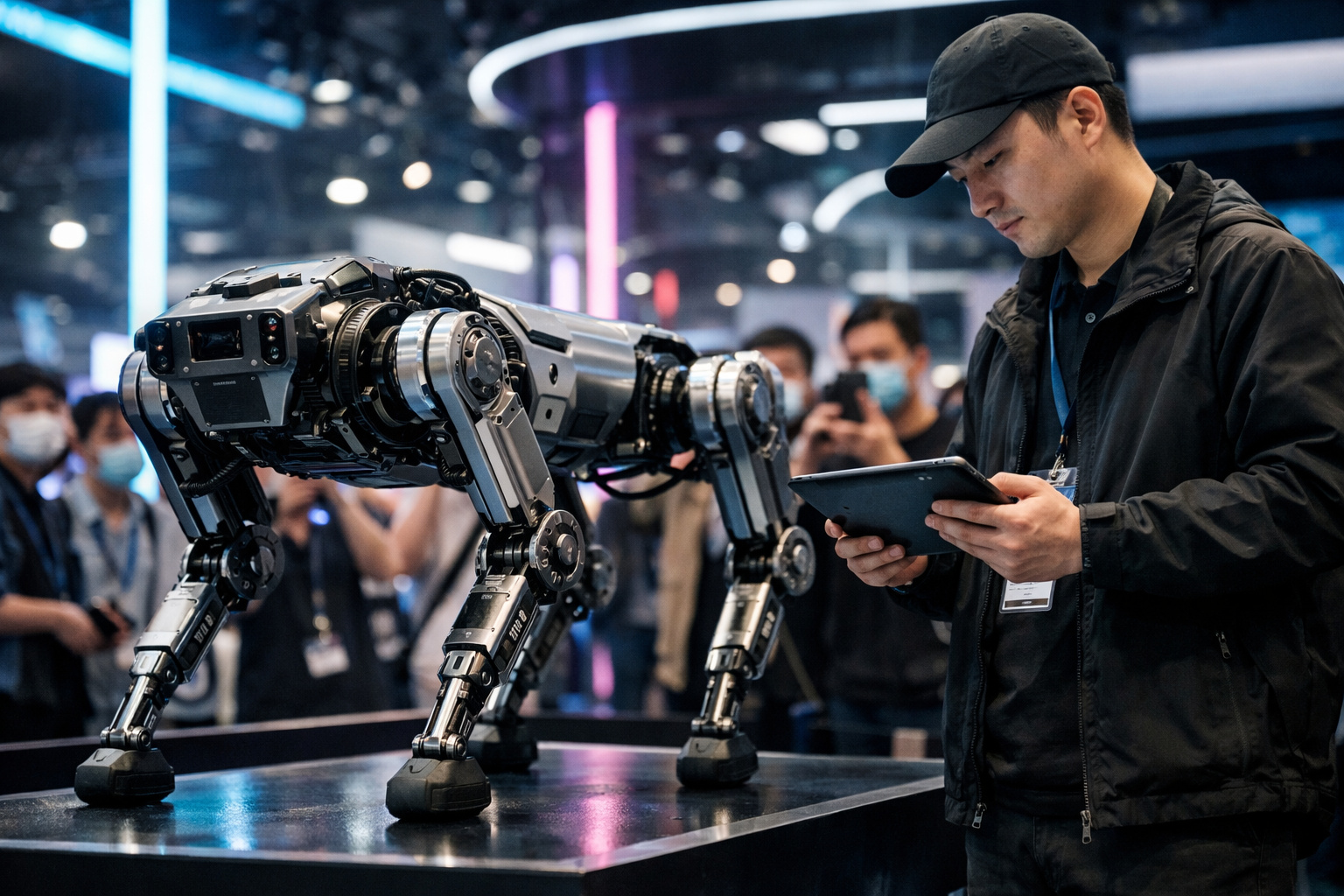
The price of robots plummets while demand explodes, transforming China into the largest real laboratory of modern robotics
The robotics industry in China has definitely entered a new phase. What once seemed distant and restricted to large companies has now become accessible and, above all, operational in the real world. Surprisingly, renting a robot is no longer something exclusive or expensive — and this is completely changing the dynamics of the sector.
From spring 2025 to winter 2026, for example, the rental of a humanoid robot for corporate events saw a drastic drop in price. Previously, the costs ranged between 10,000 and 20,000 yuan per day — equivalent to approximately R$ 7,500 to R$ 15,000 — but now it is possible to hire the same type of technology starting at 1,796 yuan, about R$ 1,300.
At the same time, the so-called robot dogs have become even more accessible. Today, these devices can be rented for just 78 yuan per day on platforms like JD.com, which is less than R$ 60. This represents a drop of approximately 80% in just 12 months, a movement that highlights the speed at which this industry is evolving.
-
350-year mystery may have been solved: remains of a soldier who inspired the hero of The Three Musketeers found beneath a church in the Netherlands.

-
NASA photographed a nearly perfect square with 3 km sides on Mars, 13 times larger than the Great Pyramid of Giza, but the official explanation is natural erosion; still, no one has explained why the four sides have almost identical lengths.

-
Starlink breaks the barrier of 10,000 satellites in orbit and takes its expansion to an unprecedented level, with a direct impact on global internet, technological competition, and the race for space.

-
Japan finds an alternative to oil amid rising prices by transforming ocean balance into electricity with a new technology that maintains efficiency even when the sea changes.


This information was disclosed by analyses of the Asian market and platforms like JD.com, which are recording rapid growth in the search for robots, reflecting an increasingly concrete and immediate demand.
However, this advancement raises a central question: what is behind this aggressive price reduction and what does it really reveal about the current state of robotics?
Accelerated growth, billions at stake, and a critical detail: each robot still depends on a human
Globally, the growth is impressive. In 2025, about 18,000 humanoid robots were deployed worldwide, representing a 508% increase from the previous year. Of this total, China accounted for 84.7%, consolidating its position as the epicenter of this technological revolution.
Moreover, over 1,500 new robot rental companies were registered in the country in the same year, a growth of 48% compared to 2024. This movement shows that the sector is not only growing but also fragmenting and diversifying rapidly.
Despite this, the market is still relatively small in financial terms. In 2025, it barely surpassed 1 billion yuan, about R$ 77 million. However, projections indicate accelerated expansion to 10 billion yuan by 2026, signaling exponential growth.
On the other hand, there is a little-discussed factor that completely changes the reading of this scenario: each deployed robot still needs a human engineer by its side.
This professional is responsible for transportation, calibration, real-time operation, and troubleshooting. In other words, the current model is not exactly “Robot as a Service,” but rather “Robot + Person as a Service.”
Thus, the traditional SaaS logic — where costs decrease as scale increases — simply does not apply. On the contrary: each new unit represents, in practice, a new payroll.
Consequently, the real bottleneck of the sector is not in the manufacturing of machines, but in the availability of qualified professionals to operate them.
High demand, limited use, and the challenge of turning robots into truly productive solutions
Meanwhile, demand continues to grow rapidly. Platforms like Qingtianzu, controlled by Zhiyuan Robotics and supported by Hillhouse Capital, already connect over 200 suppliers to companies interested in using robots for events, inaugurations, and even weddings.
During the Chinese New Year, for example, requests on the platform increased by 70%, surpassing the mark of 5,000 requests in just one week. In parallel, JD.com recorded a 25-fold increase in searches for the term “robot,” confirming the massive interest from the market.
However, even with the 80% drop in prices, operational costs remain virtually unchanged. Transportation, logistics, insurance, and, especially, labor continue to be essential — and expensive — factors.
The return on investment, according to industry operators, occurs within a period of six to eight months. However, this calculation depends on about ten monthly contracts, with an average ticket of 2,500 yuan, something that can only be sustained during periods of high demand.
Outside of these specific dates, such as holidays, the pace drops drastically.
Additionally, about 65% of current applications are concentrated in entertainment and marketing. These are robots that dance, interact with the public, or participate in fairs — uses that, while eye-catching, are temporary and infrequent.
For the sector to consolidate sustainably, it will be necessary to advance into areas such as industry, hospitals, and logistics. However, experts warn that current robots are still at a limited stage of development, often described as “cerebellum level,” where they only execute commands without real autonomy.
This technological leap, according to the most optimistic estimates, may take about five years.
China accelerates, but the future of robotics still depends on a decisive factor: real autonomy
Even with these limitations, China has already achieved something that no other country has accomplished so far: transforming humanoid robotics into a functional mass market.
With infrastructure, investment, and demand aligned, the country has created a true ecosystem in just a few months. Today, robots already operate in shopping malls, dealerships, and events, interacting directly with the public.
TrendForce projects that more than 50,000 units will be sold in 2026, a growth of 700%. This advancement resembles a recent phenomenon: that of entertainment drones, which became popular not through industry but through visual spectacles in Chinese cities.
However, there is a fundamental difference. While drones already operate autonomously, humanoid robots still depend directly on humans.
And it is precisely this detail that could define the future of the industry.
If autonomy does not evolve, growth may encounter a structural limit. On the other hand, if this leap occurs, the impact could be even greater than what has been seen so far.
In light of this, an inevitable question arises: are we truly facing a technological revolution — or just at the beginning of a large-scale experiment?
With information from: Xataka






Seja o primeiro a reagir!