





 English
  Francês
  Alemão
  Italiano
  Japonês
  Norueguês
  Portuguese
  Spanish
  5 min of reading
  0 comments


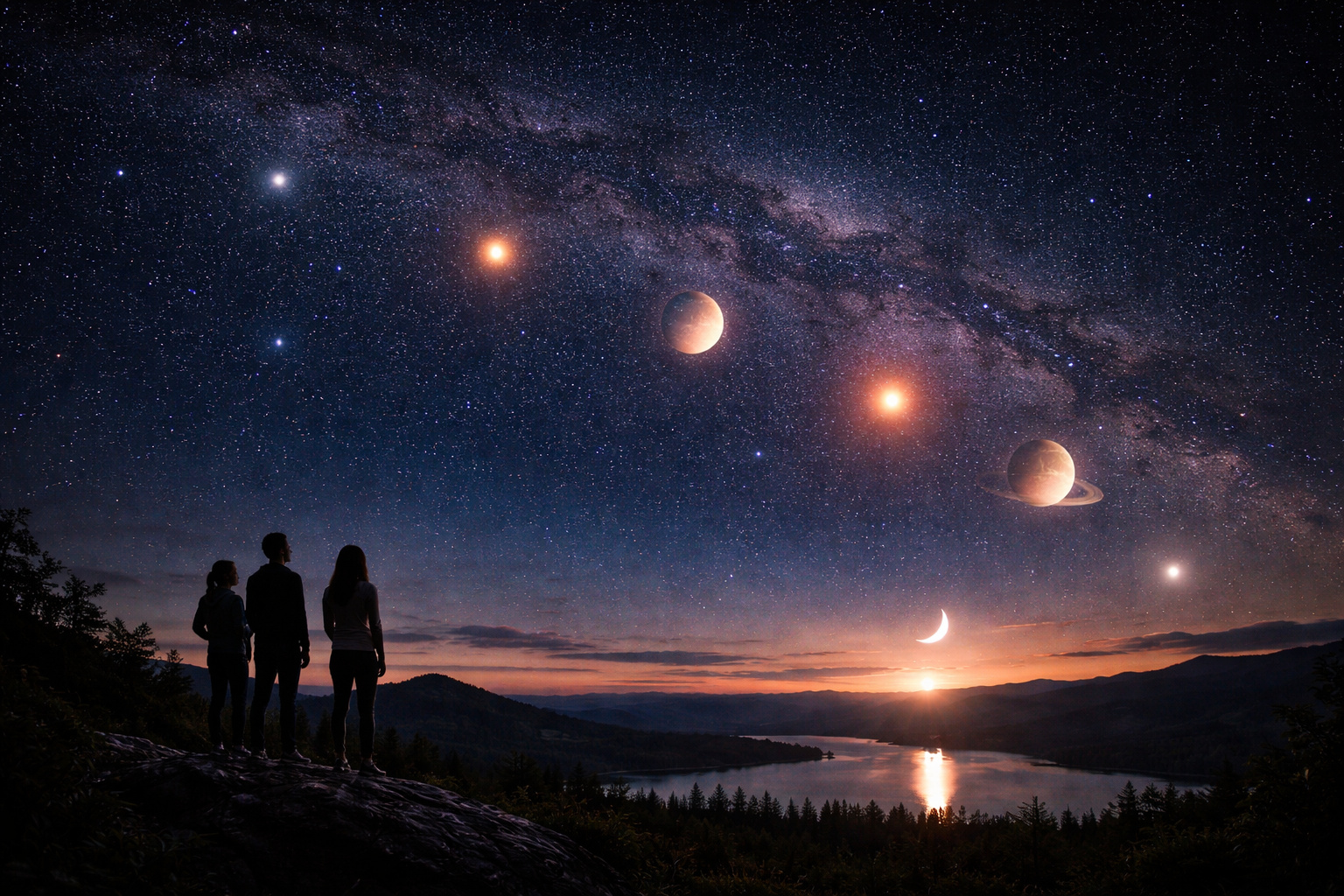
Rare alignment of 5 planets and Moon in 2040 will bring Mercury, Venus, Mars, Jupiter, and Saturn within just 9 degrees of the sky at sunset
On the night of September 8, 2040, anyone looking at the western horizon after sunset will see something that no living human has ever seen with their own eyes: the five planets visible to the naked eye — Mercury, Venus, Mars, Jupiter, and Saturn, gathered in a band of just 9 degrees of the sky, with a two-day crescent Moon positioned between Venus and Saturn as if it were a cosmic pointer indicating the center of the spectacle. The best time for observation: around 7:30 PM local time, just after twilight. According to Star Walk, no configuration like this has occurred since 2004 — and the next opportunity to observe the five planets in ordered alignment will not occur before 2040.
What will happen in the September 2040 planetary alignment
To understand what makes September 2040 an exceptional astronomical event, it is necessary to separate two phenomena that normally occur independently, but this time will be synchronized.
The first is the alignment of the five visible planets. Mercury, Venus, Mars, Jupiter, and Saturn will appear in the same quadrant of the sky, compressed into just 9 degrees of arc — the equivalent of the size of a closed fist with the arm extended. This extreme concentration is what makes the phenomenon rare.
-
350-year mystery may have been solved: remains of a soldier who inspired the hero of The Three Musketeers found beneath a church in the Netherlands.

-
NASA photographed a nearly perfect square with 3 km sides on Mars, 13 times larger than the Great Pyramid of Giza, but the official explanation is natural erosion; still, no one has explained why the four sides have almost identical lengths.

-
Starlink breaks the barrier of 10,000 satellites in orbit and takes its expansion to an unprecedented level, with a direct impact on global internet, technological competition, and the race for space.

-
Japan finds an alternative to oil amid rising prices by transforming ocean balance into electricity with a new technology that maintains efficiency even when the sea changes.




The second event is the approach of the Great Conjunction between Jupiter and Saturn, which will occur on November 4, 2040. This conjunction happens approximately every 20 years when Jupiter overtakes Saturn in its orbit, creating the illusion of proximity in the sky.
What makes 2040 special is the temporal overlap of these two events: the complete alignment of the planets will occur weeks before the conjunction, creating a unique observation window.
Why alignments of five planets are rare in the solar system
The solar system has a fundamental characteristic: all planets orbit approximately in the same plane, called the ecliptic. This causes them, when viewed from Earth, to always appear along the same band in the sky.
However, each planet moves at different speeds. Mercury completes its orbit in 88 days, while Saturn takes nearly 30 years. This difference causes their relative positions to constantly change.
For all to appear simultaneously in the same sector of the sky, a precise alignment of these orbital speeds is necessary. This type of coincidence is rare and occurs at irregular intervals over the decades.
The alignment of June 2022, for example, required observation before dawn and had the planets more spread out. The 2040 event combines three simultaneous factors: angular proximity, visibility at sunset, and the presence of the Moon in the same field of view.
How to observe Mercury, Venus, Mars, Jupiter, and Saturn with the naked eye in 2040
Each planet will have specific visual characteristics that will allow its identification in the sky. Venus will be the brightest of all, visible even in urban areas with light pollution. Its brightness makes it the main reference point for locating the other planets.

Jupiter will appear as a stable bright point, with a whitish-yellow hue. Unlike stars, it does not twinkle, making it easier to identify. Even with simple binoculars, it will be possible to observe its four largest moons.
Saturn will be near Jupiter, with a softer glow and golden color. Small telescopes will allow viewing its rings, one of the most striking phenomena of astronomical observation.
Mars will stand out for its reddish color, a result of iron oxide on its surface. This hue clearly differentiates it from other visible celestial bodies.
Mercury will be the hardest to observe. Because it is very close to the Sun, it will only appear in the first minutes after sunset, requiring a clear and unobstructed horizon.
The crescent Moon, with less than 10% illumination, will complete the scene. Its ash-colored light will allow a faint view of the dark part of the lunar disk, creating a unique visual effect.
Great Conjunction of Jupiter and Saturn in 2040 increases the importance of the event
The Great Conjunction in November 2040 will be the second major astronomical phenomenon associated with this period. This type of conjunction occurs when Jupiter and Saturn align from the perspective of Earth.
The last great conjunction occurred in December 2020, when the two planets were separated by just 0.1 degrees, creating the impression of a single bright star.
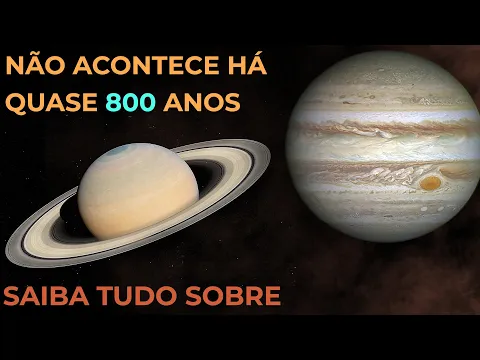
In 2040, the separation will be greater, about 1.1 degrees, but still close enough to be easily observed with the naked eye. The main advantage will be the position in the sky, higher and with better visibility conditions.
This conjunction is considered one of the most important from a historical perspective, as it occurs only once every generation and has been associated with events recorded since antiquity.
Planetary alignments throughout history and their cultural importance
Since the earliest civilizations, planetary alignments have been recorded as extraordinary events. Babylonians, Egyptians, and Mayans documented the movement of the planets and interpreted these encounters as important signs.
Historical records indicate similar alignments in 2004, 2000, and even in the 19th century. However, the configuration expected for 2040 stands out for its extreme compactness and ease of observation.
Astronomers like Johannes Kepler used planetary conjunctions to study historical phenomena, including hypotheses about the Star of Bethlehem.
Why the 2040 alignment will be one of the rarest astronomical events of the generation
The uniqueness of the September 2040 event lies in the combination of rare factors: five planets visible simultaneously, aligned in an extremely narrow band of the sky, with the presence of the Moon and visibility in the early evening.
Unlike other alignments, it will not be necessary to wake up early or use advanced equipment. Anyone will be able to observe the phenomenon with the naked eye, as long as weather conditions permit.
No living person today has witnessed this exact configuration. Previous alignments did not gather all these elements simultaneously with the same geometric precision and visual accessibility.
What makes the September 2040 alignment a unique event for humanity
More than an astronomical phenomenon, the 2040 alignment represents a rare event on a human scale. It is a configuration that occurs at long intervals and depends on a precise coincidence of planetary movements.
Those who are alive during this period will have the opportunity to observe, without instruments, the same five planets that ancient civilizations referred to as “wanderers,” gathered in a single region of the sky. The difference is that this time, the phenomenon can be understood with scientific precision, but it will still carry the same visual impact that impressed observers thousands of years ago.
The only variable beyond control will be the weather. The alignment is guaranteed by celestial mechanics. The challenge will simply be to look at the sky at the right moment.







Seja o primeiro a reagir!