





 Portuguese
  English
  Spanish
  6 min of reading
  0 comments


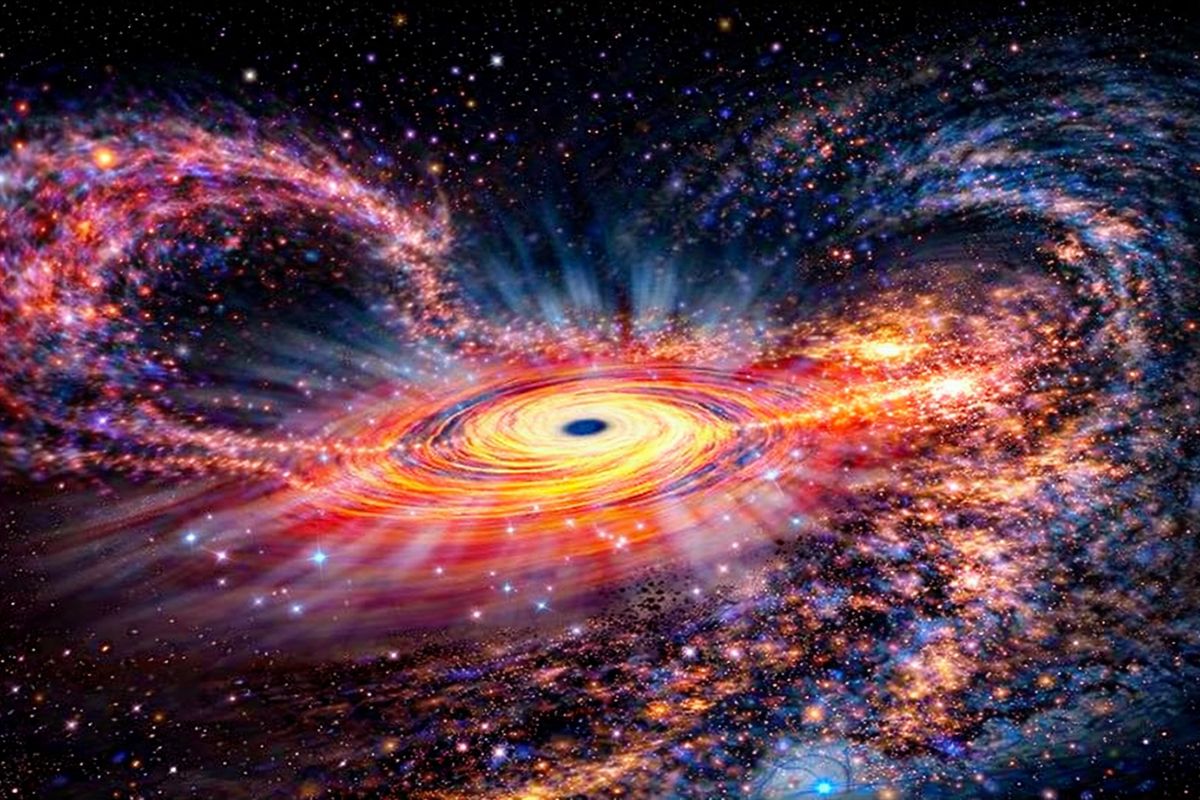
Researchers and NASA point out that in about two billion years the Large Magellanic Cloud will spiral toward the Milky Way, dumping fresh gas onto Sagittarius A* and transforming the 4 million solar mass supermassive black hole into an active galactic nucleus visible to the naked eye.
The NASA and international astrophysics teams are keeping an eye on something that most of us can hardly imagine exists: a supermassive black hole equivalent to four million suns, hidden in the heart of the Milky Way. Known as Sagittarius A*, it has remained dormant for millennia, so quietly that its presence was only definitively confirmed in 2020, when the work of three scientists earned them the Nobel Prize in Physics.
But this calmness has an expiration date. Cosmological simulations and orbital motion data indicate that, in about two billion years, the Large Magellanic Cloud, a neighboring dwarf galaxy, will collide with ours, pushing enormous amounts of fresh gas directly into the “mouth” of Sagittarius A*. The result? The sleeping monster will wake up and shine like never before in the history of our galaxy.
What is Sagittarius A* and why does NASA call it the “silent monster”

Sagittarius A* is classified by NASA as the closest supermassive black hole to Earth, located just over 25,000 light-years away in the constellation Sagittarius. To give an idea of the scale, it compresses the mass of approximately four million suns into a region so compact that it defies any everyday comparison. Despite this enormous size, it is extraordinarily discreet.
-
The Earth has just broken a record that almost no one noticed: the planet is retaining more heat than ever, and the UN warns that this invisible “thermal debt” could trigger heatwaves, storms, and coastal flooding for centuries.

-
Three submerged shipwrecks from the Iron Age found in the port of Dor challenge what was known about trade in the Mediterranean, and only 25% of the site has been excavated.

-
Dialysis as we know it may be numbered: researchers at the University of Southern California have managed to cultivate kidney cells in the lab that refuse to die and form mini-structures that mimic the actual functioning of a kidney.

-
They were going to build a highway, but they ended up finding in the Czech Republic an entire Celtic city buried for more than 2,000 years, with hundreds of gold and silver coins, precious amber, and one of the largest archaeological treasures ever discovered.


The Institute of Astrophysics of Andalusia points out that Sagittarius A* emits an exceptionally weak glow and converts matter into energy with an efficiency hundreds of times lower than many larger black holes. In simple terms, it is “at rest”: it engulfs very little matter and produces almost no detectable radiation.
It was precisely this enigmatic nature that motivated decades of research until Reinhard Genzel, Andrea Ghez, and Roger Penrose received the Nobel Prize for proving that, indeed, there is a supermassive black hole there.
To understand how such giants influence entire galaxies, astronomers also investigate distant systems.
With the James Webb Space Telescope, a team led by Aaron Romanowsky studied “The Spark,” a small galaxy with only three percent of the mass of the Milky Way, surrounded by globular clusters that resemble a young version of the halo of our own galaxy—a valuable clue about how these processes work on different scales.
The collision that will feed the monster: Large Magellanic Cloud on a collision course
The Large Magellanic Cloud is a dwarf galaxy that orbits the Milky Way about two hundred thousand light-years from Earth. At first glance, it seems like an innocuous neighbor. However, calculations based on its orbital motion show that it is losing energy and gradually spiraling toward the center of our galaxy. The researchers’ prediction is straightforward: the merger will occur in approximately two billion years.
A 2019 study conducted with EAGLE cosmological simulations detailed what happens when galaxies similar to the Milky Way absorb companions the size of the Large Magellanic Cloud.
The result is impressive: the central black hole can grow several times in size as large volumes of fresh gas fall into it. Furthermore, the entire structure of the host galaxy, including the stellar halo, ends up being reshaped by the encounter.
At this point, the scenario becomes fascinating. When the gas dumped by the collision reaches Sagittarius A*, it will form an accretion disk heated to millions of degrees, radiating across much of the electromagnetic spectrum.
Astrophysicist Nathalie Degenaar from the University of Amsterdam explains that this type of activity has already left traces: observations with NASA’s Imaging X-ray Polarimetry Explorer revealed that Sagittarius A* underwent a smaller explosion about two hundred years ago—a “sneeze” compared to what is to come.
Is the awakening of Sagittarius A* dangerous for Earth? NASA and scientists respond
The idea of a reactivated supermassive black hole in the heart of the galaxy may sound like the plot of a catastrophic science fiction story.
But experts are emphatic: there is no reason to panic. Professor Carlos Frenk from the University of Durham states that the active galactic nucleus resulting from the merger with the Large Magellanic Cloud is not expected to be powerful enough to pose a serious threat to life on Earth.
Joseph Michail from the Harvard-Smithsonian Center for Astrophysics reinforces this point with a simple argument: twenty-six thousand light-years may not seem like much on a cosmic map, but it represents a colossal separation in real terms. The extra radiation emitted by Sagittarius A* would need to traverse this entire vastness and would encounter the very gas disk of the Milky Way along the way, which acts as a natural shield.
In addition to the distance, Earth has multiple layers of protection: the atmosphere, the magnetic field, and the interstellar gas that permeates the galaxy. Together, these barriers would absorb much of any increase in radiation coming from the galactic center.
The most likely scenario, according to researchers, is that observers in that distant future will see a significantly more dramatic and luminous night sky—a cosmic spectacle, not a catastrophe.
What changes in the Milky Way after the monster wakes up
When Sagittarius A* transitions from dormant to active, the Milky Way will enter a category known as an active galactic nucleus. This means that the center of our galaxy will emit jets of energy and radiation detectable at enormous distances—something that today we only observe in distant galaxies through telescopes like the James Webb and Chandra from NASA.
The EAGLE simulations show that the process is not instantaneous. The merger between two galaxies unfolds over hundreds of millions of years, with waves of new star formation, gravitational distortions, and redistribution of gas and dust. The stellar halo of the Milky Way will be reshaped, and new structures may emerge as the remnants of the Large Magellanic Cloud integrate into our system.
It is a reminder that galaxies are not fixed structures. They transform, collide, merge—and the supermassive black holes at their centers are silent protagonists of these transformations.
Sagittarius A* has already undergone active phases in the distant past. The difference now is that, for the first time, science can predict when the next phase will begin.
A future written in the stars and in NASA data
The story of Sagittarius A* is, at its core, the story of how the universe recycles itself. A dormant black hole, a neighboring galaxy in slow decline, and a collision that will reignite the most powerful engine of the Milky Way.
The data from NASA and the most advanced simulations converge on the same point: this awakening is not a matter of “if,” but of “when.” And the answer—two billion years—is, in cosmic terms, just around the corner.
For present-day humanity, the event is fascinating precisely because we can study it without fearing it. We have the rare opportunity to understand, decades in advance, how a galaxy transforms and our planet is safe enough for us to simply appreciate the spectacle that is approaching.
With information from the portal ecoticias.
And you, what do you find more impressive: the scale of four million suns concentrated in a single point or the fact that science can already predict events that will happen in two billion years? Leave your opinion in the comments.






Seja o primeiro a reagir!