





 English
  Francês
  Alemão
  Italiano
  Japonês
  Norueguês
  Portuguese
  Spanish
  5 min of reading
  0 comments


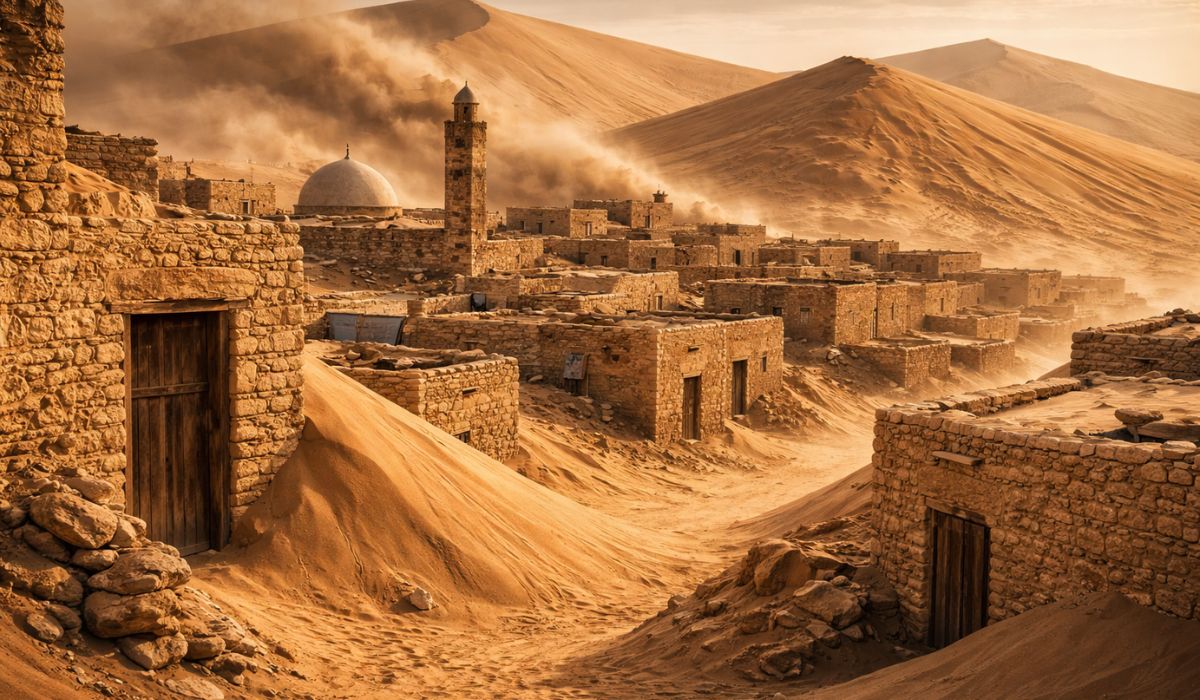
In the Mauritanian Sahara, a historic city coexists with the advance of sand over houses, streets, and family libraries, amidst a scenario that pressures daily life and challenges the preservation of a heritage recognized internationally.
In the heart of the Mauritanian Sahara, the historic city of Chingueti coexists with the continuous advance of sand.
In the area, narrow streets, old houses, and family libraries have been affected by the accumulation of dunes over doors, yards, and roofs, in a process that pressures the routine of residents and threatens part of the city’s architectural heritage.
Chingueti, in Mauritania, is part of the group of ancient ksour recognized as World Heritage by UNESCO since 1996.
-
Seen from space, a colossal ‘Y’ cuts through the largest desert in China, blending a jade-filled river, red and white mountains, and revealing the absurd scale of the transformation of the Taklamakan surrounded by a green wall with billions of trees.

-
The Pacific Ocean reveals what the cliffs of Big Sur have hidden for millennia: Pfeiffer Beach, in California, features swirling purple sand formed by garnet crystals and displays a stone arch that is illuminated by the sun in winter for just a few days each year.

-
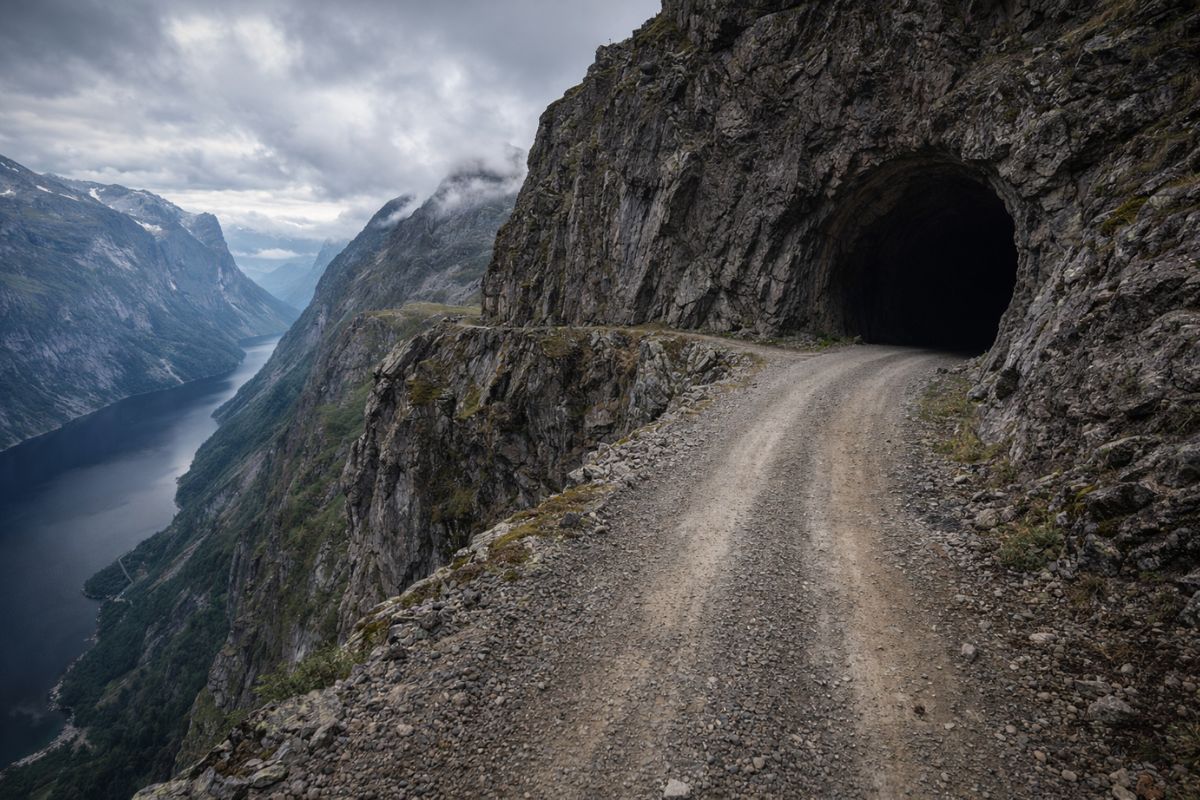
Aursjøvegen in Norway is a 100-kilometer gravel road that crosses chasms and dark tunnels carved into the rock at an altitude of 947 meters in the fjords and is only open for four months a year.
-
With about 4,000 m², the building constructed in a traditional neighborhood in France looks like a rainbow, has a colorful facade, mixes vibrant glass, and creates one of the most unusual visuals in Bordeaux.


Founded between the 11th and 12th centuries in the context of caravan routes in the Sahara, the city has consolidated over the centuries as a point of trade, religious circulation, and Islamic intellectual production.
Today, in addition to the natural wear on traditional architecture, the area faces the advance of dunes and the effects of an increasingly dry environment.
Historic city of Chingueti faces the advance of sand
For centuries, Chingueti has been linked to the crossing of caravans and the circulation of religious and scientific knowledge in the desert.
The urban layout, formed by stone and mud constructions, has been adapted to the conditions of the Sahara and has served as shelter for merchants, scholars, and pilgrims.
This heritage still appears in the urban fabric and in the preserved buildings, although part of the city has already been reached by sand over time.
In recent years, the problem has ceased to be merely a heritage issue.
According to the Associated Press, sandstorms have begun to more frequently hit inhabited areas of the city, covering streets and homes.

In narrower sections, residents manually remove the sand deposits, as larger vehicles cannot circulate.
In some cases, when the accumulation intensifies, the alternative has been to raise new walls over old structures to try to delay burial.
The local routine has begun to require constant interventions.
The sand advances, residents remove the material, and then the wind alters the landscape again.
For many families, leaving Chingueti also means breaking a direct bond with the city’s history and with generations that lived there.
Family libraries and ancient manuscripts in the desert
Among the most well-known elements of Chingueti are the private and family libraries that hold ancient manuscripts.
According to the Associated Press, the city houses more than a dozen libraries with thousands of documents, including Quranic texts and manuscripts on areas such as law and mathematics.
The collection helps explain why the municipality is associated with the written tradition in the western Islamic Africa.
Instead of large public buildings, many of these collections remain in spaces maintained by families who have taken care of the material for generations.
The conditions of the environment impose permanent risks to the documents.
Heat, dust, extreme dryness, and structural problems require continuous care and preservation measures adopted daily by those responsible for the collections.
These manuscripts have relevance not only religious.
The documents also record part of the circulation of knowledge in a region that, for centuries, connected North Africa to areas south of the Sahara.
The set reinforces Chingueti’s historical role as a transit point and center of intellectual production in an area marked by the mobility of caravans and life in the desert.
Desertification alters landscape and routine in Mauritania
The advance of the dunes in Chingueti is associated with more than one factor.
Residents interviewed by the Associated Press reported that the reduction of rainfall over the last decade has weakened the vegetation that helped stabilize the soil.
With less vegetation cover, the sand moves more easily, reaches inhabited areas, and modifies the city’s configuration.

According to these reports, trees have died from lack of water, while others have been cut down for firewood or to feed livestock, which has reduced natural barriers against the wind.
This scenario also affects the local economy.
The cultivation of dates, traditional in the region, faces difficulties with the alteration of environmental conditions, while dust carried by the wind raises concerns related to the health of residents.
At the same time, part of the younger population has been leaving the city in search of other opportunities, which reduces the availability of people to maintain houses, streets, and libraries.
Attempts to contain the dunes around Chingueti
One of the measures sought in the region is the planting of trees to form green belts around the city.
The initiative appears both in local actions and in projects linked to the proposal of the African Great Green Wall.
The goal is to recover part of the vegetation cover to reduce the movement of sand and protect urban areas and documentary collections.

So far, however, the reported results are limited.
The Associated Press reported that, even with replanting, there are still few signs of interruption of the advance of the dunes.
Species adapted to this type of terrain can take years to develop deep enough roots to access groundwater.
Meanwhile, the control of burial continues to be done manually at different points in the city.
UNESCO heritage at risk in the Sahara
The case of Chingueti helps to gauge the pressure faced by historic cities located in arid regions.
UNESCO recognizes the group of ancient Mauritanian ksour as a testimony to a form of occupation linked to trans-Saharan routes and the diffusion of Islamic culture.
In this context, the preservation of the site involves not only the maintenance of old buildings but also the protection of remnants of a historical network of trade, faith, and knowledge production.
Currently, Chingueti remains inhabited, the libraries continue to preserve manuscripts, and residents still frequently remove sand from the doors.
At the same time, the environment imposes continuous difficulties for the conservation of the historic city and its collections.
The advance of the dunes, combined with climatic pressure and local preservation limitations, keeps one of the most well-known historic centers of the desert at risk.








Seja o primeiro a reagir!