





 Portuguese
  English
  Spanish
  5 min of reading
  0 comments


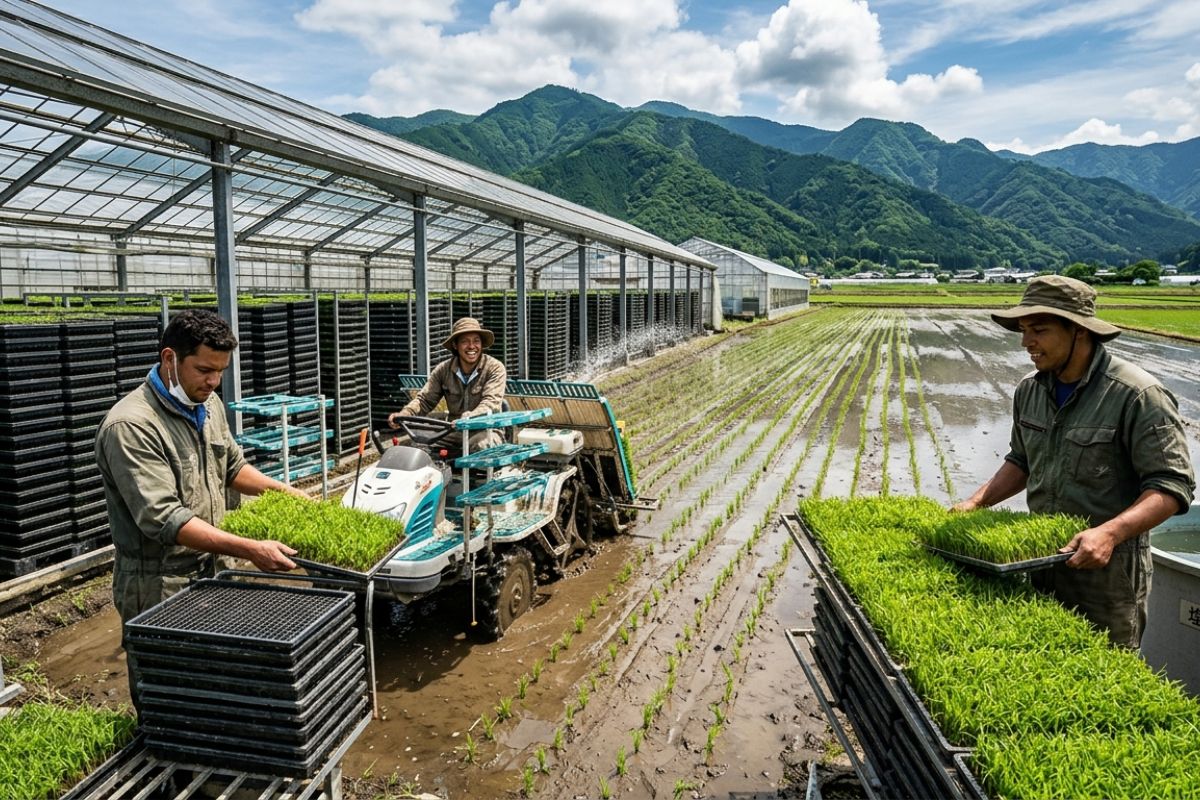
The routine of the brothers mixes water selection with salt, strict level control, water management in the drum, and mechanized transplanting that stops everything when something goes out of standard
The brothers from Brazil who plant rice in the interior of Shizuoka show that, in Japan, the result starts long before planting. The process involves brine to select seeds, waiting for the little root at the right point, and a sequence of steps where every detail changes the pace of work.
By following the brothers from seed to ready seedlings, it becomes clear why they repeat the same idea so much: you can’t skip a phase. Mechanization helps, but it also demands precision, because any deviation in level, water, soil dose, or germination time results in delays and losses.
The brine that decides what becomes a seedling
The first filter of the brothers happens in the water. The rice seed soaks, and they explain that part of the process includes throwing the rice into salt water to separate the good from the waste.
-
Brazil surprises China with a new agro offensive: first shipments of DDGS and poultry by-product meal arrive in the Asian country, expanding billion-dollar exports.

-
Brazil surprises China with new agro offensive: first shipments of DDGS and poultry by-product meal arrive in the Asian country, expanding billion-dollar exports.

-
War in the Middle East threatens this year’s harvest and wallets: Brazil depends on the Strait of Hormuz for 35% of nitrogen fertilizers, exports up to 23% of corn to Iran, and freight, diesel, and prices are skyrocketing today.

-
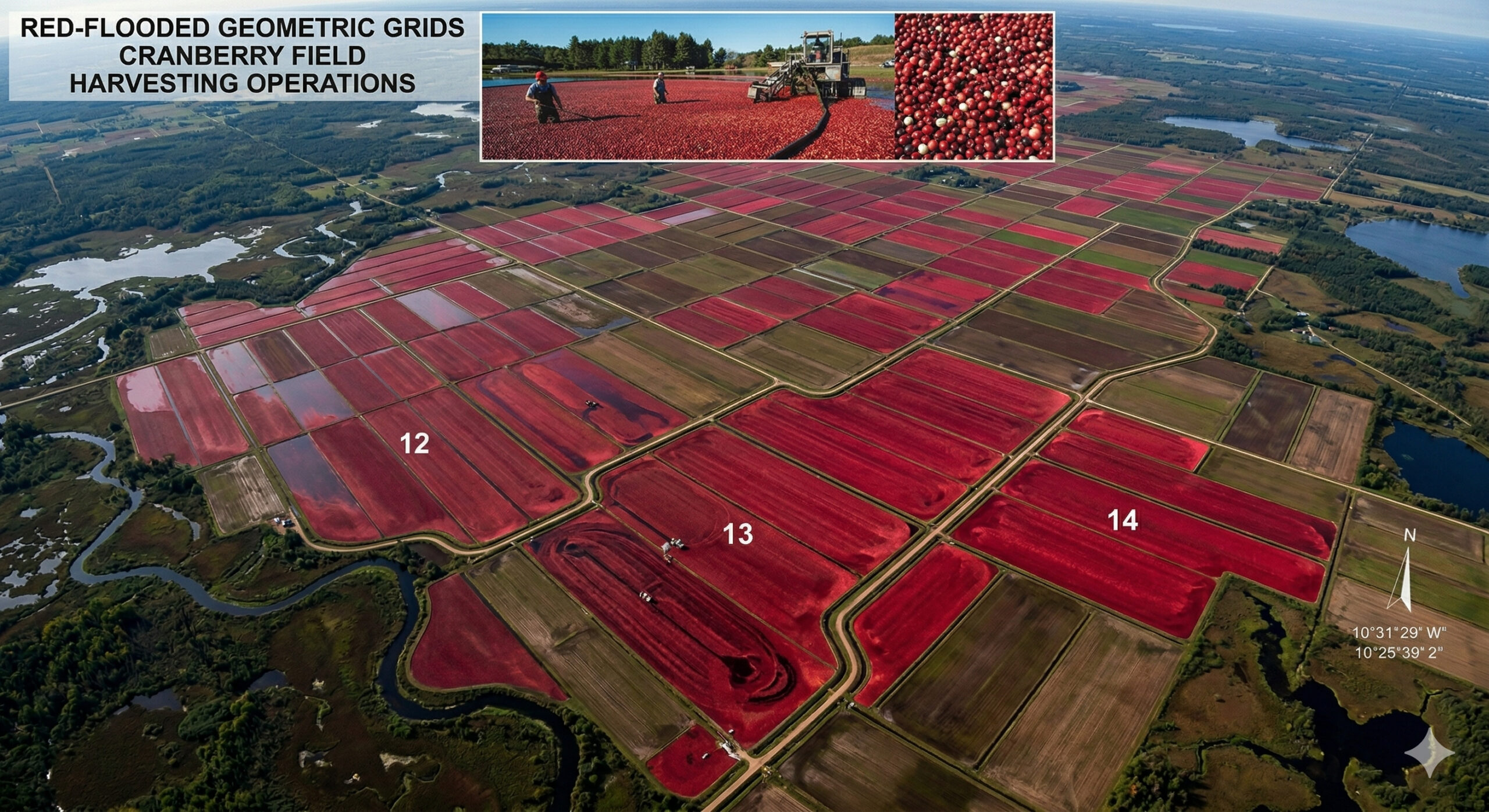
Geometric cranberry bogs in Wisconsin flood entire fields and turn red during harvest, creating an agricultural mosaic so intense and out of the ordinary that it transforms wetlands in the United States into one of the most stunning landscapes ever seen from space.
In practice, they describe a very objective measure: 40 liters of water with 6 kg of salt, using common kitchen salt. What floats is discarded, and what sinks moves on.
After that, the seed comes out of the salt, goes through drying, and returns for another step with water until it reaches the signal that controls everything.
The little root is the definitive “yes” to plant
The brothers insist on a point that seems simple, but changes the entire schedule: the little root has to appear. They show the “white tip” emerging and emphasize that it indicates the time to sow in the soil.
When the little root is not expected, the birth becomes irregular and slow. They mention that it can take weeks longer, while with the right point, the seed responds quickly and in a few days the seedling appears. The little root is the thermometer of the process.
Trays on an industrial scale and crowded greenhouses

After selection, the work becomes volume. The brothers talk about thousands of trays, with a full greenhouse and production organized by stages.
In one part, it is mentioned that there are 1,200 trays on one side and that they still need to make 2,300 more, and later the goal of 4,000 trays appears to manage the planting.
In the greenhouse, you can see the difference between a “wrong” germination and another “tight”. They show a part that became more spread out because they didn’t wait for the little root, and in contrast, they display a uniform area, looking “lawn-like”, when the seedling is born at the right time. The greenhouse becomes the quality control panel.
The point of the seedling and the standard that the machine demands

When it comes time to plant, not just any size will do. The brothers explain that there is an ideal point for the seedling to enter the mechanized system.
They mention a reference range of approximately 8 cm to 10 cm, because that is when the machine can grab it with the “claw” and transplant it more securely.
The message is clear: if the seedling is not to standard, mechanization becomes a headache. The machine speeds up, but does not correct base errors.
Drum, level, and water: rice does not accept improvisation

In addition to the greenhouses, the brothers show the drums, which are the fields where rice is planted. They describe that the drum is slightly below street level, precisely to accumulate water.
Water plays a central role from the beginning, to moisten the soil and control weeds. They also mention an important management step before harvest: about 15 days before, they drain all the water to dry it out.
And during planting, care with the level appears several times: it has to be level, because any unevenness interferes with distribution and results.
When there is a problem, everything stops and everyone enters maintenance


The workday shown by the brothers is not just planting; it is route correction. At one point, there is an unforeseen issue with the pump and hose, and they stop to adapt the pipe, adjust the valve, and resume the flow.
In the tray production line, a typical operational point also appears: sensor, locking, and fine adjustment. The system helps avoid disaster, but demands constant attention. The machine speeds up, but does not work alone.
What made the brothers enter rice and what still weighs at the beginning
The brothers share that they started from an opportunity offered by someone in the region and decided to try it out. They mention the initial challenges with a phrase that summarizes the reality of mechanized farming: machinery is expensive. Without equipment, it is impossible to maintain scale, and therefore evolution happens step by step.
Even so, they show that the routine already has division of roles and supervision. One of the brothers appears as a control reference for the process, checking levels and adjustments, while the others rotate between trays, soil, seeds, greenhouse, and field. It is family work with factory standards.
The “secret” of Japanese rice, in the end, is method
In the video, the impression is that the difference does not lie in an isolated trick, but rather in the sequence: selecting seeds, waiting for the little root, keeping trays and greenhouses in rhythm, and only then entering the mechanized transplant with seedlings at the right size and leveled ground.
The brothers leave a simple and strong lesson: in rice, a small error at the beginning becomes a big problem later on.
Which part of the brothers’ method surprised you the most: the brine, the little root as the exact point, the volume of trays, or the mechanized transplant?






Seja o primeiro a reagir!