





 English
  Francês
  Alemão
  Italiano
  Japonês
  Norueguês
  Portuguese
  Spanish
  7 min of reading
  0 comments


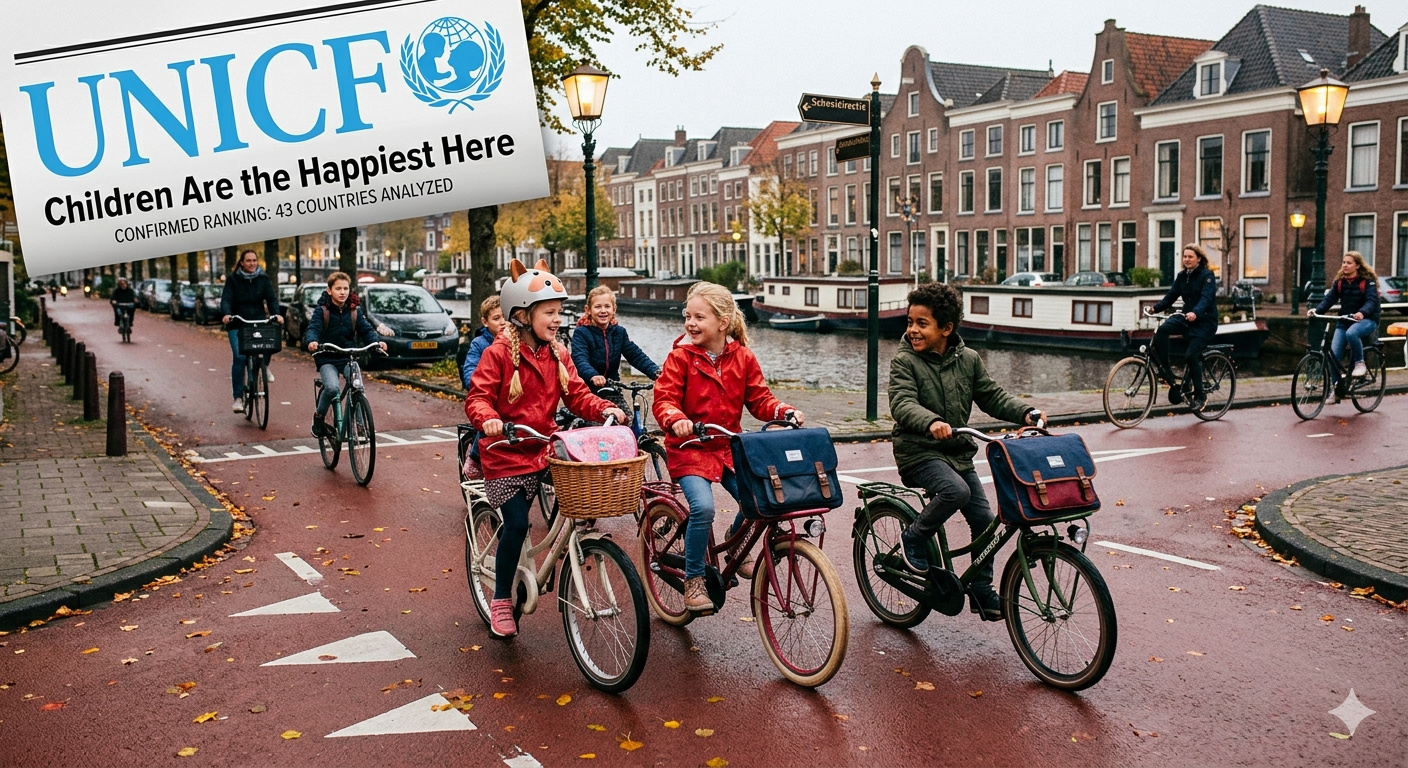
Netherlands lead UNICEF ranking as the country with the happiest children in the world; freedom, bicycle, and infrastructure explain the result.
In May 2025, UNICEF published the Card 19 Report, the most comprehensive study on child well-being ever conducted in wealthy countries. 43 OECD and European Union nations were evaluated, measured by six indicators: mental health, physical health, academic proficiency, social skills, life satisfaction, and suicide rates among adolescents. The result was the same as five years ago: the Netherlands ranked first, ahead of Denmark and France. In the life satisfaction category, 87% of Dutch children reported being happy, a number that dropped only 3 percentage points since 2018, in a world where most countries recorded a much sharper decline.
The explanation that Dutch parents, educators, and experts give, almost unanimously, is surprisingly simple: children have the freedom to walk alone in the world.
How children live in the Netherlands: child autonomy since age 7
A 7-year-old child wakes up, has breakfast, grabs their bicycle, and rides alone to school. It is not an extraordinary episode. It is a typical Tuesday in the Netherlands.
-
Spain surprises the world by erecting 62 artificial dunes, mixing sand with natural remains of posidonia, and causing the structure to lose only 1.4% of its volume in 1 year.

-
With 16 Bulava missiles, improvements in acoustic stealth, and a design focused on silent patrols, Russia’s nuclear submarine was born to ensure Moscow’s invisible retaliation and has become one of the pillars of its maritime strength.

-
‘Populous’ city in Rio among the worst in Brazil in national ranking and exposes silent development crisis.
-
Couple buys house in the South Zone of São Paulo, opens a hidden door in the garage, and finds a secret wine cellar with dozens of old wines forgotten since the 1970s.


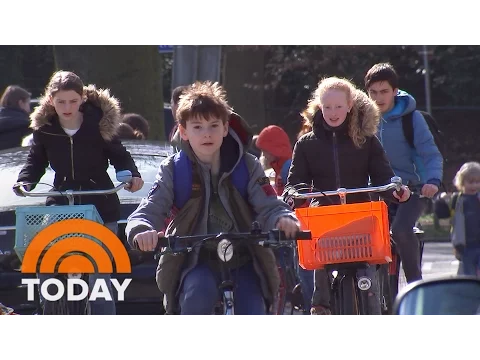

When children are between six and eight years old, most already visit local playgrounds without adult supervision. By age seven, most ride their bikes to school unaccompanied. By age ten, they navigate the city autonomously — taking buses, going to the library, visiting friends in different neighborhoods. There are no laws prohibiting this, no associated social stigma, and parents are not questioned for allowing it.
For outsiders, the contrast is immediate. In the United States, only 33% of children aged 9 to 11 are allowed to ride their bikes or walk to a friend’s house without supervision. Half can look for an item in the store while their parent is in another aisle. Only 15% can go out on Halloween with friends without an adult. In Brazil, the idea of a 7-year-old riding alone on a busy street would be received, in most cities, as negligence.
In the Netherlands, it is the norm.
The origin of the Dutch model: the Stop de Kindermoord movement and urban change
The autonomy of Dutch children is not an ancient cultural trait. It is the direct result of a political decision made just over fifty years ago and a revolt that preceded it.
In 1971, Dutch streets were dominated by cars. The country was experiencing its post-war economic miracle, and accelerated motorization was transforming entire cities. That year, 3,300 people died in traffic accidents in the Netherlands. Among them, more than 400 were children.
Vic Langenhoff was a journalist for the national newspaper De Tijd when he lost his 6-year-old daughter Simone, who was hit by a car while riding her bike to school. Months later, another of his children was seriously injured. In September 1972, Langenhoff published an article with the title that would become the cry of a generation: Stop de Kindermoord — Stop killing the children.
The name created a movement. Parents and children took to the streets. They blocked dangerous intersections. They lay on the ground with bicycles, pretending to be dead, in front of the Rijksmuseum in Amsterdam. They occupied streets to create play spaces.
Child protests?
In 1972, footage captured children blocking a street in Amsterdam with signs demanding that cars go away. The oil crisis of 1973, which forced car-free Sundays across the country, accelerated the change in mindset.
The government yielded. From the mid-1970s, the state began to systematically invest in cycling infrastructure separate from car traffic. In 1979, Delft was the first city to develop a comprehensive cycling plan for the entire urban network.
The federal subsidy for bike paths grew from 25 million guilders in 1976 to 53 million in 1982. Today, the Netherlands has 35,000 kilometers of dedicated bike paths and invests the equivalent of $35 per inhabitant per year in bicycle infrastructure — more than any other country in the world.
The result was not just more bicycles. It was a city redesigned for children.
Why the bicycle defines child freedom in the Netherlands
In the Netherlands, there are more bicycles than people: 23 million bicycles for 17 million inhabitants. The bicycle is not sports equipment nor a conscious ecological option. It is the everyday vehicle for all ages, social classes, and physical conditions, from the baby transported in the bakfiets to the 75-year-old on the e-bike.
Children start with the loopfiets — a balance bike without pedals — around age 2. By age 5 or 6, they are already riding conventional bicycles. By around age 10, most ride to school completely independently.
In schools, there is the verkeersexamen — the traffic exam — where children demonstrate skill and knowledge of traffic rules before receiving the certificate that allows them to ride independently.

What makes this possible is not the courage of Dutch parents. It is urban engineering. Dutch bike paths are completely separate from car lanes, have their own signage, and dedicated traffic lights.
At intersections, drivers are legally required to give full priority to cyclists, and mandatory car insurance fully covers any accidents involving cyclists, as long as the driver has committed some infraction. If the cyclist is under 14 years old, the driver pays for all damages even if the minor was at fault. The law was designed to protect the most vulnerable.
Adolescents aged 12 to 17 are statistically the ones who cycle the most in the country: an average of 32.9 kilometers per week. University students ride more than 22 kilometers per week on two wheels. For Dutch children, the bicycle is what their parents’ car is for American children: the device that connects them to the world.
The impact of child autonomy on the well-being and mental health of children
Researcher Lisa Corrie, an education consultant based in the Netherlands, identifies a precise mechanism behind UNICEF’s numbers. The freedom of movement — being able to go to school, to the store, to friends’ houses without depending on an adult — requires the child to make decisions, solve unforeseen problems, and negotiate social situations. This develops what psychologists call an internal locus of control, the perception that the individual has control over their own life.
A study published in 2023 reached the following conclusion: a primary cause of the increase in mental disorders is the decline, over decades, in opportunities for children and adolescents to play, move around, and engage in activities independently of direct adult control. A weak internal locus of control, derived from a lack of independence in childhood, is a consistent predictor of anxiety and depression in adolescence.
The Netherlands seems to have solved this problem through a chain of structural decisions. When a child rides alone to school, they are not just moving. They are exercising autonomy.
The result appears in the data. In the UNICEF report, 81% of Dutch adolescents aged 15 said they make friends easily, one of the highest rates among the 43 countries evaluated. Life satisfaction remained high even after the pandemic, and suicide rates among adolescents are among the lowest in the analyzed group.
Overprotection versus autonomy: the contrast between wealthy countries
There is an American statistic that clearly illuminates the contrast. A 2023 Pew Research Center survey revealed that 40% of American parents describe themselves as overprotective. Most say they restrict their children’s freedom as a form of protection.

The data suggest the opposite of what is expected. Excessive protection is associated with higher levels of anxiety, lower resilience, and difficulty coping with adversity.
In the Netherlands, the logic is inverted. Parents understand that granting independence is a form of protection against psychological fragility. “You are not made of sugar” is a common expression used to encourage children to face everyday challenges, such as rain or long distances.
Education consultant Amanda Gummer notes that the Dutch school system is deliberately non-competitive. The focus is not on maximum performance from an early age, but on developing curiosity and motivation to learn. This reduces pressure and contributes to higher levels of life satisfaction.
The result is a coherent ecosystem: safe infrastructure, a culture of independence, a less pressuring educational system, and lower social inequality, factors that together sustain the confidence necessary for children to move around alone.
Why the Dutch model is not geographical, but political
It is common to attribute the Dutch model to geographical factors, such as flat territory or small size. But history shows that this does not explain the transformation.
In the 1960s and early 1970s, cities like Amsterdam were dominated by cars, with the demolition of urban areas for the construction of parking lots. Bike paths were removed to make way for automotive traffic.
The change did not come from geography. It came from sustained political decisions over decades: continuous investment, cyclist-friendly legislation, and pedestrian-centered urban planning.
The 2025 UNICEF report brought an important warning: in 14 of the 32 countries with available data, children’s satisfaction significantly declined between 2018 and 2022. In a global scenario of deteriorating child well-being, the Netherlands maintained stability.
A network of 35,000 kilometers of bike paths, combined with consistent public policies over fifty years, created an environment where child autonomy ceased to be an exception and became the rule.








Seja o primeiro a reagir!