





 Portuguese
  English
  Spanish
  7 min of reading
  1 comment


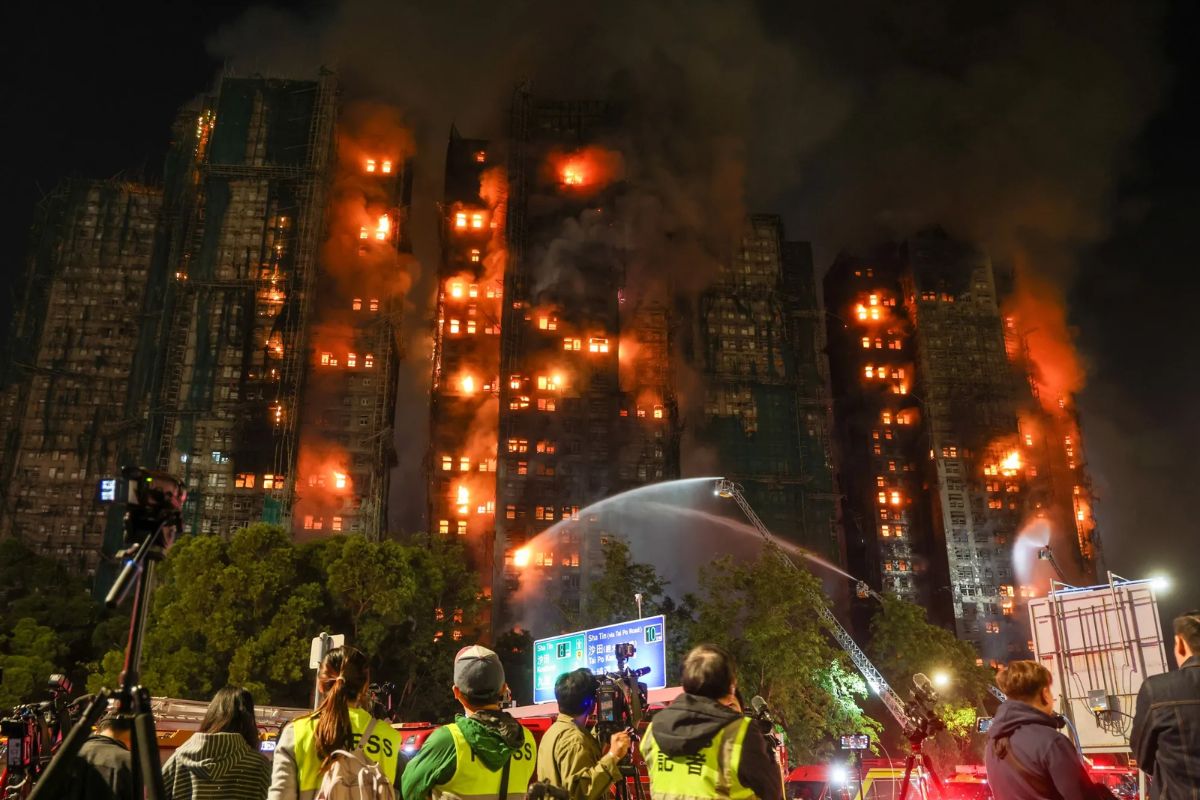

The Fire In Hong Kong That Affected The Wang Fuk Court On November 26, 2025 Accelerated By Bamboo Scaffolding, Plastic Netting, And Polystyrene Created Chimney Effect On The Facade And Annulled Internal Compartmentalization; The Level 5 Alarm Came With 83 Dead, 250 Missing, And Formal Criminal Investigation
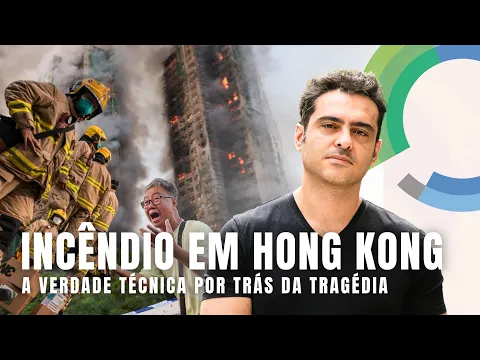
On November 26, 2025, a fire in Hong Kong affected the residential complex Wang Fuk Court, in the Tai Po district, and quickly escalated into a maximum emergency, with 83 dead recorded so far, 250 missing, dozens injured, and hundreds displaced. The sequence described in the report indicates an external focus linked to renovation work and a spread that reached 7 of the 8 towers.
On November 27, 2025, the technical summary available up to that date described the event as the result of a combination of combustible materials in a temporary facade, wind, and security failures that neutralized the building’s passive defenses. The case began to expose structural problems of urban oversight, construction management in occupied buildings and vendor selection.
Timeline Of The Fire In Hong Kong At The Wang Fuk Court

The fire in Hong Kong was associated with an initiation in the external structure of scaffolding from one block of the Wang Fuk Court, with signs perceived by residents still during the afternoon.
-
The 2nd safest city in Brazil is attracting new residents, industries, formal jobs, and also has a giant free park.
-
“Brazilian California”: the city is one of the best places to live in Brazil.
-
A collector bought a black stone in Morocco in 2011 without knowing that he had in his hands a Martian meteorite 4.45 billion years old with ten times more water than any other fragment of Mars ever found on Earth.

-
European cities are building public climate refuges to cope with extreme heat.
The report describes the day November 26 referencing a start time around 2:30 PM, and mentions first signs of smoke in the scaffolding at approximately 2:50 PM.
At 3:30 PM, the Fire Department raised the alarm level, and evacuation began under rapidly deteriorating conditions, with smoke and heat advancing through multiple towers.
The situation escalated to a level 5 alarm, the highest level, when the spread already involved a large part of the complex and the rescue faced physical obstacles created by the temporary facade of the work.
Propagation Triangle: Bamboo Scaffolding, Plastic Netting, And Polystyrene

The report describes a set of three components that accelerated the disaster: bamboo scaffolding, synthetic netting, and polystyrene exposure.
In Hong Kong, the use of bamboo scaffolding in high buildings remains common due to cost and tradition, but dry bamboo can become highly flammable, releasing volatile compounds with heat and burning with constant oxygenation due to the woven design.
The green nets, commonly used for debris containment, are described as being made of polyethylene or polypropylene, and, without flame retardants, can act as vertical wick, melting and forming burning droplets that create new ignition points.
This behavior, combined with bamboo scaffolding, was identified as a vertical propagation path in the Wang Fuk Court.
The third element was polystyrene, used as temporary sealing for windows and elevator areas for protection during construction and dust control.
The report states that the polystyrene was exposed or poorly protected and, when burned, generates thick and toxic black smoke, citing styrene, benzene, and carbon monoxide as relevant byproducts for respiratory risk.
Chimney Effect And Wind: Why The Fire Rose Dozens Of Floors In Minutes

The technical description points out that the original facade, combined with the external layer of bamboo scaffolding and nets, created a continuous vertical void that functioned as a channel for hot gas ascent.
This arrangement generated chimney effect, in which the heated air rises rapidly and pulls more air from the base, fueling combustion and heating materials above the ignition point even without direct contact with flames.
On that day, there was reference to a red fire danger alert, with low humidity and high ignition risk.
The report also links the behavior of the fire to winds channeled by local topography, with a Venturi-like effect, amplifying flames and carrying embers between towers.
This mechanism helps explain how the fire reached 7 of the 8 towers of the Wang Fuk Court.
Flexi 2 Architecture And The Neutralization Of Compartmentalization
The Wang Fuk Court is described as a complex inaugurated in 1983, with eight towers of 31 to 32 floors, about 2,000 units, and an estimated population of 4,800 residents.
The design is associated with the Flexi 2 pattern, with a central core for elevators and staircases and residential wings, dependent on passive compartmentalization by concrete and fire doors to contain fire within a unit long enough for intervention.
The central problem described is that the fire came from outside.
The work would have created a “second skin” of combustible material, and when the fire rose through the temporary facade, it encountered multiple openings on each floor.
The windows, designed for cross-ventilation, became entries for flames, neutralizing the logic of concrete box and allowing fire to invade apartments and corridors.
Escape Routes, Toxic Smoke, And Failures In Stair Pressurization
The report points out that the staircases, which should be safe evacuation areas, lacked modern pressurization systems, a frequent scenario in buildings from the 1980s without retrofit.
Consequently, smoke entered and accumulated, producing a phenomenon described as smoke logging, making escape routes impractical.
The polystyrene appears again as an aggravator, both for thermal load and smoke toxicity, directly affecting the capacity for evacuation, especially for the elderly and people with reduced mobility.
The sealing of windows during construction is also described as a factor delaying the perception of danger inside apartments, compounded by the use of air conditioning, which reduced external signals and noise.
Operational Response: Level 5 Alarm And Rescue Limitations
The fire in Hong Kong led the Fire Department to declare a level 5 alarm, and the report mentions the dispatch of over 12,200 firefighters to the scene.
The standard strategy of remaining in the apartment or evacuating via stairs, common in concrete buildings, failed because the windows broke and flames and smoke invaded common areas.
The operations faced intense heat, near-zero visibility, and corridors described as beyond the limit bearable for equipment, reducing the effectiveness of aerial ladders in certain positions.
The report also notes the death of a firefighter identified as R, aged 37, due to smoke inhalation and burns, after losing contact with the team during searches.
Dead, Missing, And Most Exposed Groups
By the cited summary, the fire in Hong Kong at the Wang Fuk Court recorded 83 dead, in addition to 250 missing, with expectations of increases due to the number of unlocated individuals.
The social impact included hundreds of displaced persons and dozens of injured, in a complex with high population density.
The report highlights that the mortality was aggravated by toxic smoke and evacuation barriers, disproportionately affecting the elderly and migrant workers, partly due to the rapid spread from outside and the practical failure of escape routes within the towers.
Investigation, Arrests, And The Focus On Prestige Construction
The police began the investigation immediately and treated the case as a potential crime, not just an accident.
The work at the Wang Fuk Court was attributed to Prestige Construction, and the report details the arrest of three individuals linked to the company, two directors, and one engineering consultant, under suspicion of involuntary manslaughter.
The narrative mentions a history of safety violations associated with Prestige Construction, including a conviction in 2023 for infractions in other projects in the Mid Levels area.
There are also reports of workers smoking on the scaffolding and discarding cigarette butts, as an indication of a failure in basic supervision, in addition to the hypothesis of green nets without flame retardant treatment or of inferior quality, even counterfeit.
Urban Oversight, Bidding, And What Should Change After The Disaster
The renovation contract is described as being worth 330 million Hong Kong dollars, approximately R$ 207 million, and the report points out that the choice of a company with negative records raises doubts about due diligence, oversight, and urban oversight in large-scale construction in occupied buildings.
The Independent Commission Against Corruption, cited as ICAC, entered the case to investigate possible irregularities in the bidding process.
The report contextualizes with a history of manipulation of bids in the building renovation sector, with suspicions of price inflation and a reduction in the quality of materials, which reinforces the debate on minimum controls for scaffolding, nets, and polystyrene in dense urban environments.
The fire in Hong Kong at the Wang Fuk Court shows that works in occupied buildings need to treat the temporary facade as a critical safety system, not just as a construction detail.
Prohibiting combustible materials without retardant, controlling the use of bamboo scaffolding, ensuring the covered use of polystyrene, requiring temporary alarms, and reviewing escape routes during renovations are direct measures pointed out by the very logic of the event.
If you live or work in a building under renovation, the most immediate action is to demand from the manager, the condominium, and local oversight a public checklist of facade and evacuation materials, with documented inspections and penalties for non-compliance, before risk becomes routine.
In your assessment, would the fire in Hong Kong at the Wang Fuk Court have been prevented if the work had prohibited plastic nets and polystyrene and required daily oversight of bamboo scaffolding?







A fiscalização em qualquer obra de pequeno ou grande porte é de vital importância, se trata de vidas e vidas importam, portanto não se deve negligenciar. A irresponsabilidade gera prejuízos vitais graves. Nada e agregar trará de volta as vida que se foram, mas, só resta agora apurar e punir os responsáveis, pelo menos é o que precisa ser feito depois de agregar os que estão dispersos e sem moradias.