





 English
  Francês
  Alemão
  Italiano
  Japonês
  Norueguês
  Portuguese
  Spanish
  4 min of reading
  0 comments


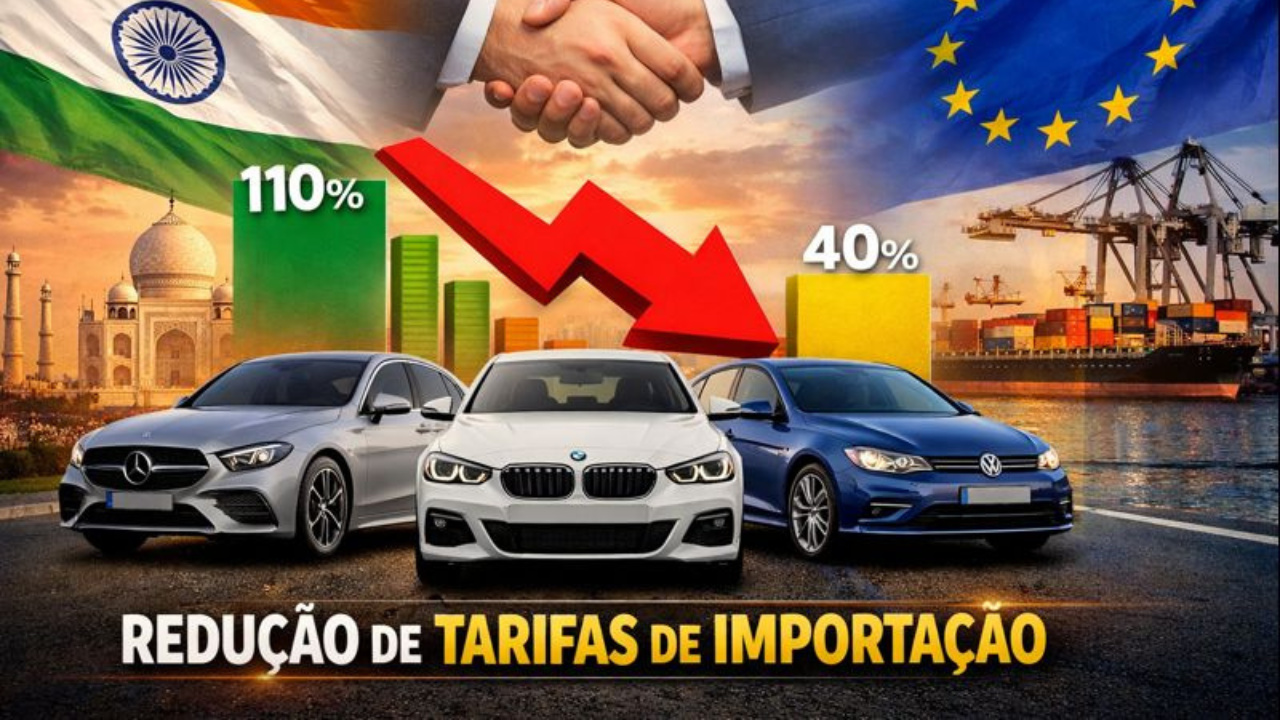
India-EU Trade Advances With Proposal to Reduce Import Tariffs and Increase Access for European Cars to India.
India is preparing one of the largest recent changes in its trade policy by signaling a reduction in import tariffs on vehicles coming from the European Union.
The measure, negotiated within the India-EU trade, could redefine the Indian automotive market, increase the presence of European cars in India, and accelerate trade negotiations between the two blocks.
India Plans to Reduce Import Tariffs on EU Cars in Historic Agreement
India is considering drastically cutting import tariffs on cars from the European Union, reducing them from as high as 110% to 40%.
-
Middle East War Hits Fertilizers and Transportation and May Strain Brazilian Wallets

-
Russia Considers Suspending Gas to Europe After Surge in Energy Prices
-
How A War Thousands of Miles From Brazil Started Disrupting Global Shipping Routes, Raising Container Costs, and Putting Up to 40% of Brazilian Beef Exports at Risk

-
Iran-U.S. War Drives Up Oil Prices and Pressures Global Financial Markets


The initiative involves the government of Prime Minister Narendra Modi, takes place in New Delhi, could be announced as early as next Tuesday (27), and is part of the final negotiations of a broad free trade agreement with the European Union.
The goal is to unlock India-EU trade, reduce historical barriers, and boost economic exchange between the parties.
According to sources close to the negotiations, the reduction will occur immediately for a limited number of imported vehicles from the European bloc.
The strategy seeks to balance economic openness with protection for the local sector while accelerating the trade negotiations that have dragged on for years.
Reduction of Import Tariffs and Impact on the Indian Automotive Market
The proposal envisions that the reduction in import tariffs will start at 40% and gradually decrease to 10% over time.
This change could facilitate access for European automakers to the Indian automotive market, which is currently considered one of the most closed markets in the world.
Among the potentially benefited companies are giants like Volkswagen, Mercedes-Benz, and BMW, which have been pushing for more competitive conditions to sell their models in the country for years.
Currently, India imposes tariffs ranging from 70% to 110% on imported cars, a level frequently criticized by executives in the global automotive sector.
Sources interviewed by Reuters state that the initial measure may cover about 200,000 combustion engine vehicles per year.
Still, the final number may be adjusted until the formal agreement is concluded.
“Mother of All Agreements” in India-EU Trade
The authorities involved classify the possible pact as “the mother of all agreements,” a phrase that reflects the economic and political significance of the understanding.
Expectations are that India and the European Union will announce the completion of negotiations on Tuesday, paving the way for ratification of the text in the following months.
In addition to benefiting the automotive sector, the agreement is expected to significantly expand India-EU trade in other strategic areas.
Indian products such as textiles, jewelry, and manufactured goods may gain greater competitiveness in the European market, especially after being affected by U.S. tariffs of up to 50% since the end of August.
European Cars in India and Protection for the National Sector
Despite the opening for European cars in India, the Indian government remains cautious regarding electric vehicles.
According to sources, battery electric models will be excluded from the reduction in import tariffs for the first five years of the agreement.
The decision aims to protect investments from domestic manufacturers such as Mahindra & Mahindra and Tata Motors, which have been heavily investing in the development of the domestic electric sector.
After this initial period, imported electric vehicles are also expected to benefit from tariff reductions similar to those of combustion models.
Confidential Trade Negotiations and Next Steps
The trade negotiations remain confidential, and both the Ministry of Commerce of India and the European Commission have refrained from officially commenting on the progress of the process.
The sources involved requested anonymity, emphasizing that last-minute changes are still possible.
Nevertheless, analysts believe that the agreement represents a turning point for the Indian automotive market and India’s trade strategy in the global scenario.
By reducing barriers and strengthening India-EU trade, the country signals greater integration with international supply chains while trying to preserve national strategic interests.
Thus, the reduction in import tariffs could increase the presence of European cars in India.
See more at: India Will Reduce Tariffs on Cars to 40% in Agreement With the EU










Seja o primeiro a reagir!