





 Portuguese
  English
  Spanish
  4 min of reading
  0 comments


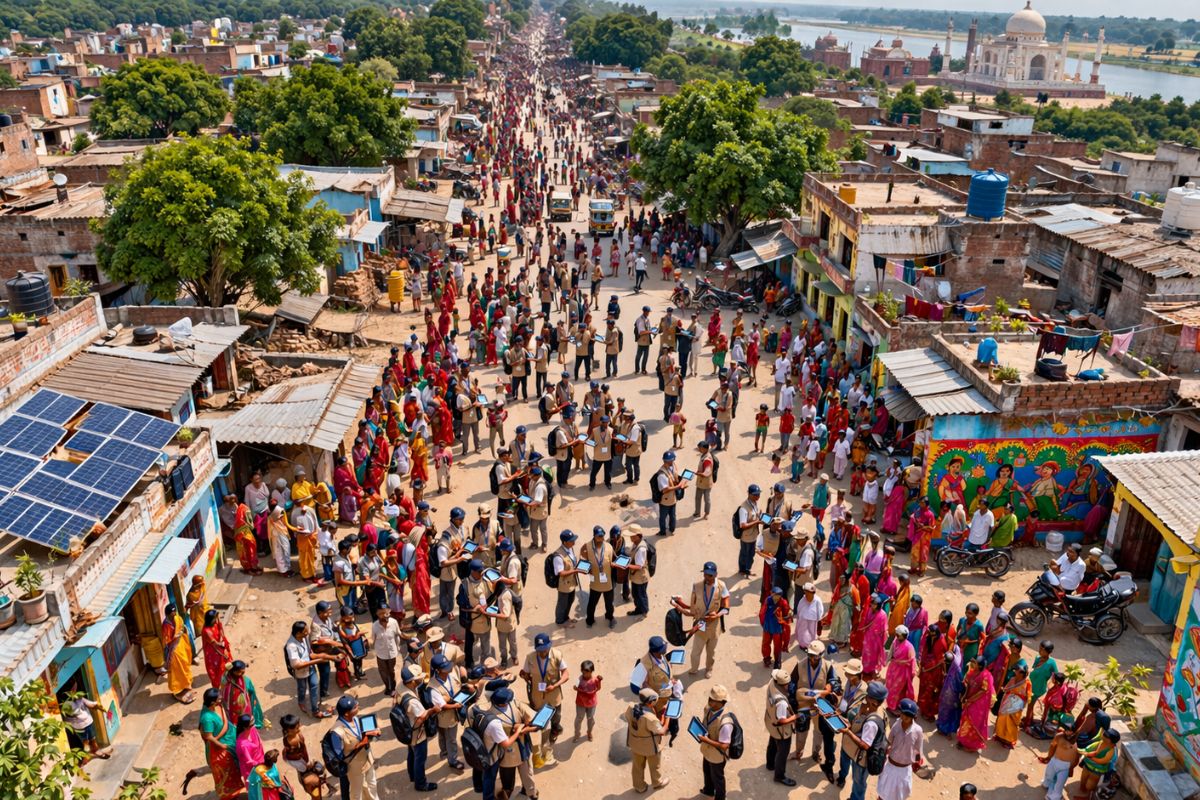
With 3 million enumerators, India will reach 640,000 villages and 9,700 cities in two phases by 2027, using an app and detailed collection to update the country’s portrait
India has begun what may be the most ambitious national census ever conducted, with the mission to count a population that already exceeds 1.4 billion inhabitants. The operation mobilizes more than 3 million technicians and requires unprecedented logistical scale to reach homes and residents across the territory.
The goal is to build an updated portrait that helps New Delhi make more accurate decisions about the economy, public services, and social policies. Without recent data, the country is forced to work with samples and estimates, in a scenario where population distribution changes rapidly.
Why does India need a new portrait of the country
India updates its records every 10 years since 1881, but this tradition was interrupted in 2021 when the COVID-19 pandemic prevented the update of the 2011 record. Since then, the process has been postponed for various reasons until April 2026.
-
Navios resume transit through Hormuz after ceasefire between Iran, the USA, and Israel: two bulk carriers cross safely, but hundreds remain held in the Persian Gulf, in a strategic corridor through which 20% of the world’s oil passes.

-
Brazil’s exports to the U.S. plunge for the eighth consecutive time, while China expands its leadership, and this is changing the landscape of foreign trade in 2026.

-
The Federal Government wants to curb family indebtedness and is considering releasing FGTS with a renegotiation that could cut up to 80% of debts for families and individual micro-entrepreneurs (MEIs).

-
‘Theory of the Madman’ is the strategy that explains why Trump threatened to end Iran and hours later offered a two-week truce as if nothing had happened.

The census is seen as a tool to “see” the country more clearly. It is the basis for planning policies, calibrating services, and understanding how the population is distributed among rural areas, urban areas, and transforming regions.
The scale of the census: 3 million enumerators and an entire country to cover
Counting 1.4 billion people is already, in itself, an extraordinary challenge. But the scale becomes even more apparent when operational details come into play: more than 3 million technicians, mostly public employees and teachers, traversing 36 states and territories.
In practice, the enumerators must cover 7,000 sub-districts, over 9,700 cities, and about 640,000 villages. It is an operation of maximum reach, designed to leave no gaps in housing and population data.
Two phases until 2027: houses first, people later
To manage the complexity, India intends to divide the work into two phases. The first started this month and will last until September, a six-month period in which technicians compile a complete list of houses and residents.
In this initial stage, they record the size and characteristics of the residences and whether there is access to services such as internet and basic sanitation. The logic is to map the “where” and the “how people live” before diving into the “who”.
The second phase begins in 2027 and focuses on individuals. In this phase, enumerators must collect data such as name, gender, age, marital status, education, income, religion, and other characteristics, including migration and disability. This is where the census gains social and economic depth, with the potential to guide more sensitive decisions.
The app comes into play and changes the way of enumerating
A significant difference in this edition is the adoption of an app, which should reduce reliance on printed forms and speed up data collection. Additionally, the plan provides for citizens themselves to use the app to submit their data, with subsequent verification by the enumerators.
Technology, in this case, is not just convenience: it is a way to make the impossible feasible, reducing rework and speeding up stages in an operation with millions of visits and checks.
When the results come out and what to expect from the pace
Even with the start of data collection, the conclusions are not expected to arrive quickly. The forecast mentioned in the base is that the final count will be released only next year, reflecting the size of the process and the volume of information to consolidate.
In the first phase, census participants answer just over 30 questions. The housing stage alone already requires rigorous standardization, because small errors multiply when the universe is hundreds of millions of people.
What is at stake: public policies, economy, and representation
It is no coincidence that India is willing to invest resources and mobilize labor on such a large scale. The state needs updated data to define policies and direct programs, including initiatives aimed at employment and rural areas.
Moreover, the census can impact parliamentary representation by territory and provide information about the caste system, one of the most controversial aspects of the study.
An expert cited in the base summarizes the importance by pointing out that the census captures dimensions ranging from caste and religion to jobs, education, and services, helping to show how people live in the country.
India is already regarded as the great population giant of the planet, after estimates from 2023 indicated that it would surpass China. Now, the idea is to go beyond the total number and understand, in detail, how this population is distributed and what its conditions are.
And you, do you think India will be able to complete such a gigantic census without delays, or will the complexity push the schedule back once again?








Seja o primeiro a reagir!