





 Portuguese
  English
  Spanish
  3 min of reading
  0 comments


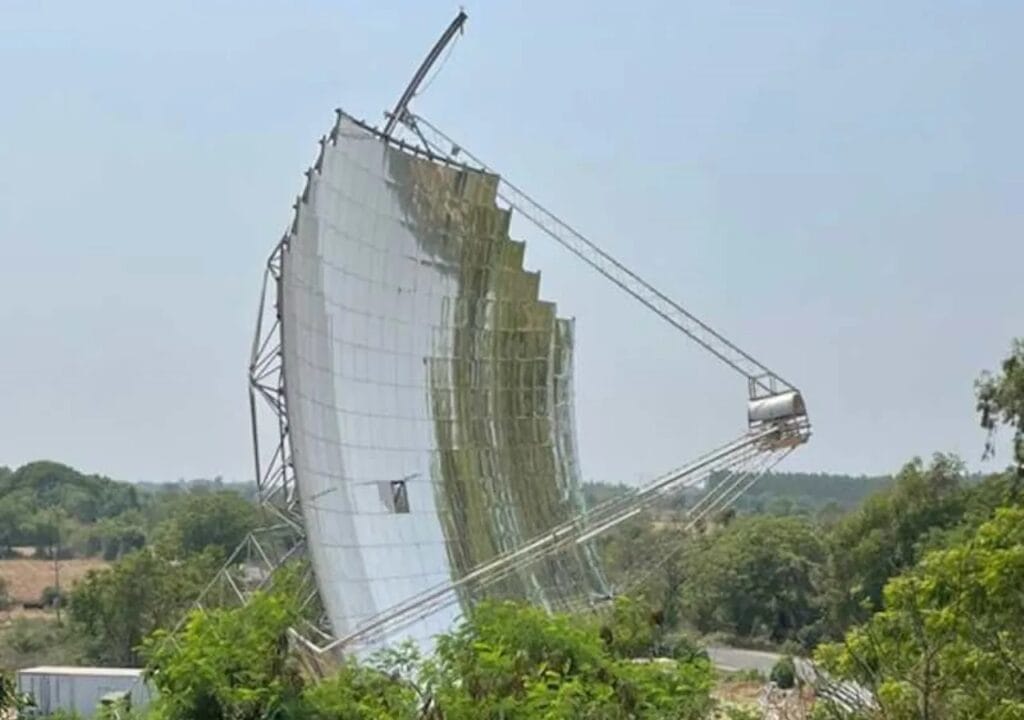
India Inaugurates The World’s Largest Solar Concentrator, Weighing 26 Tons and Featuring Over 380 Parabolic Mirrors, Capable of Generating Electricity for Multiple Establishments.
In the western region of India, the world’s largest and most efficient solar concentrator has been installed, marking a milestone in renewable energy generation. This pioneering project aims to provide sustainable electricity to a research center and a hospital, highlighting India’s commitment to public health and scientific advancement. This solar energy initiative reflects a long-term strategy focused on the well-being of people and technological progress.
Solar Concentrator Named SG4 Big Dish
This impressive solar concentrator from India will supply energy for air conditioning, which is very essential for the country, as well as for other everyday applications. Currently, the team is aligning this monumental structure, weighing 26 tons, with the trajectory of the sun, as it is necessary to maximize irradiance performance.
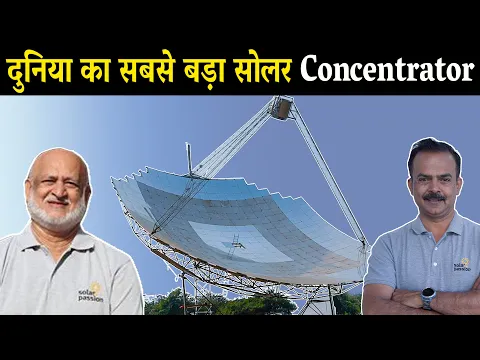

It is important to remember that irradiance is used to define the power of electromagnetic radiation reaching a specific location. It is also worth noting that defining the value of solar constant is essential. All of this is done through the solar tracker RaZon+ from Kipp & Zonen, which records irradiance, solar duration in hours, and energy.
-
The Brazilian state accelerates industrial competitiveness with a focus on the extraction of strategic minerals to boost the energy transition in Goiás.

-
A Canadian retiree creates a hydroelectric system on a real river, generating energy continuously throughout the day and demonstrating how the power of water can supply a house with stability even in a simple structure.

-
Petrobras reaffirms its commitment to the market and ensures that it will carry out the energy transition safely to maintain national sovereignty.

-
Researchers discover a possible hydrogen deposit of up to 46 million tons beneath an ancient coal basin, and the volume could exceed half of the entire global production.


The solar concentrator installed in India, featuring 380 parabolic mirrors, is named SG4 Big Dish. Moreover, its solar energy reflecting area covers an impressive 500 m². Located at its focal point is a thermal collector, which enables the parabolic mirrors to concentrate solar light.
With the energy generated by the solar concentrator, sterilization and laundry operations can be performed at the hospital. As if that were not enough, it also enables the preparation of 2,000 meals per day.
Challenges Encountered in Implementing the Solar Power Generator in India
To succeed in maximizing the efficiency of this solar concentrator, extremely precise monitoring of the RaZON+ system from Kipp & Zonen from OTT HydroMet was essential. Thus, it was possible to align the solar power equipment with the trajectory of the sun, allowing for maximum irradiance capture. Over the months, challenges arose, such as cloud movement impacting the amount of received energy.
Therefore, weather forecasting applied to the daily operation of the solar concentrator is essential. However, this technological advancement serves as a model to follow in meeting energy demands more sustainably.
Undoubtedly, it is an initiative that can be replicated worldwide, potentially becoming part of urgent climate policies, thus generating a clearer vision of the steps to be taken for a nature-friendly lifestyle.
Construction of The Solar Concentrator
The mission was to develop a large area solar antenna to generate electricity at minimal installation cost when mass-produced and in large scale. Additional requirements included minimizing technical risks and maximizing reliability. The ease of transformation for operators and the applicability of a range of energy conversion options were considered attractive points for investors.
The design process followed rigorous system design principles and carefully considered the interactions between the main subsystems structure, mirrors, foundation, receiver, and actuation, as each was developed in parallel.
While the previous design of the SG3 antenna, with 400 m², depended on the assembly of precise prefabricated space structure components to produce the required paraboloid, the SG4 design relies on a very precise reusable template to provide the structural accuracy that supports the optical surface.








Seja o primeiro a reagir!