






 Portuguese


The Jaipur Foot prosthetic leg was designed for walking barefoot, navigating rugged terrain, squatting, and working in flooded areas. With a sturdy build and personalized fitting, the below-knee version can be delivered in one day and costs an average of around $100, significantly less than the price for a comparable solution in the United States.
A worker steps barefoot into a rice paddy, sinking his feet into the mud and needing to squat repeatedly while working. In this environment, a prosthetic designed solely for walking with shoes on flat surfaces would not meet the basic needs of the daily routine.
The Jaipur Foot prosthetic was developed in India to accommodate movements integral to domestic life, rural work, and local customs. It allows users to walk barefoot, squat, swim, sit cross-legged, and navigate wet or uneven terrains.
The Bhagwan Mahaveer Viklang Sahayata Samiti, known as BMVSS, the organization responsible for the Jaipur Foot technology, maintains the technical specifications of this solution. A custom below-knee prosthesis can be manufactured and fitted in just one day, with an average reported cost of approximately $100.
-
Scientists Develop Hydrogen-Powered Car That Doesn’t Require Gasoline or Charging

-
How the Cyclotron Resolved a Problem that Electrical Engineering Couldn’t with Voltage, Earning the 1939 Nobel Prize in Physics

-
Europe Removed 603 Old Dams, Dikes, and Barriers in One Year, Reconnected Over 3,740 km of Rivers, Transforming Obsolete Structure Demolition into an Ecosystem Recovery Tool

-
Chinese Manufacturer Challenging Tesla and Boston Dynamics with Humanoid Robots Could Be Valued Over $7 Billion After IPO in Shanghai and Plans to Raise 4.2 Billion Yuan for Expanded Production and Investment in AI and Robotics


A Prosthetic Designed for Local Lifestyles
The development of the Jaipur Foot began in 1968 at the S.M.S. Medical College Hospital in the Indian city of Jaipur. Orthopedic surgeons and craftsmen collaborated to create an artificial foot capable of mimicking important movements for the local population.
The entity responsible for subsequent improvements was established in 1975. The project sought to address an issue that extended beyond amputation, focusing on how people worked, sat, and moved.
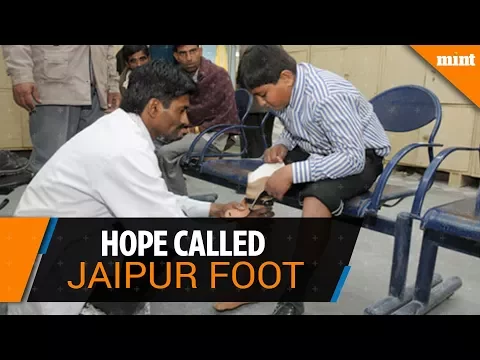

In many communities, walking barefoot, sitting on the ground, and working in flooded fields are part of daily life. Therefore, the prosthesis needed to provide mobility, durability, and adaptability to terrain, without limiting the user to a single way of walking.
Movement in Three Directions Brings the Jaipur Foot Closer to the Human Foot
The Jaipur Foot offers movement in three different planes. Simply put, this means that the artificial foot can bend upward, tilt sideways, and perform slight rotations.
These movements help adapt the footfall when the user encounters stones, uneven surfaces, mud, or unpaved paths. A completely rigid structure would struggle to keep up with these changes in terrain.

The freedom of movement also allows for activities that require greater leg flexion. Users can squat, kneel, sit cross-legged, run, dance, swim, and walk on uneven terrain.
HDPE Pipe Reduces Manufacturing Steps and Accelerates Production
The structure of the below-knee prosthetic leg can use high-density polyethylene, known as HDPE. This is a lightweight plastic, impact-resistant and capable of withstanding weather changes.
The pipe assists in forming the part that connects the leg fitting to the artificial foot. Since this structure does not need to be assembled with multiple joints, the process produces a continuous and durable piece in less time.
This choice reduces manufacturing steps and allows for the completion of a below-knee prosthetic leg in one day. In centers that use traditional processes, production and delivery can take several weeks or even months.
Squatting and Walking Barefoot Enhance Independence
The Jaipur Foot can be used with or without shoes. This feature provides a practical difference for people who walk barefoot by habit, necessity, or due to work conditions.
Water resistance also allows for swimming and traversing wet terrain. In a muddy field, the user can move around and perform tasks without needing to remove the prosthetic leg just because the environment is damp.
Squatting and sitting cross-legged are equally important movements. They can be part of meals, household tasks, professional activities, and social interactions in various Indian communities.
US$100 vs. US$10,000 in Institutional Comparison
BMVSS, the organization responsible for the Jaipur Foot technology, publishes an average cost of approximately US$100 for the prosthetic leg. The organization itself compares this amount to the US$10,000 of a comparable solution in the United States.

The difference should be understood as a comparison made by the organization itself, rather than an independent survey of all models sold in the North American market. Prices may vary between manufacturers, materials, and individual needs.
Even with this caution, the numbers help explain the logic behind the project. Affordable materials, local manufacturing, and quick production reduce costs and allow for assistance to people who would struggle to pay for equipment costing thousands of dollars.
Free service took the technology beyond India
The service model was structured to provide prosthetic legs and other mobility resources free of charge. The individual undergoes an assessment, receives a piece tailored to their body, and makes the necessary fittings.
Rapid manufacturing decreases the time between the arrival of the user and the delivery of the prosthetic leg. This avoids relying on several weeks of waiting just to produce a below-the-knee piece.
The technology has also crossed Indian borders. Its international expansion took a solution created for local needs to amputees in other countries, especially in places where high-cost prosthetics remain out of reach for a significant portion of the population.
The Jaipur Foot demonstrates that an effective prosthetic leg must not only replace a part of the body. It must also respect the terrain, the work, the customs, and the movements that are part of the life of the person who will use it.
By combining low cost, rapid manufacturing, and mobility, the solution created in Jaipur transformed common needs into central criteria of the project.
If a prosthetic leg accommodates the body but ignores the routine of its user, can it truly be considered efficient? Share your thoughts in the comments and spread the word.


