





 Portuguese
  English
  Spanish
  4 min of reading
  3 comments


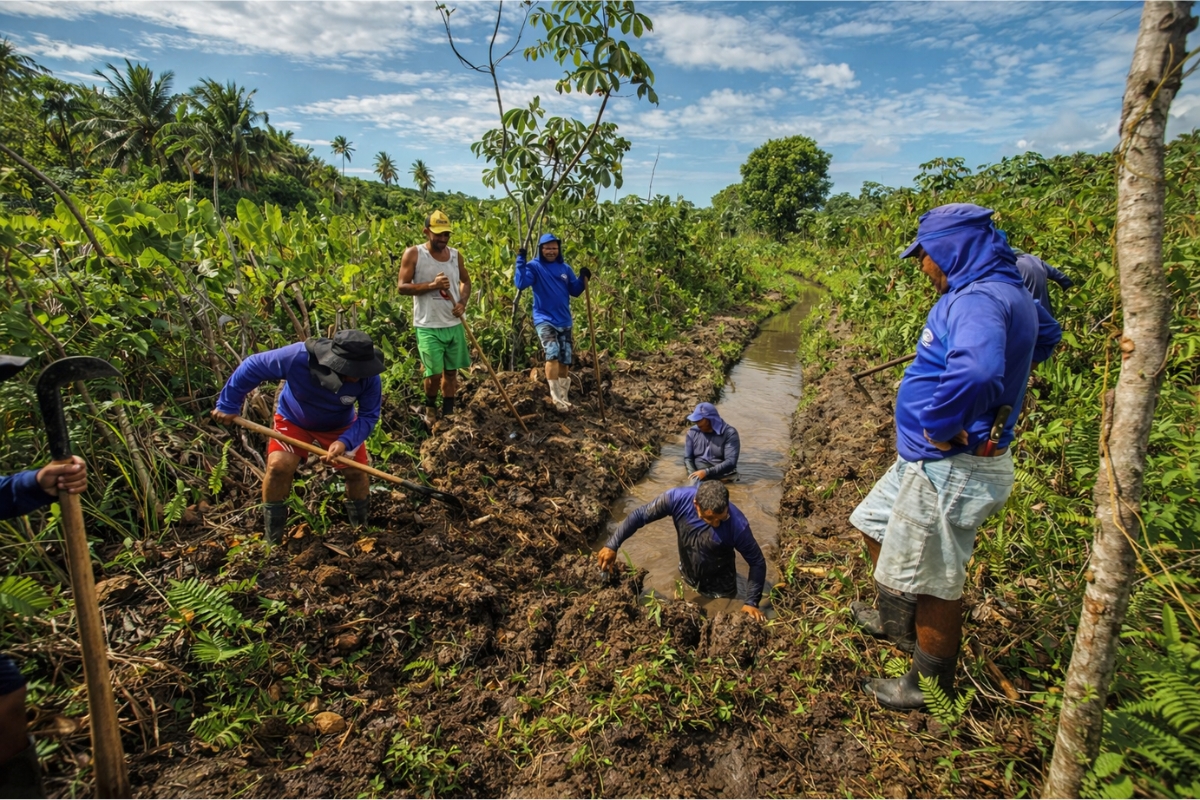


In The Bay of Traição, Indigenous Potiguara Initiated on January 21, 2021, the Revitalization of the Aterro River, Already Recovering Over 3.5 Kilometers and Working to Clear About 1 Remaining Kilometer, Causing Environmental, Social, and Cultural Impact Within the Territory.
Saturday dawned with heavy rain, but that has never been a reason to give up. Since 6:30 AM, volunteers had already gathered in the Alto Tambá village for another community effort.
Every Saturday, this routine repeats, and Potiguara Indigenous people meet to reopen the bed of the Aterro River, which has been almost buried after decades of neglect and inadequate interventions.
What began during the pandemic has turned into one of the most symbolic environmental projects in the local territory.
-
Friends have been building a small “town” for 30 years to grow old together, with compact houses, a common area, nature surrounding it, and a collective life project designed for friendship, coexistence, and simplicity.

-
This small town in Germany created its own currency 24 years ago, today it circulates millions per year, is accepted in over 300 stores, and the German government allowed all of this to happen under one condition.

-
Curitiba is shrinking and is expected to lose 97,000 residents by 2050, while inland cities in Paraná such as Sarandi, Araucária, and Toledo are experiencing accelerated growth that is changing the entire state’s map.

-
Tourists were poisoned on Everest in a million-dollar fraud scheme involving helicopters that diverted over $19 million and shocked international authorities.


Potiguara Waters Project Was Born in the Pandemic and Became a Permanent Action
The Potiguara Waters project emerged during a time of isolation, amid the COVID-19 pandemic. With the community closed off from the outside world, leaders began discussing land management and environmental issues. The conclusion was direct. It was necessary to take care of the river.
Without waiting for political promises, the group decided to act. In November and December 2020, the idea gained momentum. On January 21, 2021, the first cleanup action took place.
The project operates in the Forte and Alto do Tambá villages, in the Bay of Traição, North Coast of Paraíba. The initial focus was the Aterro River, a tributary of the Sinimbu River, which runs through both villages.

Heavy Work Removes Roots, Mud, and Vegetation Accumulated Over Decades
The cleanup is not simple. With machetes, hoes, and straight hoes, the volunteers cut through dense blocks formed by roots, soil, and organic matter accumulated over time.
On one of the days monitored still in 2023, just over seven meters were advanced. It may seem little, but the stretch was considered the most difficult, with consolidated sediments and extremely dense vegetation.
Even so, after three years, over 3.5 kilometers have already been recovered. Approximately 1 kilometer is left to completely free the river’s course.
The progress is slow but steady. And each meter opened is celebrated.
Siltation Began About 30 Years Ago After Inadequate Dredging
Reports from older residents indicate that the destruction of the river intensified about three decades ago.
A dredging altered the river’s natural meandering and practically eliminated the riparian forest. The course that used to be filled with meanders became straight.
Over time, collective use decreased. The arrival of piped water in the late 1990s drove families away from the river. Planting on the banks was also abandoned.
Without care and social use, the aningas grew uncontrollably. The river was gradually filled until it practically disappeared.
Environmental Recovery Includes Nursery Aiming for 10,000 Seedlings Per Year
Opening the riverbed is not enough. To keep the river alive, the group began restoring the riparian forest.
At the project’s headquarters, set up in a collectively renovated house in the Alto Tambá village, a seedling nursery is being structured.
The goal is ambitious. To produce 5,000 seedlings every six months, totaling 10,000 seedlings per year.
Species such as jenipapo, ipê, copaíba, and pau-brasil are already being prepared for planting at the beginning of the rainy season.
According to project members, reforestation can take years or even decades, as the forest practically no longer exists in various stretches.
Even before total completion, results are already visible. Fish species that hadn’t been seen for years have started to reappear.
Social and Spiritual Dimension Strengthens Potiguara Identity
The impact goes beyond the environment. The river has always been a space for bathing, leisure, fishing, agriculture, and coexistence.
In the past, there were clear rules for use, times, and space divisions. With abandonment, this social dynamic was lost.
Today, the project also seeks to restore collective use, encourage community gardens, and strengthen agroforestry as a model for sustainable production.
There is also a spiritual dimension recognized by the group. An incident involving a jararaca during the cleanup in September 2022 marked a turning point.
After the scare, the group created a campaign to acquire protective equipment and officially launched the name Potiguara Waters on social media.
From then on, the project gained visibility in the local media and began to be seen as a strengthening of the sacred and cultural identity.
The recovery of the river also fueled the recovery of symbols, paintings, crafts, and a sense of belonging among the youth.
Example of Sustainable Coexistence Inspires New Generations
One of the examples cited by participants is the property of about eight hectares belonging to Cedinha, a 64-year-old family farmer.
The area is divided between floodable land used in the summer, dry land for planting in the winter, and a stretch of preserved native forest.
The model demonstrates that it is possible to plant and preserve at the same time. Father and son actively participate in the community efforts and dream of seeing children swimming in the river again as they did in the past.
The project already plans to expand its actions throughout the Potiguara territory. But for that, volunteers emphasize that partnerships and support are needed.
Potiguara Waters has ceased to be just an environmental community effort. It has become a long-term movement aimed at future generations.
Do you believe that community actions like this can transform entire territories in Brazil? Share your opinion in the comments.










Parabéns pela iniciativa, o terceiro poder é o que muda.Esperar o poder público tomar iniciativa é acreditar em papai Noel. O mundo é comandado por incompetentes.
Parabéns!!!
Estou torcendo que mais pessoas como vocês, comecem a ver que precisamos fazer a nossa parte.
Se esperarmos dos políticos, estamos ferrado,eles só pensam nos interesses deles, apanhar nosso dinheiro, com cada dia mais impostos,e aumentando o número de impostos.
Que Deus proteja e abençoe vocês 🙏
Linda iniciativa! Está na hora de todos acordarem para o potencial do nosso grande país e colaborar para que ele não seja destruído….