





 Portuguese
  English
  Spanish
  2 min of reading


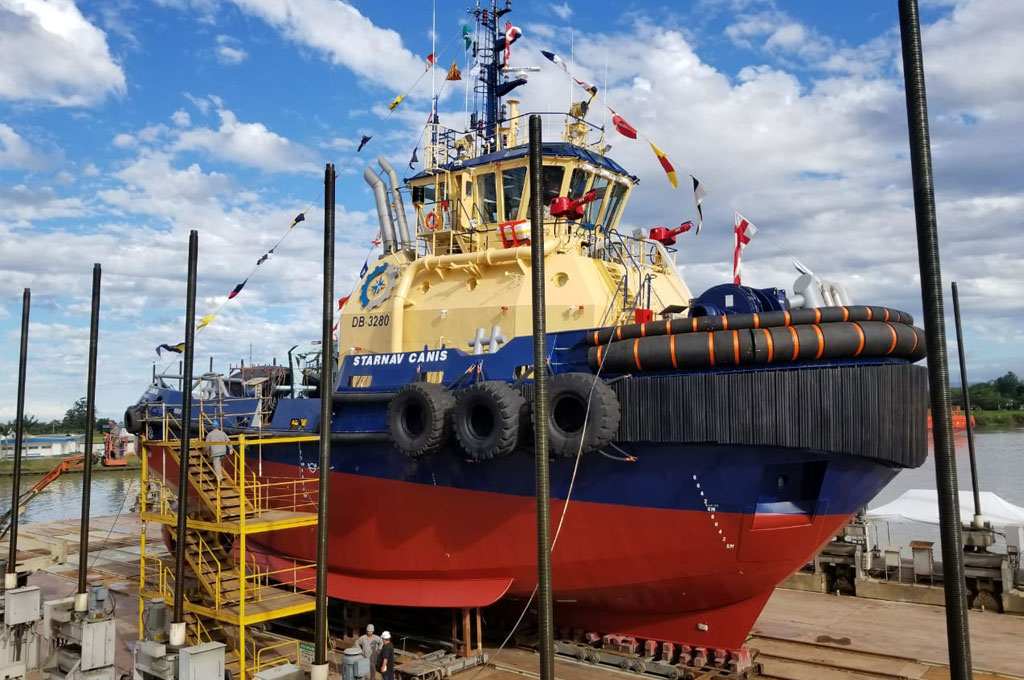
Contrasting with the Current Scenario of the Brazilian Shipbuilding Industry, Starnav Celebrates the Christening of the First Escort Tug Class Towboat, from a Series of Eight Vessels, to be Built at the Detroit Shipyard in Itajaí, Santa Catarina
Last Thursday (06/14) brought good news to the Brazilian Shipbuilding Industry. The shipowner Starnav christened, in Rio de Janeiro, the first of a series of eight azimuthal tugs with 80 tons of static bollard pull, ordered from the Detroit shipyard in Itajaí, Santa Catarina.
The vessel, designed by Detroit itself, was launched in March of this year and after completing fit-out and tests, is now being christened and incorporated into Starnav’s fleet.
The “Starnav Canis” belongs to the Escort Tug class, which will require investments around US$ 80 million and had Lidiane dos Anjos, Starnav’s crew coordinator, as its godmother.
The plan of the Detroit shipyard and Starnav is that all eight units will be delivered by June 2020.
-
Government unlocks R$ 554 million for a highway that has been requested for decades and accelerates the duplication of BR.
-
Without bricks, without cement, and without endless construction: the cardboard house that is assembled in modules and can be moved.

-
Billions of barrels on the equatorial margin could lead Amapá to double its oil production in Brazil — the state aims to enter the route of companies in the Campos Basin, attract investments, and boost jobs and businesses in the oil and gas sector.

-
Without bricks, without cement, and without endless construction: the cardboard house that is assembled in modules and can be moved.
Shipowner’s Confidence
Starnav celebrates the reception of the vessel and asserts that it has absolute confidence in the Brazilian shipbuilding industry, which is fighting for its survival, as it believes in the resumption of growth and the technical capacity of the sector.
The construction of the eight tugs is financed by the Merchant Marine Fund (FMM), classified by ABS, equipped with two Caterpillar engines, azimuthal propulsion from Schottel, and a winch from the Spanish company Ibercisa.
Alongside its high bollard pull capacity (80 Tons), the Starnav Canis features azimuthal propulsion, granting it high maneuverability and an excellent degree of automation.
The vessel is 32 meters long, 11.6 meters wide, has a mold depth of 5.43 meters, a draft of 4.10 meters, and can reach speeds of 12.5 knots.
The shipbuilding industry in Santa Catarina continues to make the Brazilian shipbuilding industry proud. It is worth mentioning that the Oceana shipyard, part of the Águas Azuis consortium with ThyssenKrupp, won the bidding from the Brazilian Navy for the construction of four Tamandaré Class Ships.









Seja o primeiro a reagir!