





 Portuguese
  English
  Spanish
  5 min of reading
  0 comments


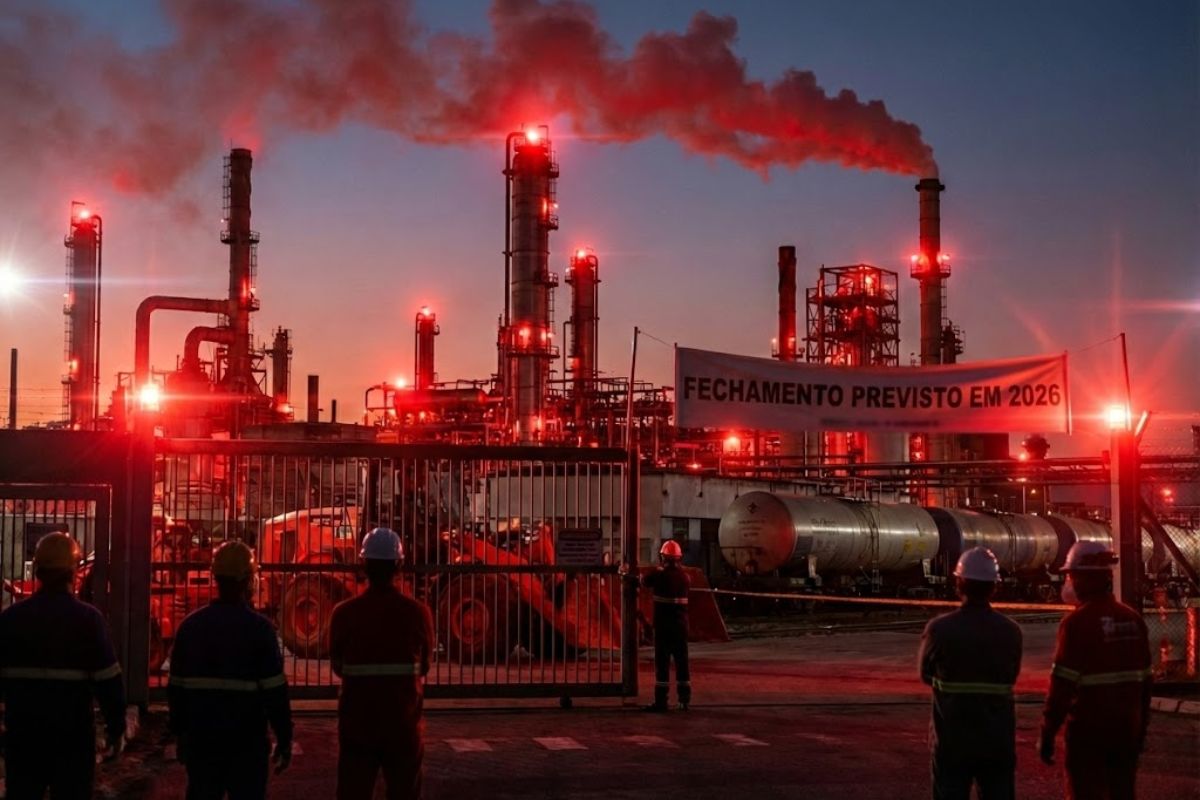
Workers’ Entities and the Chemical Industry Warned Geraldo Alckmin That, Without Immediate Solution for the REIQ in 2026, Regulatory Insecurity Increases, Shifts Decline, and Units Close Operations. The Fear Is of Mass Layoffs, Disruption of Strategic Supply Chains, and a Domino Effect in the Brazilian Petrochemical Complex This Year.
According to the portal Brasil 247, The Chemical Industry has gone into alert mode upon seeing the discussion about the REIQ for 2026 remain undefined, even with recent government signals toward strengthening the industrial park. Entities representing workers and companies have begun to treat the topic as a short-term urgency, seeing risks of cuts and plant closures.
In a formal statement addressed to the vice president and minister, the sector describes an environment in which uncertainty is already changing decisions within factories, even before any changes come into effect. The concern is not abstract: the argument is that the lack of predictability anticipates layoffs, interrupts investments, and can “dismantle” hard-to-recompose competencies.
What’s at Stake with the REIQ and Why 2026 Has Become the Breaking Point
The REIQ is at the center of the problem because it operates as an industrial policy instrument with a direct effect on competitiveness. When the sector talks about a “special regime,” it is pointing to a mechanism that, in the view of the entities, reduces asymmetries against foreign competitors and helps maintain production and employment in the country.
-
The largest food company on the planet, JBS, has just opened a 4,000 square meter laboratory in Florianópolis to develop customized proteins that modulate muscle mass gain, immune response, and metabolic performance.

-
After nearly 30 bids and competition among industry giants, a Spanish company purchases one of the largest airports in Brazil for almost R$ 3 billion and takes over the management of Galeão in a concession that will last until 2039.

-
The Federal Revenue Service now automatically cross-references everything you declare with data from banks, credit cards, brokerage firms, and insurance companies, and any discrepancy between your income and your expenses triggers an alert in seconds.

-
Amid global tensions, Brazil blocks the United States’ proposal at the WTO and paves the way for a trade crisis and possible retaliations.


The tension surrounding 2026 arises because, without a quick definition, companies start planning the next cycle without knowing what the rules of the game will be. In continuous process industries, cost and operation decisions do not wait for politics to “resolve”: shift cuts, reduced pace, and line reorganizations happen as a preventive response when regulatory risk increases.
Vetoes, PRESIQ, and the Feeling of Regulatory “Vacuum”
The entities acknowledge government initiatives aimed at rebuilding industrial capacity, citing Nova Indústria Brasil and trade defense mechanisms. At the same time, they point out that the vetoes to Law 15.294/2025, which established the PRESIQ, have increased uncertainty about how the REIQ will look next year.
The political point is delicate: when one instrument is born with vetoes and the other does not have a consolidated final design, the sector interprets this as a period of uncertainty that is not neutral. The regulatory “vacuum” becomes a signal to delay investment, reduce exposure, and accelerate disinvestment decisions, especially in more aggressive international environments.
Signs That Entities Say They Are Already Seeing: Reduced Shifts, Units Closing, and Layoffs
In the assessment presented, uncertainty is already producing concrete effects: reduced shifts, closure of production units, and elimination of jobs in different regions. The logic here is one of contagion: when one plant reduces its operation, it undermines the demand for services and inputs, which pressures suppliers and subcontractors.
This type of adjustment is usually difficult to reverse quickly. When a unit closes, it’s not just the gate that goes down: operational knowledge disperses, teams disband, and recovery requires time, capital, and predictability. That’s why the entities insist that the decision “needs to be immediate,” rather than being pushed to the last minute.
Qualified Jobs and the Difficulty of Rebuilding Strategic Supply Chains
Another central point of the alert is the profile of the affected worker. The document highlights that the jobs impacted are mainly those of highly qualified professionals, embedded in strategic production chains. The message is that once the structure is dismantled, resuming is not simply “hiring again,” because industrial competencies are accumulated, trained, and refined over time.
There is also the dimension of productive linking: the chemical and petrochemical industry feeds various segments, and loss of capacity can create cascading impacts. When a step “disappears,” costs and risks rise for the entire chain, and this tends to push purchases abroad and reduce the space for domestic production.
The International Environment That Pressures the Sector from Within
The document describes an adverse external scenario marked by excess productive capacity in other countries, presence of subsidies, and aggressive trade practices. In the view of the entities, this creates asymmetric competition: products enter with prices and conditions that domestic production cannot match without industrial policy instruments.
In this context, the REIQ is defended as a piece of competitive protection, not as an isolated benefit. The argument is that without such a mechanism, economic incentives start pointing outward: investment and jobs migrate, while the domestic industrial base shrinks. The practical consequence, in the sector’s view, is the loss of density of the productive park.
The Risk to the “Heart” of the Brazilian Petrochemical Complex and Regional Examples
The entities warn that the problem may reach the structural core of the Brazilian petrochemical complex, compromising the integrated logic of the sector. The word “integrated” here is key: petrochemicals depend on continuity, scale, and synchronization among units and stages, and breaking one part can disorganize the rest.
The text cites as a recent example the closure of industrial plants and elimination of jobs in municipalities along the São Paulo coast, such as Cubatão and Guarujá. When the alert points to specific locations, the message is that the crisis is not theoretical: it is already appearing in the territory and in the lives of those who depend on industrial jobs.
The Request to the Government: Predictability, Competitiveness, and Protection of Formal Jobs
In the end, the request is straightforward: commitment from the Ministry of Development, Industry, Commerce, and Services to urgently build a solution to restore predictability, preserve competitiveness, and protect formal jobs, maintaining national productive capacity in a sector deemed essential.
This request also makes it clear that, for the signatories, the topic transcends the tax dimension. The dispute is framed as a strategic choice about the future of industry and work, in an environment where corporate decisions can be anticipated precisely due to legal insecurity.
The sector’s alert places a public policy dilemma on the table: how to balance fiscal rules, competitiveness instruments, and the preservation of an industrial base that, according to the entities, already feels effects even before 2026 begins. And, beyond the technical debate, the case exposes the weight of predictability: when it is lacking, the real economy tends to react first.
NFrom your perspective, should the government prioritize a quick solution for the REIQ even under fiscal pressure, or accept the risk of sector contraction as an “inevitable adjustment”? And, if you work or live near industrial hubs, have you noticed signs of reduced shifts, layoffs, or unit closures in recent months?







-

-

-

-

-

12 pessoas reagiram a isso.