





 Portuguese
  English
  Spanish
  5 min of reading
  0 comments


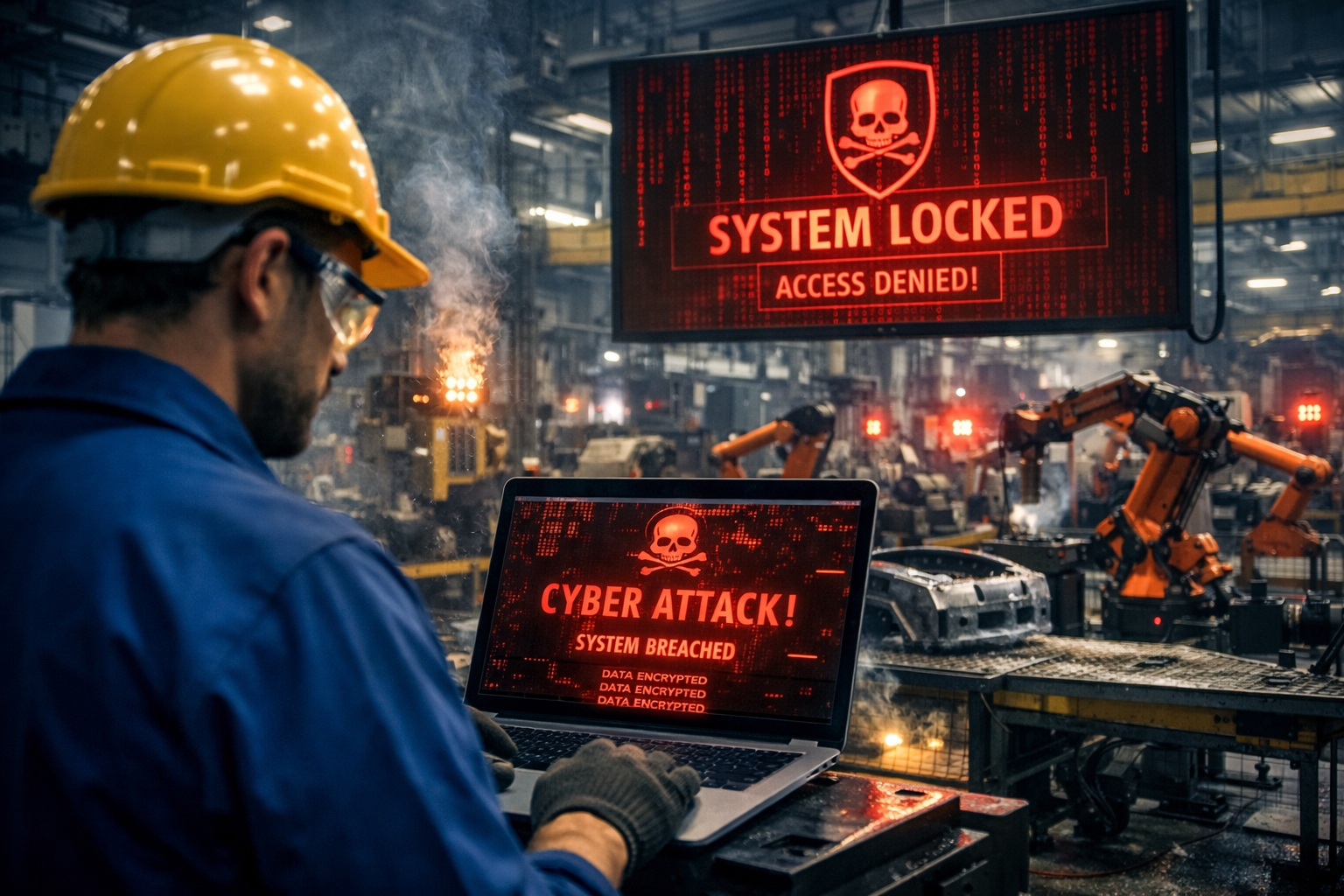
With the Integration Between IT and OT, More Remote Access and Legacy Systems Connected to What Never Should Be, the Industry Has Come Under the Target of Ransomware, Phishing, and Attacks Via Suppliers, and the Difference Between Continuing to Produce or Putting Out Fires Has Become a Matter of Preparedness.
Not long ago, many factories treated cybersecurity as something distant, like a theme of corporate IT, something stuck in the office, far from the production line. But the real world decided to give a push. Today, the factory floor is full of sensors, remote access, integrations, control software, mixed networks, and legacy systems that continue to operate because no one has the courage to stop the plant to change them.
Then comes the question that no one likes to face. If even gates, badges, cameras, and locks are part of physical security, why does the digital door remain open?
The reason is simple and somewhat cruel. It is easier to attack than to defend. And cybercrime does not choose “the biggest” for sport. It chooses the most vulnerable. When it finds a gap, it enters, spreads, and tries to corner the company. The favorite move of the moment is ransomware, as it turns the operation into a hostage situation and puts a timer on the executives’ heads.
-
Motorola launched the Signature with a gold seal from DxOMark, tying with the iPhone 17 Pro in camera performance, Snapdragon 8 Gen 5 that surpassed 3 million in benchmarks, and a zoom that impresses even at night.

-
Satellites reveal beneath the Sahara a giant river buried for thousands of kilometers: study shows that the largest hot desert on the planet was once traversed by a river system comparable to the largest on Earth.

-
Scientists have captured something never seen in space: newly born stars are creating gigantic rings of light a thousand times larger than the distance between the Earth and the Sun, and this changes everything we knew about stellar birth.

-
Geologists find traces of a continent that disappeared 155 million years ago after separating from Australia and reveal that it did not sink, but broke into fragments scattered across Southeast Asia.

In the industry, the impact is not just “data leaked.” The impact is machines stopping, orders freezing, trucks waiting, clients getting irritated, and losses growing in real-time. That’s why this topic is becoming news, and for many companies, turning into trauma.
Why the Industry Became a Target and Why That’s Getting Worse Quickly
The attack has become more common because the industry has become more connected. In the past, many machines were isolated, with local control and little external communication. Today, digital transformation has pushed the convergence between IT and OT. What was separate has become interconnected. And this increases the attack surface.
When an intruder enters through a phishing email, a weak password, a poorly configured remote access, or a forgotten server, they can start in the corporate network and eventually reach industrial systems. If there’s a poorly protected bridge between the two worlds, the factory ceases to be a difficult environment and becomes a profitable target.
The supply chain has also become a shortcut. A compromised supplier can carry malware along with software, a component, or an update. And the most dangerous part is that responsibility can become murky. The supplier makes a mistake, but it’s the manufacturer that stops production.
Another factor is cultural. IT teams tend to think about risk all the time. Meanwhile, OT teams need to maintain availability and efficiency because the goal is to keep things running. When these priorities don’t communicate, exceptions arise, permissions become too broad, and access remains eternal out of convenience.
In the middle of this scenario, one point stands out as a maximum alert. The finance sector has heavily invested in protection in recent years, while many industrial operations have fallen behind, pushing criminals to focus on those who still have easy gaps.
What Attacks Want and Why Ransomware Hurts So Much on the Factory Floor
Ransomware is the type of attack that hijacks systems and demands payment to release them. In a factory, it is devastating because it can lock down critical processes and force a poor choice. To stop and lose money or to pay and hope to recover everything.
Phishing helps open the door because it exploits the weakest link in any operation: people. Increasingly convincing messages mimic colleagues, suppliers, and internal systems. One click turns into an infection. A leaked password equals access. And the attack gains scale.
The worst part is the false sense of security. Some companies think they are not interesting enough because they don’t handle highly sensitive data. But if the company generates revenue and depends on machines running, it is already interesting. The criminal knows that stopping production becomes a bargaining chip.
At the center of this discussion, The Manufacturer cites the recent breach affecting Jaguar Land Rover as an example of alarm and reinforces a point that is valid for any industrial plant: even those with structure can suffer, and those who only do the basics become easy targets.
What Changes the Game in Practice: Three Moves That Reduce Risk and Accelerate Recovery
The idea is not to promise invincibility. That is fantasy. The goal is to reduce the likelihood of invasion, minimize damage when something happens, and shorten recovery time.
The first move is real prevention. Update systems, reduce permissions, segment networks, remove unnecessary access, eliminate weak passwords, and close obvious doors. It seems basic, but many factories still suffer from simple failures.
The second move is rapid detection and response. Continuous monitoring, alerts, and automation reduce the time an intruder spends in the environment without being noticed. The shorter that time, the less the damage.
The third move is to prepare for the worst without improvisation. Incident response plans, simulations, drills, penetration tests, and clear protocols to decide what to shut down, who to notify, and how to resume operations. Companies that only discover this during an attack tend to pay a higher price.
There is also the layer of cyber insurance, which can help cover losses, but it works best when the company can prove maturity and consistent practices. The insurer does not like an open door.
In the end, the industry is learning an uncomfortable lesson. Digital security is not an invisible cost. It is what prevents the factory from becoming headline news for the wrong reasons.







-

Uma pessoa reagiu a isso.