





 Portuguese
  English
  Spanish
  4 min of reading
  1 comment


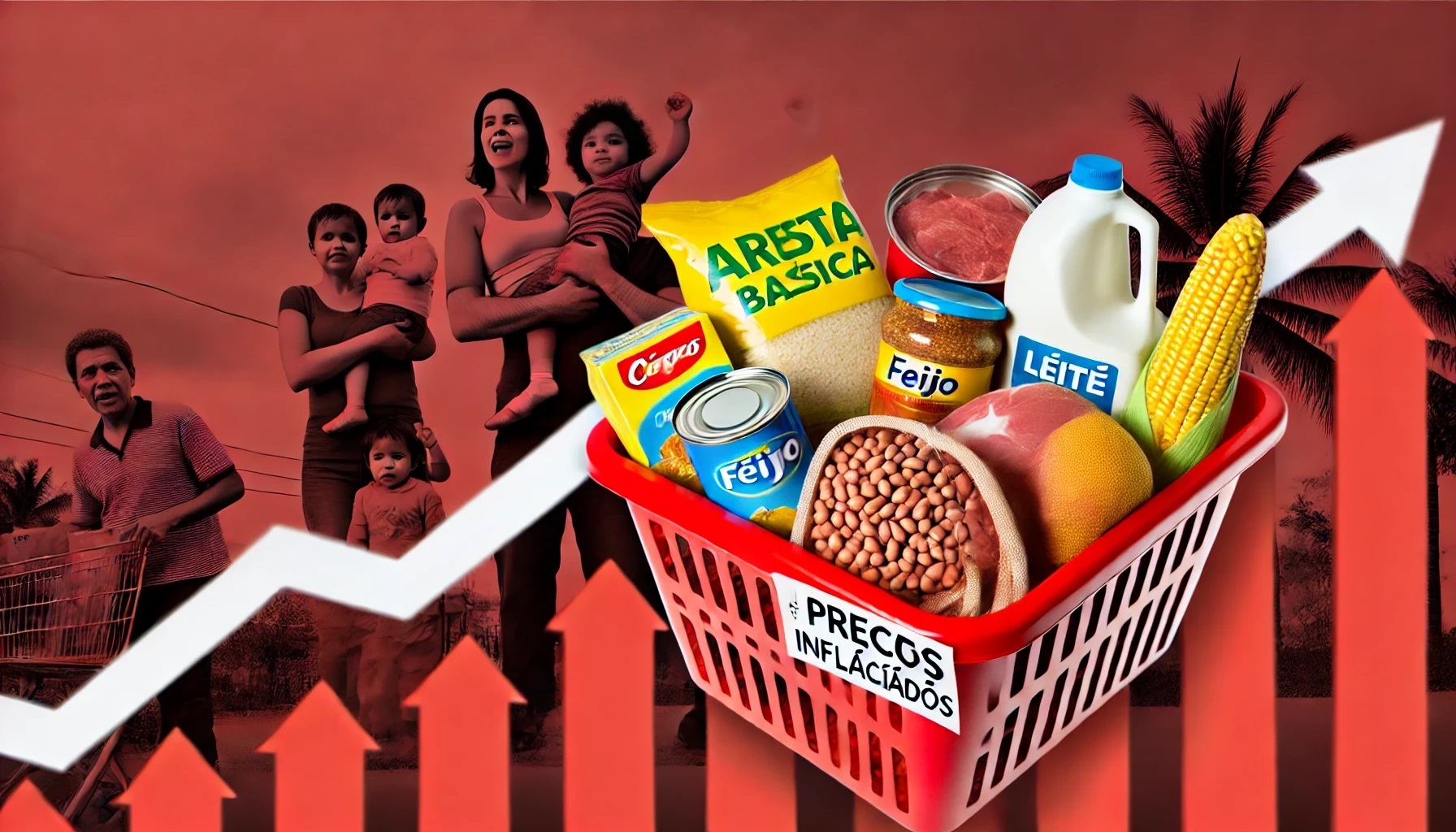

The Rise of Inflation in Brazil, Driven by High Food Costs, Concerns Experts and Affects the Brazilian Economy. The Impact on Families Is Increasingly Evident.
Inflation in Brazil has again raised concerns among experts and consumers. According to data released by IBGE, the Broad Consumer Price Index (IPCA) rose from 0.44% in September to 0.56% in October, accumulating 4.76% over the last 12 months. The index exceeded the upper limit of the target set by the Central Bank, putting the Brazilian economy on alert. This increase is mainly attributed to the rise in food and electricity costs, as well as the appreciation of the dollar.
With the end of the year approaching, the inflationary scenario complicates, and experts warn that the situation may remain challenging in 2024 and 2025. Let’s understand the factors driving inflation and what the projections are for the coming months.
What Is Driving Inflation in Brazil?
Inflation in Brazil has several causes, but some factors are more decisive. In October, meat prices rose 5.81%, the highest increase in four years, driving the IPCA. Additionally, the rise in electricity costs, driven by the yellow tariff flag, and the appreciation of the dollar against the real, which has already risen 17% this year, considerably contributed to the price surge.
-
Brazilian city bets on the business environment to generate jobs and attract investments in the energy sector — secretary reveals strategy at Macaé Energy 2026.

-
50 viaducts, 4 tunnels, 28 bridges, and 40 kilometers of bike paths: BR-262 in Espírito Santo will receive 8.6 billion reais for the largest engineering project in the state’s history, inspired by the Immigrant Highway in São Paulo.

-
Brazil produces too much clean energy and doesn’t know what to do with it: over 20% of solar and wind capacity was wasted in 2025 while investors flee and 509 renewable generation projects were abandoned in the last year.

-
Piauí will produce a new fuel that replaces diesel without needing to change anything in the truck’s engine and reduces pollutant gas emissions by half: truck drivers from all over the Northeast are already celebrating the news that will arrive later this decade.




According to economist Luiz Roberto Cunha from PUC-Rio, the exchange rate has a direct impact on internal prices, especially for imported products and agricultural inputs. With the dollar reaching R$ 5.77, production and distribution costs increase, putting pressure on the final price of products in retail.
Forecasts for 2025
The forecast for 2025 is not very promising. Despite the expectation of a record harvest, analysts indicate that food prices will continue to rise due to a combination of factors such as the high exchange rate and the mismatch between supply and demand. Sergio Vale, chief economist at MB Associados, highlights that food will be the main risk variable for inflation in the coming years.
This increase may be felt even more during the holiday season, when demand for food traditionally grows. Additionally, seasonal and climatic factors may worsen the situation, making it more difficult to control inflation.
Measures to Contain Inflation
With inflation in Brazil above the target, the Central Bank has adopted a stricter stance. Recently, the institution decided to raise interest rates by 0.5 percentage points, an attempt to contain the rise in prices. According to Sergio Vale, this measure is correct, but it will not be sufficient if the government does not present a robust fiscal package.
The need for fiscal adjustments is also highlighted by experts. The government, led by Minister Fernando Haddad and the president of the Central Bank, Roberto Campos Neto, faces the challenge of balancing public accounts and ensuring economic stability. A well-structured fiscal package could help contain inflationary pressure and stabilize the exchange rate, reducing the impacts of the dollar’s rise on internal prices.
Electricity and Hope for the IPCA
One piece of news that could temporarily relieve inflation is the reduction of the electricity tariff. With the expected change from the yellow tariff flag to green in December, a drop in prices is anticipated.
According to economist Luiz Roberto Cunha, this change could make the IPCA for November around 0.20%. Despite this, the reduction in the electricity bill is unlikely to be sufficient to bring the annual index below the upper limit of the target.
The global scenario also directly influences the Brazilian economy. The recent victory of Donald Trump in the U.S. presidential elections brought uncertainties about American economic policy, with forecasts of dollar appreciation. This movement could worsen inflation in Brazil, further increasing the cost of imported products.
The geopolitical environment, including tensions between Russia and Ukraine and climate challenges, also affects commodity and input prices. The Brazilian Central Bank closely monitors these factors, adjusting its monetary policy as necessary.
Projections for 2024 and 2025
Projections indicate that inflation in Brazil is expected to remain above the center of the target in 2024 and 2025. Economist Sergio Vale estimates that the IPCA will close 2024 around 4.7%, with an average variation of 0.38% between November and December of this year. For the following years, expectations remain above 4%, requiring continuous government measures to stabilize the economy.
Vale emphasizes that, without a robust fiscal package, inflationary pressure will persist. “It is up to the government to seek a different outcome for this situation,” concludes the economist.
The rise of inflation in Brazil is a challenge that requires attention and coordinated action between the Central Bank and the federal government. With the IPCA accumulated over 12 months exceeding the upper limit of the target, it is essential that fiscal and monetary measures are adopted to contain the pressure on prices.
The next year will be crucial for the Brazilian economy, with emphasis on the food and energy sectors, which will continue to impact consumers’ wallets. Stay alert to changes in the economic landscape and prepare for potential price adjustments. After all, inflation is a thermometer for the economic health of the country and directly affects the day-to-day lives of all Brazilians.
This article was produced with information from the newspaper O Globo.









Realmente, apesar de não ser economista, concordo com tudo. Porém, a festa do governo de gastar sem limites para acolher a companheirada toda, ministérios inúteis, viagens nababescas e corrupção generalizada e que não é de hoje, vai levar a nação ao fundo do poço. E quem viver, verá.