





 English
  Francês
  Alemão
  Italiano
  Japonês
  Norueguês
  Portuguese
  Spanish
  5 min of reading
  0 comments


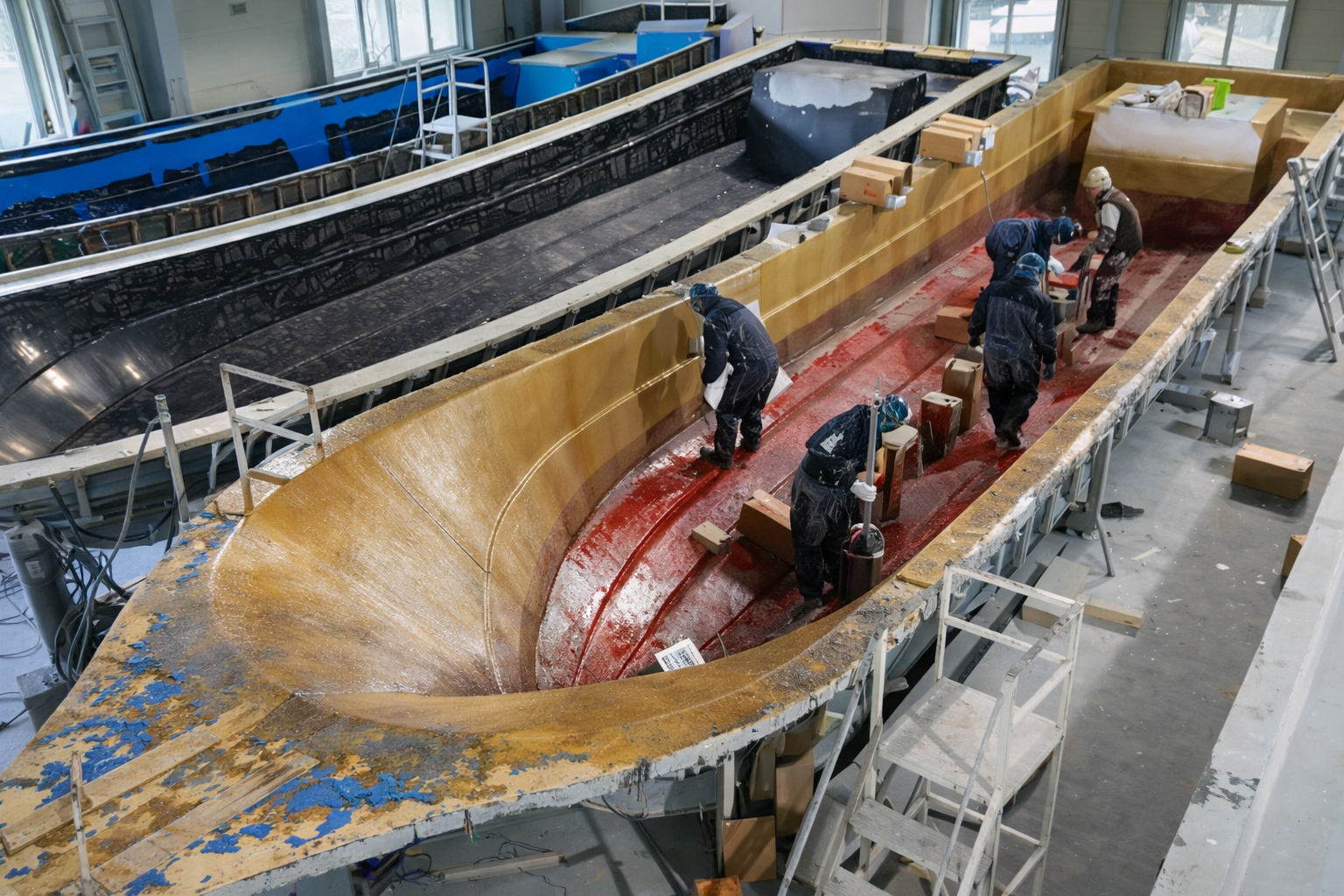
The process of a fiberglass boat factory shows how shipyards apply nautical engineering and impress with manual procedures and various materials
Inside a factory, what seems like just an empty mold quickly starts to take shape until it becomes one of the most used fiberglass boats in shipyards. The process draws attention for its level of detail and the manual work involved in each step.
The images released by Process K, a channel that records industrial processes with a technical focus, show how nautical engineering happens in practice, without shortcuts. Each layer applied defines the final result of the structure.

The impact of this goes beyond curiosity. This type of production explains why fiberglass boats manage to combine lightness with strength, something essential for continuous use in demanding environments.
-
Seen from space, a colossal ‘Y’ cuts through the largest desert in China, blending a jade-filled river, red and white mountains, and revealing the absurd scale of the transformation of the Taklamakan surrounded by a green wall with billions of trees.

-
The Pacific Ocean reveals what the cliffs of Big Sur have hidden for millennia: Pfeiffer Beach, in California, features swirling purple sand formed by garnet crystals and displays a stone arch that is illuminated by the sun in winter for just a few days each year.

-
Aursjøvegen in Norway is a 100-kilometer gravel road that crosses chasms and dark tunnels carved into the rock at an altitude of 947 meters in the fjords and is only open for four months a year.

-
With about 4,000 m², the building constructed in a traditional neighborhood in France looks like a rainbow, has a colorful facade, mixes vibrant glass, and creates one of the most unusual visuals in Bordeaux.


Initial mold defines the entire shape of fiberglass boats
Everything starts with a rigid mold, already with the complete design of the hull. Inside the shipyards, this mold serves as the base for all the fiberglass boats produced in the factory.
In practice, the surface receives a liquid layer applied with a brush and roller. This first contact already requires precision because any flaw there shows up in the final finish of the hull.

The result of this step is a smooth and uniform base, which will serve as a reference for all the subsequent layers. It is at this moment that the external shape of the boat is practically defined.
The care is visible. The surface gains shine and regularity, showing that control at this stage directly influences the final result.
Fiberglass mats come in and show how nautical engineering works
With the mold prepared, the fiberglass mats are placed as flexible sheets over the structure. This is where nautical engineering begins to appear more evidently.
The execution follows a clear pattern. The mat is placed, resin is applied, and a metal roller moves across the entire area pressing the material. This movement is repeated several times.

The effect is immediate. The structure begins to gain thickness and strength, ceasing to be just a thin layer. The hull gains more consistency with each application.
The work rhythm is noteworthy. The roller does not stop, ensuring that the mat stays well adhered and without visible flaws.
Successive layers transform the mold into a rigid hull
Inside the factory, the process continues with the repetition of layers. More mat, more resin, more pressure. This is how fiberglass boats gain real strength.
In execution, everything follows the same pattern but with more intensity. The layers accumulate until they completely cover the mold, creating a thicker assembly.
The result appears in the rigidity of the structure. The hull begins to maintain its shape even before being removed, showing that the construction is already consolidated.
The environment also reveals the rhythm. Tools used, scattered waste, and constant movement indicate that the process does not stop.

Internal reinforcements increase stability in shipyards
At a specific moment, internal elements come in that reinforce the structure. These are pieces positioned inside the hull still in formation.
The application follows the same principle. These parts receive resin and, thus, are covered with mat, becoming fully integrated into the assembly.
The effect is a firmer structure, with internal support that helps maintain the shape. This is part of the logic of nautical engineering, which seeks balance and strength.
The images released by Process K, a channel specialized in detailed industrial processes, show, therefore, the care in aligning these pieces before fixation.
Finishing adjusts the surface of fiberglass boats
After the structure is ready, finishing begins. The fiberglass boats already have shape, but still show marks from the previous process.
In practice, abrasive tools and material application come in to level the surface. The work thus traverses the entire hull continuously.
The result is a more uniform appearance, with fewer visible imperfections. The structure now has a cleaner finish.
The environment changes at this stage. Dust and waste appear, showing that fine-tuning requires constant effort.
Removing the mold reveals the finished boat inside the factory
The final step shows the separation of the hull from the mold. It is the moment when the work done inside the factory is fully revealed.
The removal happens carefully, using tools to avoid damage. Gradually, the hull detaches and reveals its final shape.
The visual impact is clear. What was just an empty mold transforms, therefore, into a complete boat, with a rigid structure and defined finish.
This transition makes evident the entire process applied in the shipyards, from start to finish.
Process shows the strength of applied nautical engineering in practice
What is seen throughout the production is, therefore, a method based on repetition and precision. Fiberglass mat, resin, and manual roller form the basis of everything.

Each step directly influences the final result. The way the layers are applied defines, therefore, the quality of the structure.
This type of production shows, thus, how nautical engineering can transform simple materials into robust vessels. And reinforces the role of manual labor within a modern factory.
In the end, it becomes clear that it is not just the material that matters. The process and the care in every detail make all the difference.
Did you enjoy seeing how these boats are made in practice? Leave your comment and share with those who are also interested in engineering and industry!









Seja o primeiro a reagir!