





 Portuguese
  English
  Spanish
  6 min of reading
  0 comments


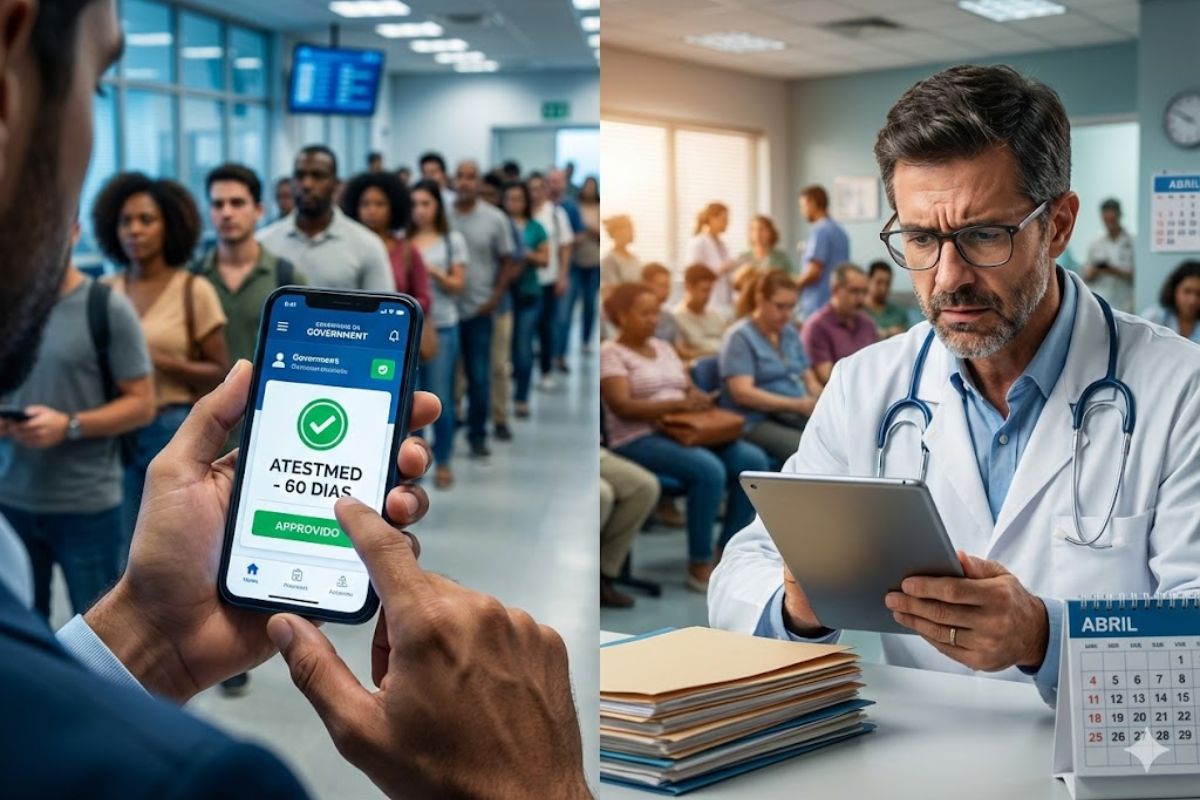
New INSS Act Exceptionally Extends Sick Leave Without In-Person Examination From 30 to 60 Days Until April, Seeks to Relieve Line of 2.9 Million Insured and Intensifies Conflict With Experts, Who See Risk of Fraud and Explosive Pressure on Spending on Digital Atestmed and Public Accounts.
The INSS published new regulations that doubles the maximum period for sick leave granted without in-person examination by the Atestmed system from 30 to 60 days, for requests made through Meu INSS. The measure is exceptional, valid only until April, and aims to address the line of 2.9 million insured individuals waiting for a decision from the agency in October, amid pressure to reduce wait times.
The changes come after two years of back-and-forth on the Atestmed rules and recent amendments to legislation approved in November, which had set the limit for remote requests at 30 days. While the government hopes that the temporary extension of the period can alleviate the medical examinations and expedite approvals, associations of experts and specialists warn of structural flaws in the model and talk about a possible future explosion in spending.
Sick Leave Period Changes Again in Atestmed
In the regulations, the INSS confirms that the original sick leave period via Atestmed remains 30 days, but opens up the possibility for exceptional extensions, as long as they are technically justified by the Ministry of Social Security.
-
Brazilian city bets on the business environment to generate jobs and attract investments in the energy sector — secretary reveals strategy at Macaé Energy 2026.

-
50 viaducts, 4 tunnels, 28 bridges, and 40 kilometers of bike paths: BR-262 in Espírito Santo will receive 8.6 billion reais for the largest engineering project in the state’s history, inspired by the Immigrant Highway in São Paulo.

-
Brazil produces too much clean energy and doesn’t know what to do with it: over 20% of solar and wind capacity was wasted in 2025 while investors flee and 509 renewable generation projects were abandoned in the last year.

-
Piauí will produce a new fuel that replaces diesel without needing to change anything in the truck’s engine and reduces pollutant gas emissions by half: truck drivers from all over the Northeast are already celebrating the news that will arrive later this decade.


In practice, until April, absences granted solely based on document analysis may last up to 60 days, without the requirement for an in-person medical examination.
This is not the first change in direction. Until June of this year, workers could obtain leave for up to 180 days through Atestmed.
Then, a provisional measure that raised the IOF lowered the limit to 30 days. Internal disputes within the government led to an extension of the period to 120 days, but law 15,265 definitively set the ceiling back to 30 days, now temporarily relaxed by the new regulations.
Created during the Covid-19 pandemic, the automatic sick leave without in-person examination has been expanded in 2023 and 2024 by then-Minister of Social Security Carlos Lupi and former INSS President Alessandro Stefanutto.
The goal was to reduce the backlog of evaluations with a faster digital triage, but the model has also been pointed out as a source of control problems and rising expenses.
INSS Line Exceeds 2.9 Million and Average Wait Reaches 62 Days
Official numbers show the extent of the pressure. In October, the INSS line reached 2.9 million insured individuals awaiting a response.
There were 1.2 million pending requests in the medical examination line, according to data from the Social Security.
When adding insured individuals who still need to undergo a medical examination through a requested review, the total reaches 1.6 million people.
The official statement reports that, out of the total of 1.2 million requests in the examination queue, 525,323 insured are waiting for assistance for up to 45 days and 373,762 are waiting up to 90 days.
The average waiting time today is 62 days, more than double the new maximum period for automatic leave now authorized.
The government claims that the changes aim to bring more agility to the granting of temporary incapacity benefits, preventing the insured from spending months waiting for an in-person examination when the case can be resolved with document analysis.
At the same time, pressure on benefits spending increased in 2025, and public accounts became a central point in the dispute surrounding Atestmed.
Complementary Examinations Paid by INSS and Expansion of Digital Services
One of the regulations stipulates that the INSS will fully cover complementary examinations requested by medical experts, at three different times during the benefit: initial granting, review, and any reinstatement.
The rule provides for two ways of execution, either through direct reimbursement to the insured or via partnerships with accredited clinics to perform the procedures.
Another front is the expansion of digital services. Social Security has extended the deadline for a test initiated in August to allow part of the insured to be attended to in specific services without the need for prior scheduling through Meu INSS or Central 135.
The idea is to reduce bottlenecks in high-demand services, such as guidance, document receipt, and adjustments to already submitted requests, creating a faster entry point for those who only need simple procedures.
According to the government, these measures, combined with the new period for sick leave without examination, form a package to expedite evaluations, improve service flow, and reduce the backlog of temporary incapacity benefits.
The reaction from the expert community, however, shows that there is no consensus on the safety and sustainability of the digital model.
Experts Criticize Atestmed and Talk About Future Explosion in Spending
ANMP, the national association representing medical experts, reacted strongly to the regulations. The vice president of the entity, Francisco Eduardo Cardoso, claims that Atestmed is not comparable to a real examination and increases pressure on public accounts.
For him, it is merely a document analysis of patients who would have conditions to attend a physical evaluation.
The leader criticizes the notion that it is possible to extract, solely from paper, information that in practice only emerges during the interview and physical examination conducted in a clinic.
In his words, “you cannot extract from paper information that can only be obtained in an in-person examination”, which, in the association’s view, undermines control and quality of approvals.
Cardoso also states that the government insists on a model that has already shown flaws. He sees a temporary decrease in the queue followed by an “unavoidable explosion” of problems, either through increased spending or the need for future reviews.
ANMP states it will go to court and to the Federal Medical Council to formally register the alert about possible system flaws and the technical responsibility involved.
Experts Point Out Where Sick Leave Without Examination Works and Where It Does Not Work
On the other side of the debate, social security experts recognize limits but see gains in certain situations.
Lawyer Adriane Bramante, a counselor of OAB-SP and IBDP, assesses that Atestmed has been effective in simpler leave cases, where the clinical picture is clear, the period is short, and the documentation presented is sufficient to prove temporary incapacity.
In these cases, the digital model prevents the insured from remaining in the medical examination queue for long periods, without income and without an expected time for service.
The lawyer emphasizes, however, that “even though Atestmed exists, there are many cases that require examination”. Among the benefits that necessarily require an in-person medical examination are retirement due to permanent incapacity, the Continuous Cash Benefit for persons with disabilities, and special retirement, which depends on detailed analysis of reports and examinations regarding work conditions.
In practice, the discussion is not whether the INSS should or should not use digital tools, but how far sick leave without examination can go without compromising technical rigor. The extension of the period to 60 days until April is seen as a test of limits: on one side, the urgency to reduce queues; on the other, the obligation to preserve the sustainability of the system and the trust of the insured.
In your opinion, is the INSS correct in extending sick leave without in-person examination to 60 days, or does this decision simply push the problem to later and increase the risk of uncontrolled spending?








-

-

-

3 pessoas reagiram a isso.