





 Portuguese
  English
  Spanish
  4 min of reading
  0 comments


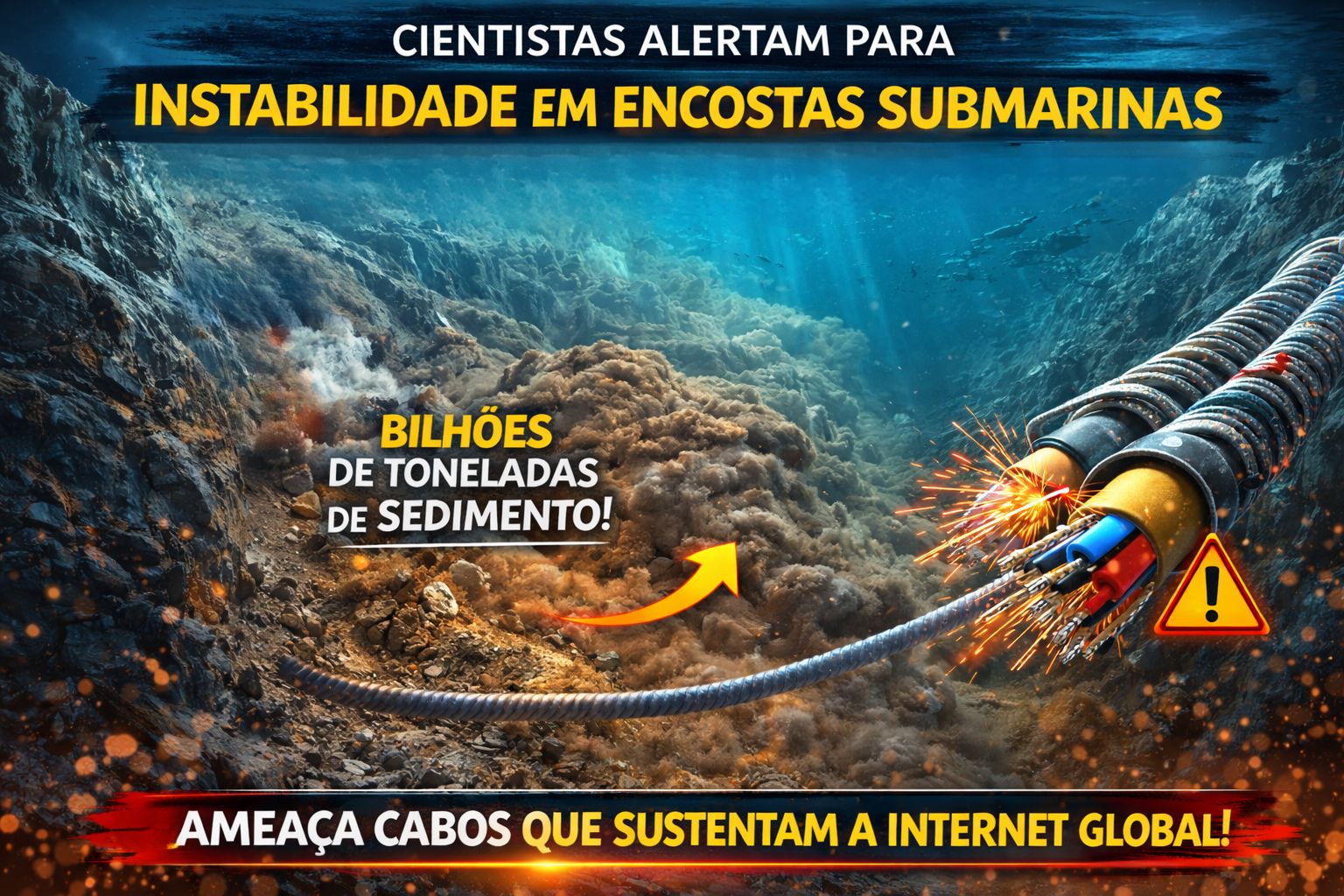
Studies Indicate Risk of Underwater Landslides in Deep Slopes That Can Break Fiber Optic Cables and Affect Global Digital Infrastructure.
Thousands of meters below the ocean’s surface, far from sunlight and invisible to satellites, there are underwater slopes as unstable as continental mountains subject to landslides. At depths that can exceed 3,500 meters, large volumes of sediment accumulate along continental margins and oceanic slopes. When these masses lose stability, the result can be a submarine landslide capable of displacing billions of tons of material in a matter of hours.
Research in marine geology and historical records confirm that these events are not hypothetical. They have occurred several times throughout recent geological history and, in some cases, have caused direct impacts on infrastructures installed on the seafloor.
What Are Submarine Landslides and Why Do They Occur at Great Depths
Submarine landslides are gravitational movements of sediments that occur on the ocean floor, usually on steep slopes of continental margins. These events can be triggered by:
-
Archaeologists discover in China a 5,000-year-old tomb with over 350 artifacts, nearly 200 jades, and signs of intentional destruction, in a discovery that could be the gateway to a lost prehistoric kingdom.

-
A vacuum robot with a five-axis mechanical arm capable of picking up objects from the floor, avoiding obstacles in real time, and continuing to clean on its own inaugurates a new generation of appliances that see, think, and act within the home.

-
Geographers redefine the Brazilian relief and confirm the presence of mountains in 14 states with a new system that changes historical criteria and alters the way the territory is classified.

-
At a depth of 3,800 meters in the Atlantic, scientists have discovered a “lost city” with white towers up to 60 meters tall that has been active for over 120,000 years without relying on volcanoes.

- Underwater earthquakes
- Excessive accumulation of sediments
- Instability caused by gas hydrates
- Rapid changes in pressure or in the composition of seabed soil

At great depths, such as 3,500 meters, the environment is characterized by high pressures and low temperatures. Nevertheless, the seabed is not a static surface. It consists of layers of sediment deposited over thousands or millions of years, which can lose cohesion under certain conditions.
When stability is disrupted, the mass slides down the slope, generating what geologists call a turbidity current — a mixture of water and sediment that can travel hundreds of kilometers on the ocean floor.
Turbidity Currents Can Travel Thousands of Kilometers
Turbidity currents act like “submarine avalanches.” After the landslide begins, the flow accelerates due to gravity and can reach high speeds, carrying fine particles and blocks of sediment over long distances.
One of the most documented cases occurred in 1929, following an earthquake in the Grand Banks region of the North Atlantic. The event generated a submarine landslide that successively broke several telegraph cables on the ocean floor. The series of failures allowed for the calculation of sediment current velocity, revealing the force of the phenomenon.
Modern studies indicate that these flows can displace gigantic volumes of material, completely reorganizing the seafloor relief.
Submarine Cables: The Invisible Infrastructure That Connects the Planet
More than 95% of international data traffic flows through submarine fiber optic cables installed on the ocean floor. There are hundreds of systems linking continents, responsible for banking communications, financial transactions, streaming, social networks, and government systems.
While many damages to cables occur in shallow waters due to human activity, deep areas also present natural risks. Unstable slopes pose a direct threat, as a single landslide can hit multiple cables simultaneously.

In areas where cables cross continental margins, submarine valleys, and slopes, vulnerability increases. If a large-scale event occurs in a strategic area, the interruption of communications can affect entire countries.
Billions of Tons of Sediment: The Scale of the Phenomenon
The magnitude of some recorded submarine landslides is comparable to major terrestrial events. In certain continental margins, unstable deposits accumulate significant thicknesses of fine sediment. When rupture occurs, the mobilized volume can reach billions of tons.
This displacement not only alters the seafloor topography but can also trigger:
- Tsunamis in extreme cases
- Damage to offshore energy infrastructure
- Breakage of telecom cables
The geological scale of these events reinforces scientific interest in mapping risk areas with greater precision.
Monitoring and Ongoing Geological Studies
Research institutions use marine seismic, multibeam sonar, and scientific drilling to identify potentially unstable areas on the ocean floor. The goal is to understand:
- Thickness of sediment layers
- Presence of geological faults
- Influence of methane hydrates
- History of previous events
Technological advances have allowed for extensive mapping of oceanic regions, revealing that submarine slopes are more dynamic than previously thought decades ago.
Potential Impacts on Global Infrastructure
The global dependence on submarine cables makes the subject strategic. A geological event in a critical area can provoke:
- Temporary interruption of internet services.
- Reduced speed of international transmission.
- Impacts on financial systems and corporate communication.
Although there is redundancy in the global network — with multiple alternative routes — simultaneous events or in strategic points can generate temporary instabilities.
Submarine Slopes and Climate Change
Some studies investigate whether climate change and changes in ocean circulation could influence the stability of marine sediments. The increase in ocean temperature may affect gas hydrates present in the seabed, potentially altering the cohesion of sediment layers.
Even though the topic is under investigation, it broadens the debate on the vulnerability of critical infrastructures in the face of complex natural processes.

Submarine landslides at depths greater than 3,500 meters are real phenomena documented by marine geology. These events can displace gigantic volumes of sediment and generate turbidity currents capable of reaching infrastructure installed on the ocean floor.
With the increasing dependence on submarine cables for global communications, the study of these instabilities has moved from being merely an academic concern to integrating strategic discussions about digital security and the resilience of international infrastructure.
The dynamics of the ocean floor, often invisible to the public, continue to be one of the natural factors with the potential to impact technological systems that support the contemporary global economy.






Seja o primeiro a reagir!