





 Portuguese
  English
  Spanish
  8 min of reading
  0 comments


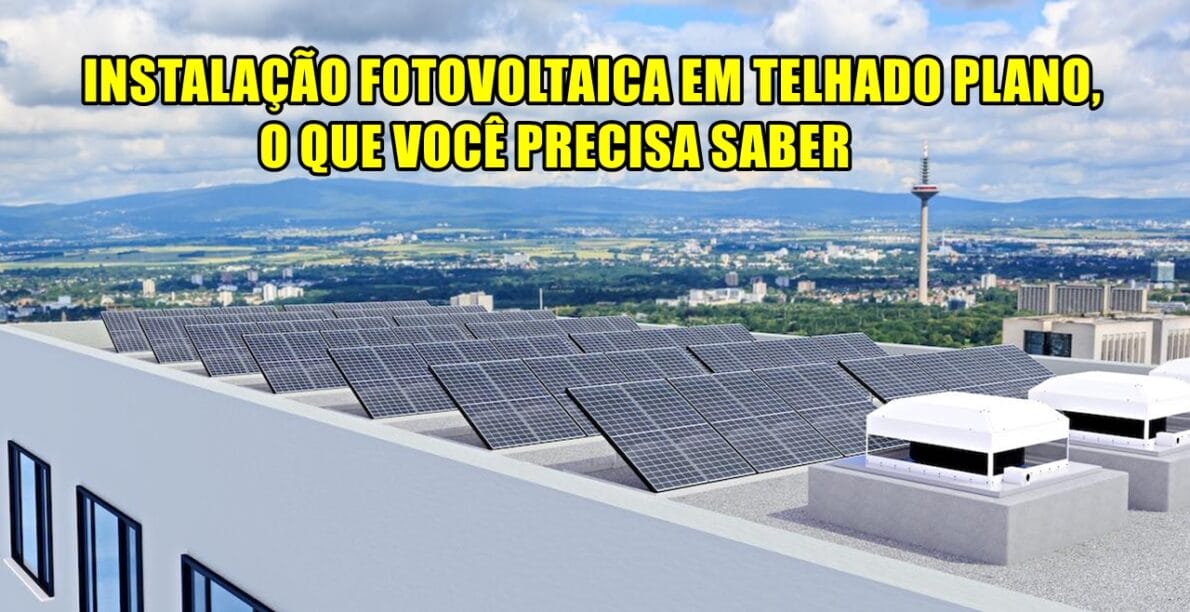
Install Solar Panels on Flat Roofs Effectively. Make the Most of Solar Energy! Click Here and Check It Out!
If you have a flat roof, you can also install a photovoltaic system for self-consumption. The roof’s inclination can influence performance of the installation, but there are ways to simulate this inclination artificially. By the way, a flat roof even offers some advantages for generating solar energy.
Yes, in most cases, you can install photovoltaic solar panels on a flat roof without any problems. Most modern buildings have flat roofs, and it is possible to install solar panels on top of them. However, there are some differences between solar systems on flat roofs and pitched roofs.


Solar panels placed directly on the roof would have lower energy efficiency. Engineers solve this by mounting them on angled metal structures, which are known as solar panel mounting systems. With the right adjustments, it is possible to make solar panels for flat roofs work effectively, potentially even more effectively than on a sloped roof structure.
-
The Brazilian state accelerates industrial competitiveness with a focus on the extraction of strategic minerals to boost the energy transition in Goiás.

-
Seagri’s headquarters invests in solar energy with Neoenergia Coelba and promises to cut electricity costs, highlighting a strategic advance in sustainability and energy efficiency within state public administration.
-
A Canadian retiree creates a hydroelectric system on a real river, generating energy continuously throughout the day and demonstrating how the power of water can supply a house with stability even in a simple structure.

-
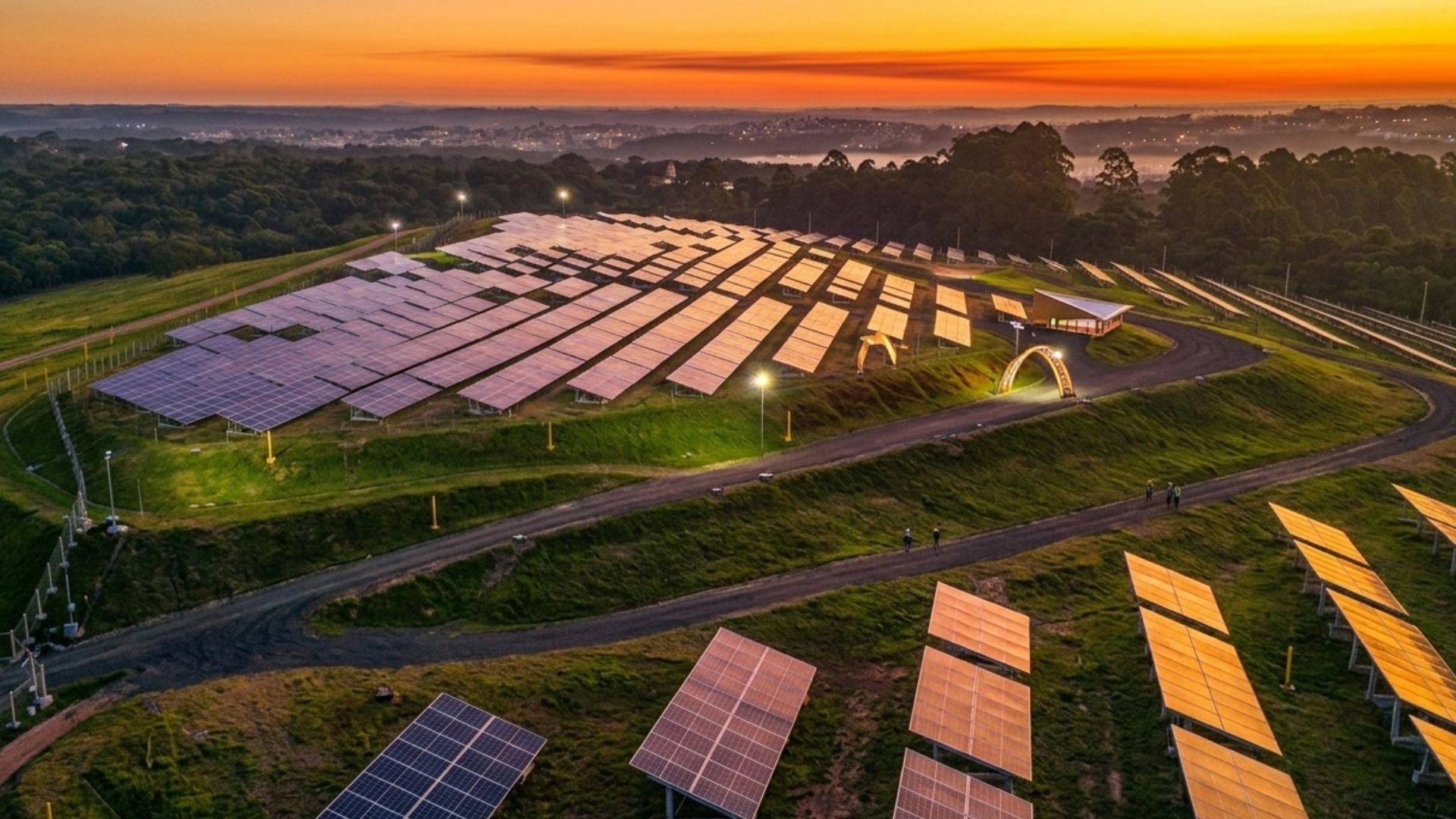
Solar Pyramid draws attention by converting solar energy into million-dollar savings and repositioning the City Hall of Curitiba as an example of innovation, sustainability, and intelligent use of public resources.

A solar panel installation of this kind is always better performed by industry specialists who understand the sun’s location and the angles of solar panels to achieve the best energy generation results.
Installation of Solar Panels on a Flat Roof
For a photovoltaic installation to produce the highest possible yield of solar electricity, the solar modules must be installed so that the sun’s rays hit them as optimally as possible.
A south-facing roof with no shades and a roof angle between 30 and 35 degrees is considered ideal basic requirements for efficient solar energy generation. However, it is also possible to install a solar system on a flat roof with good performance. Some basic points must be considered.
We start from the premise that solar modules can also be installed on a flat roof. The larger the roof surface, the more space there will be for the modules. This influences the amount of solar electricity we can produce.
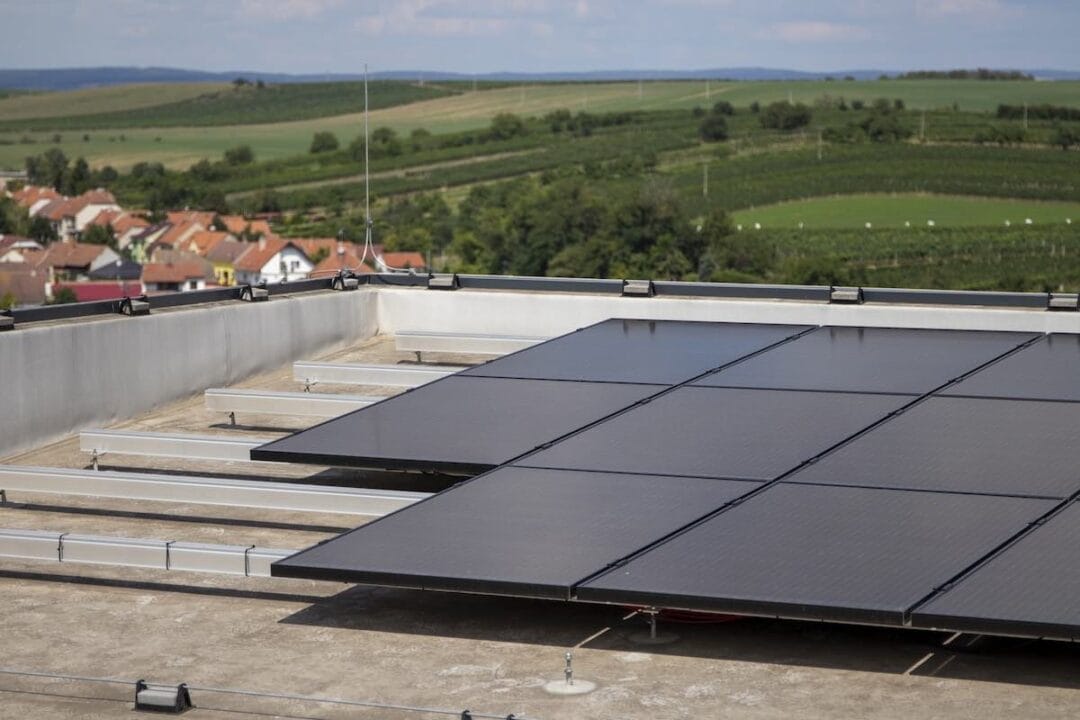
The incidence of sunlight is not ideal on a flat roof. For solar modules to produce electricity more efficiently, there is the option of support devices. By elevating the solar modules, an artificial slope is created for the sun’s rays to hit the solar modules better.
Before installing a photovoltaic system, you should talk to a specialist to check the feasibility of your house’s roof. The supports for solar modules on a flat roof represent a greater weight.
Furthermore, elevated solar modules are usually installed with a certain distance between them to avoid shading. If you live in a cold climate area, in winter, this can leave snow between the modules. This also represents additional weight, which should be considered before proceeding with the installation.
The space between the solar modules offers the possibility of better utilization of the roof. Placing vegetation on the surface has the advantage of providing cooling to the solar modules in summer. This can have positive effects on solar energy generation. Seek advice on this.
You should consider that if your house is a protected building, the installation of a solar system, whether on a sloped or flat roof, must comply with stricter regulations. Therefore, the processes will be more complicated.
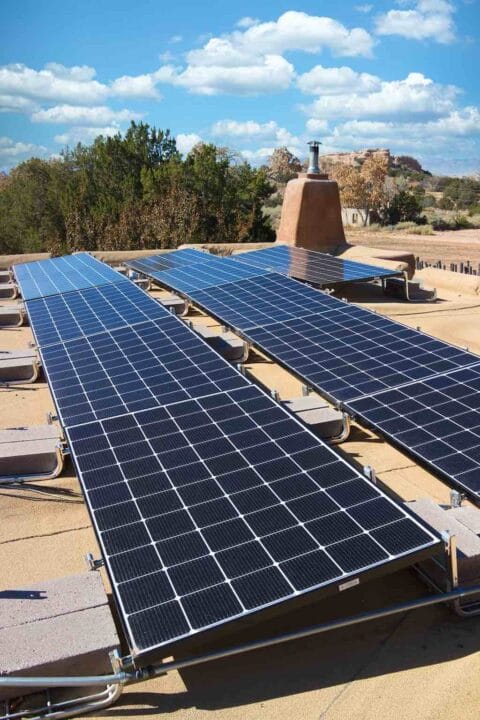
To install the photovoltaic system on a flat roof in the best and safest way possible, it is much more advisable to have it installed by a professional.
On flat roofs, a surface area of up to 30m² may be needed to achieve 1kWp.
This figure varies depending on the type, size, and power of the module. A photovoltaic system on a flat roof requires approximately three times the surface area of a pitched roof, as horizontal solar modules lose efficiency due to a worse angle of sunlight incidence and therefore more modules need to be mounted to achieve the same production.
For the same reasons related to surface area calculation, it is difficult to give a fixed price for solar systems on flat roofs and to determine the payback time.
Photovoltaics: The Advantages of a Flat Roof
The installation of a photovoltaic system on a flat roof also offers us some advantages.
One of the biggest advantages of a flat roof is that support structures allow for greater flexibility in installation. Solar modules can be individually adjusted and aligned to create an ideal angle for sunlight. This increases electrical yield.
Since there are no tiles on flat roofs, there is no need to remove them before installation. This speeds up the system installation and reduces the installation price.
On a flat roof, installation is easier than on a sloped roof. Therefore, as a general rule, scaffolding can be dispensed with. This reduces installation costs.
Inspection, maintenance, and cleaning of solar modules are also easier on flat roofs than in houses with sloped roofs.
Solar Energy: The Disadvantages of a Flat Roof
There are several disadvantages that we should be aware of.
One disadvantage is that elevated solar modules are more susceptible to wind. Wind has the advantage of cooling the modules, but a storm can affect them. Therefore, photovoltaic panels must be firmly anchored to the roof. There is the option of fixing the modules with or without penetration into the roof.
The electrical yield depends on the roof size. The larger the roof surface, the more solar modules can be installed, resulting in more electricity production. Elevated photovoltaic modules must be mounted so that there is no shading. Due to the distance, it is often possible to mount fewer solar modules on the roof than on a sloped roof with the same surface area. This means lower electrical yield.
In winter, snow slides less off a flat roof and stays between the solar modules with a support structure. Snow can also cast shade on the modules and thus cause reduced electricity production. Therefore, depending on the amount of snow, you would have to remove it.
Although mounting on a flat roof is easier and therefore cheaper, the support devices, structures, and mounting materials often increase the total cost of the photovoltaic system compared to a pitched roof.
7 Things You Should Know Before Installing Solar Panels on Flat Roofs
1 – Orientation Matters: The sun is constantly moving. It rises in the east and travels across the sky until it sets in the west. Its position along the horizon also changes depending on where you are in the world and the time of year. This is important because the sun’s rotation affects how much energy is harvested by solar panels! Don’t worry. The good news is that you can address this by changing the orientation of your solar panel. So, what is the best position for solar panels? It is believed that panels facing east or west are about 20% less efficient. For optimal energy production in the UK, solar panels on your homes should be oriented south.
2 – Angle Adjustments Are Necessary: In addition to orientation, there is also an ideal tilt for solar panels. For those with flat roofs, it is essential to use solar mounting structures to allow the panels to rest at an appropriate angle to capture the daylight they need to generate energy. In summer, the sun is higher in the horizon. In this case, a solar panel with a lower angle is best. On the other hand, a vertically inclined panel is more efficient in winter. Additionally, the angle increases the further you are from the equator. There are solar panels with adjustable tilt available. If you have an adjustable structure, you can change the angle of your solar panels throughout the year to better adapt to the season, although an angle of 35 degrees is generally considered the most efficient if you prefer to install your panels on a flat roof and then leave them alone.
3 – Factor in Water: Tilt is not only useful for increasing efficiency. It can also reduce water complications. Did you know that rain can be a problem for flat roof installations when flat roof systems do not involve a support? Without proper tilt, water cannot slide off. This means that mounting a solar panel directly on a flat roof can cause water accumulation, so solar panels installed on a flat roof will need special consideration. You should avoid water accumulating on the solar panels, as this can cause irreparable damage. Installing drainage devices on flat roof solar panels is a great solution, but changing the angle also works.
4 – Consider Maintenance: In general, solar panels are self-cleaning. Whenever it rains, water can wash away dirt and dust. It is worth mentioning that a solar panel system on a flat roof may require more frequent cleaning, maintenance, and repairs. If you have a low-angled setup, rain can accumulate rather than wash away the panels. As a result, you may need to manually wash your installation from time to time to keep your photovoltaic solar modules in good condition and check for signs of accumulation in adverse weather conditions.
5 – Consider Wind Speed: Wind can be a problem for photovoltaic solar systems on flat roofs. This is because they are not placed close to a surface, as is the case with panels installed on pitched roofs. For those with flat roofs, it is advisable to consult professionals about the proper size, tilt, and spacing of the panels to combat wind. In most cases, it is necessary to use weights to prevent the panels from flying off the roof. Having a stable metal structure also helps.
6 – Remember to Consider Weight: Ballasts are heavy materials that contribute to the balance and stability of the solar system. They are essential for flat roof setups because they counterbalance the weight of the angled panels. You can use sand, gravel, or cement to stabilize the panels without making roof penetrations. Metal structures are also excellent for a more robust mounting system. Unfortunately, using ballasts and metal structures has a downside. Your roof has a weight limit and may not be able to support excessive weight; investigate this and ensure you have adequate roof guarantees for your new and heavy installation as well.
7 – Prices Can Vary: Are solar panels for flat roofs more expensive? Supports, drainage solutions, and additional structural supports can increase the cost of your new solar system. Additionally, you may need to repair the roof to support the weight of the system. Because of this, solar panels for flat roofs can be more expensive. Of course, the price still varies depending on your circumstances. The upside is that it is safer and simpler to install than solar panels on pitched roofs. No special equipment is needed to install them.










Seja o primeiro a reagir!