





 Portuguese
  English
  Spanish
  5 min of reading
  1 comment


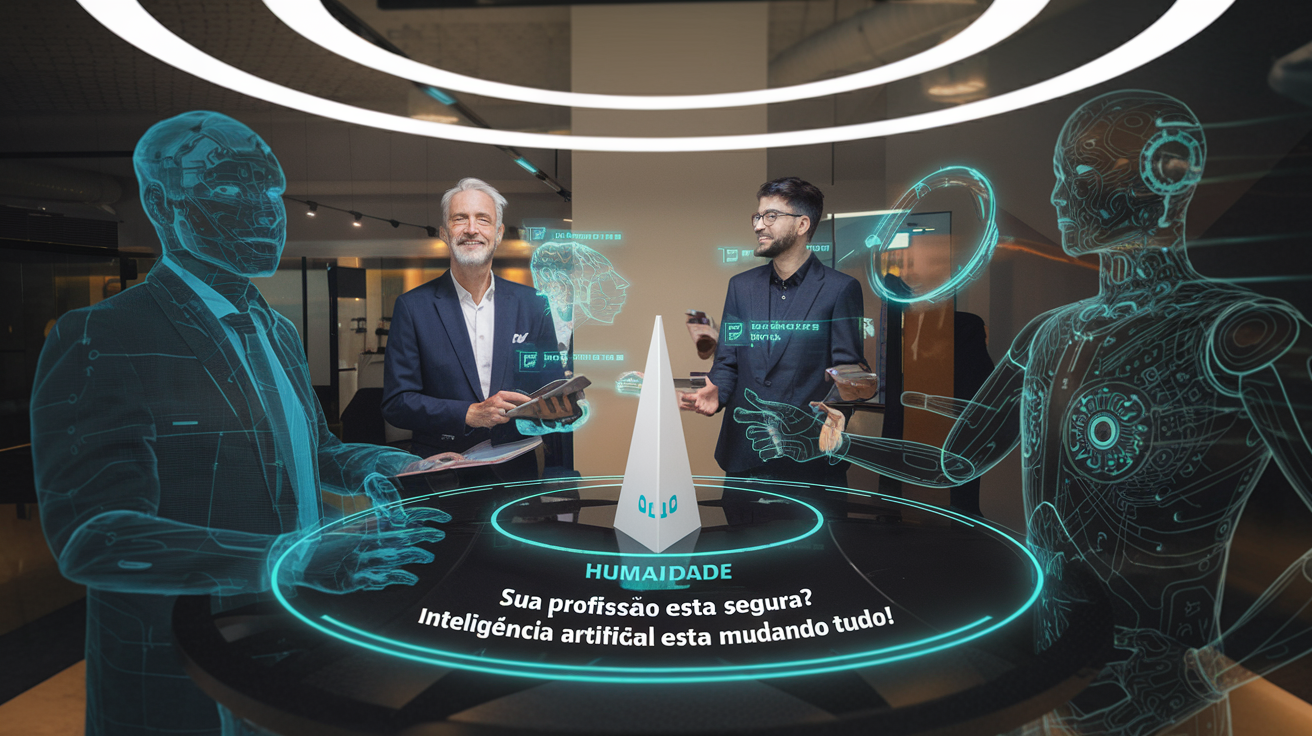

The Job Market Is Being Transformed By Artificial Intelligence, And 300 Thousand Professionals Will Need To Change Jobs In The Coming Years. In Brazil, There Will Be 16 Million. Find Out Which Sectors Are Most Threatened And How Human Skills Can Be The Key To Survival In This New Scenario.
In the coming years, the job market in Brazil and worldwide will undergo profound and irreversible changes.
Innovative technologies and the rapid advancement of Artificial Intelligence (AI) are reconfiguring the professional landscape, threatening established careers and opening paths for new demands.
However, the true extent of these transformations and who will be the main affected remain open and challenging questions.
-
Future profession with immediate earnings: Specialist reveals how a solar energy technician earns R$ 8,000 per month by taking advantage of the explosion in demand across the entire country.

-
Work from 8:30 AM to 5:30 PM with a 1-hour break at Sicredi as a Customer Service Assistant and receive a salary + benefits such as life insurance, dental plan, partnerships, Gympass, and much more in job openings across various states.

-
Subsea7 has job openings: the company has offshore and onshore positions available in 2026 for operators, pilots, supervisors, engineers, and much more.

-
Unimed is hiring candidates with and without experience! More than 10 job openings for Assistants, Analysts, Kitchen Assistants, and much more!


A Warning in Espírito Santo: 300 Thousand Workers Affected
According to a study released by the McKinsey Global Institute, up to 300 thousand professionals will need to change jobs in Espírito Santo in the next six years, a direct result of the evolution of AI and digitalization.
On a national level, the impact will be even more significant, with around 16 million workers needing to reskill or seek new careers, representing 14% of the total workforce in Brazil.
Global Futurist Jaqueline Weigel, A Reference in Data-Based Projections, Believes This Number Could Be Even Higher By 2030.
She states that it is difficult to predict which professions will escape this revolution, but points out that some workers will have to face radical changes in their careers.
“Perhaps the radical career change will be for a slightly smaller group, but the impact will be widespread,” she stated in an interview.
AI: The Employee of the Future
Ana Carolina Matos, an entrepreneur and mentor in Digital Marketing, is an example of someone who has faced these changes head-on.
After leaving her position as a bank manager in 2021 due to stress, Ana found in AI a powerful ally for her new professional trajectory.
“I use artificial intelligence as if it were an employee,” she told Tribuna Online, highlighting how technological tools assist her in content production for the internet.
This movement of reskilling, partly forced by technological transformations, is already a reality in the country.
Professions that once seemed untouchable now face an uncertain future, while others, less spotlighted, begin to gain prominence due to their resilience.
Human Skills as a Competitive Differentiator
Roberta Kato, CEO of Grupo Kato, pointed out that despite the speed of technological changes, exclusively human skills will continue to be essential.
“Professionals who combine technical competencies with skills like empathy, creativity, and emotional intelligence have a greater potential to thrive in a scenario where technology and humanity coexist,” she stated.
Among the least impacted professions, she cites those that demand intuition, imagination, and interpersonal relationships, such as psychology, education, therapy, and others related to human development.
Jaqueline Weigel adds: “Everything that requires creativity and originality still depends heavily on human action.”
The Professions Most Impacted by AI
However, sectors such as financial services, credit analysis, financial consulting, auditing, law, accounting, design, marketing, and communication are already experiencing drastic changes.
The automation and autonomy offered by AI are transforming these areas, which were previously seen as more protected due to requiring a high level of qualification.
Leadership Under Threat
Another point highlighted by Jaqueline is the impact of AI on leadership positions.
Traditional management models are being replaced by a more collaborative approach, where technology takes on part of the strategic work.
According to her, the ability to adapt will be crucial for future leaders, who will need to combine emotional intelligence and interpersonal skills with mastery of technological tools.
Generative AI: A New Era of Creation
Professor Marcos Sanchez, an expert in Artificial Intelligence and director of Innovation and Technology at Saint Paul, explains that generative AI is one of the most disruptive advances in this technological revolution.
This modality allows AI to create new content, such as texts, images, music, and videos, based on learned patterns.
“The great differentiator of generative AI is its ability to innovate, creating something new instead of merely classifying or analyzing existing data,” he explained to Tribuna Online.
A Market in Transformation
Despite the changes, not all professions are threatened.
Healthcare professionals, educators, and customer experience specialists have shown resilience to the impact of AI, precisely because they perform roles that require care, empathy, and personalized interaction.
Roberta Kato observes that educators, for example, are taking on a curatorial role in the educational process, helping students develop socio-emotional skills and critical thinking.
Lack of Qualified Labor
Paradoxically, while some professions disappear, the shortage of qualified labor in technical sectors is worsening, as noted in a study by the National Confederation of Industry (CNI).
Between 2025 and 2027, over 14 million Brazilians will need to qualify to meet the demands of the industrial sector.
In Espírito Santo, the situation is no different. It is estimated that 200 thousand workers will need reskilling during this period to keep pace with the rhythm of transformations.
Sidnei Oliveira, a specialist in human behavior, warns that the disconnect between market needs and the training offered by educational institutions is one of the major challenges.
“Business owners are looking for engaged and qualified professionals but face difficulties finding this profile,” he stated to Tribuna Online.
Innovation as the Key to the Future
Lucas Calazans, a specialist in Digital Marketing, emphasizes that the secret to standing out in this new scenario is to seek innovation. “Instead of fighting for what already exists, fight for what no one has done yet,” he advised.
This proactive stance, combined with continuous qualification, will be essential for those looking to thrive in the job market in the coming years.
What to Expect from the Professional Future?
With the constant transformations driven by technology, it is clear that the job market will never be the same.
The Question That Arises Is: Are You Prepared To Adapt To This New Reality Or Will You Be Swallowed By The Changes?









Como que a indústria precisa de Técnicos? A culpa está nos setores de RH que priorizam a indicação e não a experiência.