





 Portuguese
  English
  Spanish
  6 min of reading
  0 comments


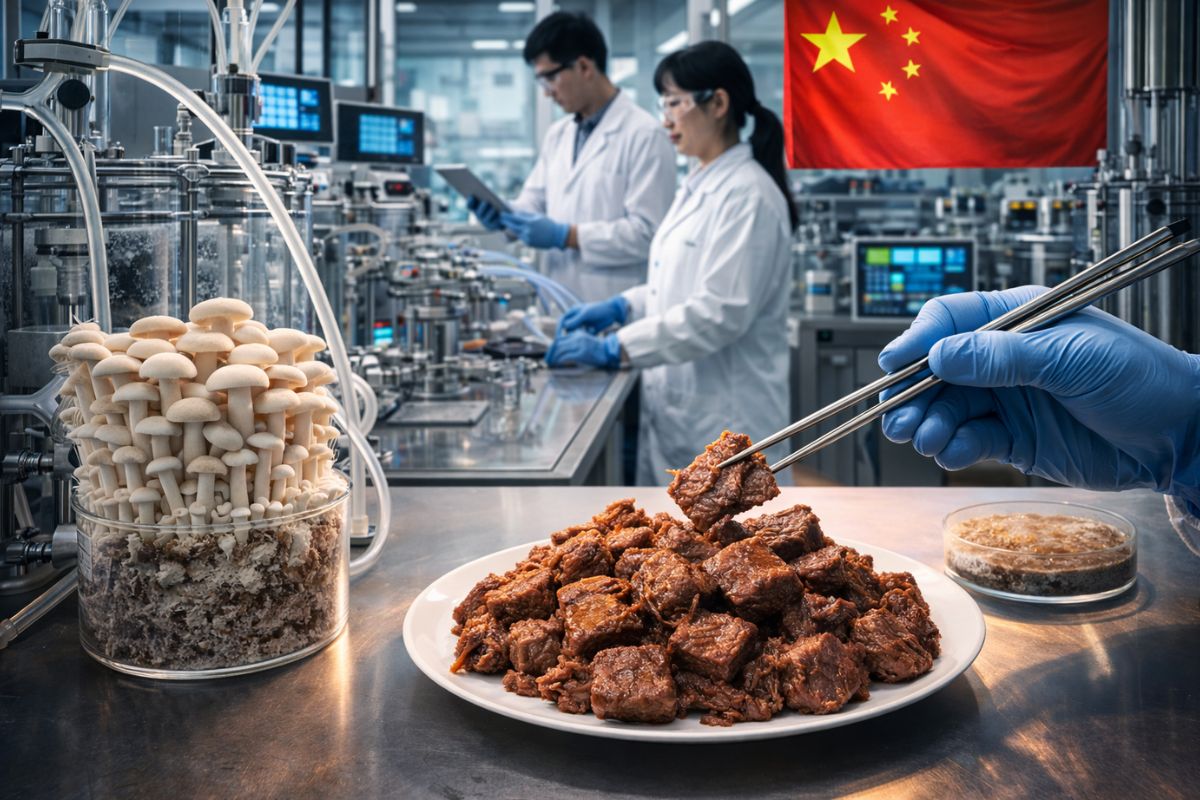
Based on Genetic Editing and Industrial Fermentation, the Chinese Invention from Jiangnan University Creates Mycoprotein from Mushrooms and the Fungus Fusarium Venenatum, Using CRISPR to Increase Production and Digestibility; the Goal is to Imitate Chicken, Reduce Emissions, and Save Land and Water on Plates, on a Global Scale.
In laboratories and pilot plants in China, a Chinese invention from Jiangnan University has put a fungus capable of generating protein with texture and chewiness close to meat at the center of the debate. The edited strain, called FCPD, is described as a mycoprotein that attempts to replicate the behavior of chicken without animal farming, using a fraction of resource utilization.
The movement is gaining traction in a scenario where the United Nations projects the world population to be nearly 9.8 billion by around 2050, while food systems are already putting pressure on soil, water, and climate. Today, livestock is associated with approximately 14 to 15% of global greenhouse gas emissions and occupies about 40% of agricultural land, largely for feed, not for direct human consumption.
Why Sustainable Protein Became a Topic of Engineering

The urgency for alternatives does not arise from slogans, but from numbers and bottlenecks.
-
Researchers in the U.S. have created a flying robot that transforms into a land vehicle while still in the air. The technology, based on aerodynamic transition, converts landing into a scene worthy of Transformers and redefines mobility between sky and ground.

-
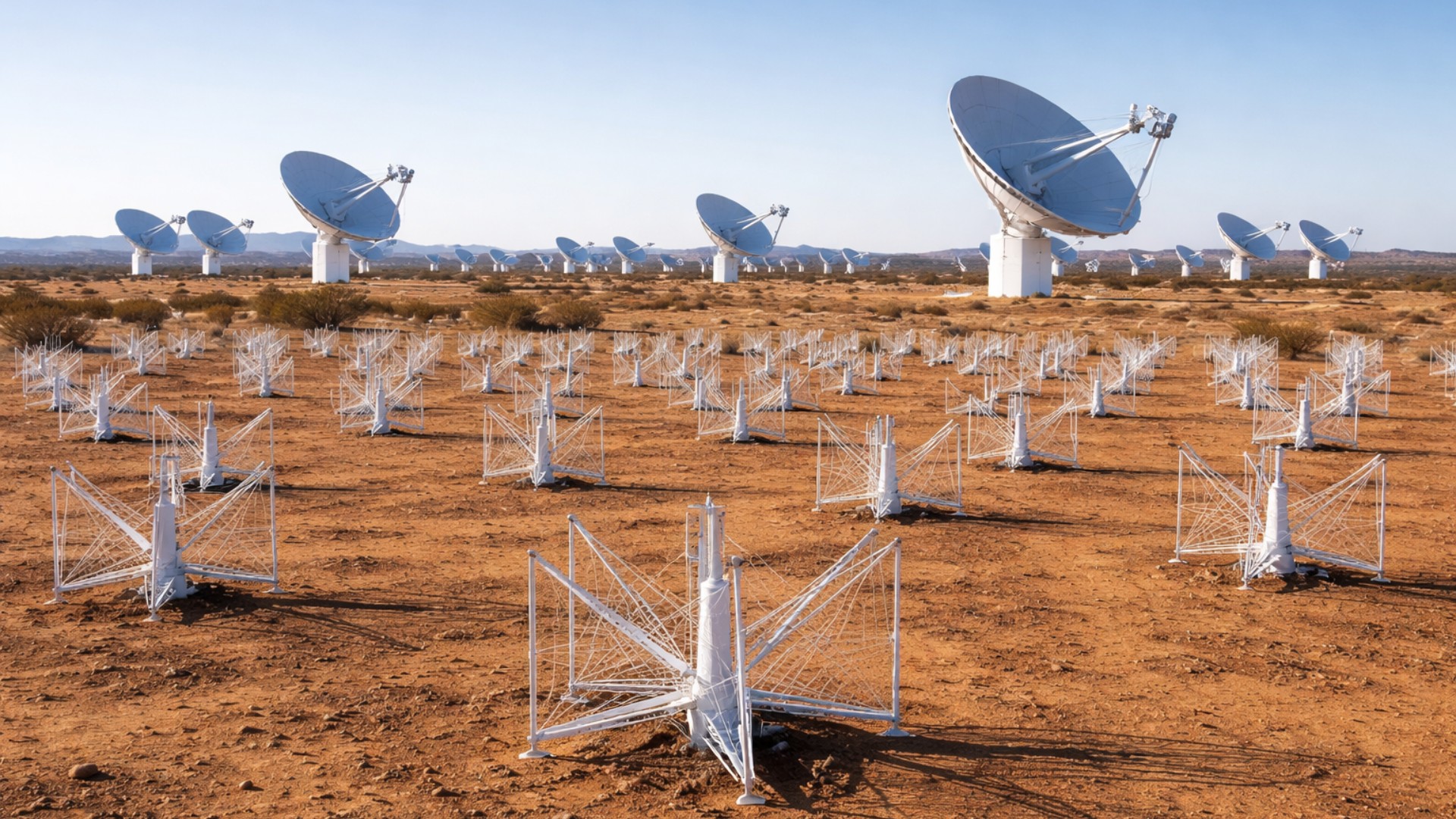
Spread across two continents, with 197 parabolic antennas in South Africa, 131,000 2-meter antennas in Australia, and a range of up to 150 km, the SKA begins to “listen” to the Universe on an unprecedented scale and accelerates the search for black holes, primitive galaxies, and nearly invisible radio signals.
-
Goodbye batteries: a new sensor created by Japanese scientists uses sweat as an energy source and points to a promising path for more sustainable devices, with greater autonomy and less need for frequent recharging.

-
The Brazilian Army inaugurated the assembly line for the Guaicurus armored vehicle with a contract for 420 units by 2033, and the same vehicle has already been tested in combat in Afghanistan and Lebanon by European armies.


When a productive chain concentrates a large part of agricultural land and accounts for a significant slice of emissions, each point of efficiency becomes a matter of engineering, regulation, and market.
In this context, the Chinese invention serves as a practical test of how biotechnology attempts to compress environmental costs without relying on livestock.
The proposal is not just to swap an ingredient, but to reorganize the logic of production.
Instead of creating chicken, slaughtering, processing, and transporting, the mycoprotein is designed to be born in fermenters, fed with sugar and nutrients, with control over temperature, oxygen, and cultivation time.
Mushrooms and microorganisms stop being a culinary detail and become an industrial platform.
There is also an economic and logistical component that explains why this agenda has moved out of the niche.
If the same amount of protein can be obtained with less sugar and less fermentation time, the energy and supply costs change, impacting final cost, production capacity, and supply predictability.
On paper, it is a pathway to “factory-made” meat; in practice, it is a rearrangement of the food industry.
How Genetic Editing Redefined Fusarium Venenatum

The starting point is Fusarium venenatum, known for sustaining mycoprotein products like Quorn and being accepted in markets such as the United States, European Union, and China.
The challenge, according to researchers, lies in thick cell walls, which hinder the body’s access to some nutrients, and in sugar and energy requirements when production scales up.
To overcome this, the team applied CRISPR Cas9 as an internal adjustment tool, deleting genes from the organism itself, without inserting exogenous DNA.
One target was the gene linked to chitin synthase, associated with building the cell wall; the other was the pyruvate decarboxylase gene, which influences how carbon is channeled in metabolism.
By fine-tuning the wall and redirecting metabolism, the mycoprotein tends to become more digestible and more efficient in converting sugar into protein.
In simple terms, the editing tries to make the fungus deliver more of what matters to the industry and the consumer, with less input and fewer metabolic wastes.
That’s where mushrooms and fermentation stop being synonymous with niche and start behaving like a production line.
What Fermentation Tests Indicate About Productivity


The team claims to have sustained the narrative with fermentation measurements.
In tests, the FCPD strain produced the same amount of protein with about 44% less sugar than the original strain and achieved this result in about half the time, which equates to a production rate nearly 88% faster.
For the industry, this means reducing an expensive and sensitive input, sugar, and shortening the manufacturing cycle.
There is also the nutritional dimension. Researchers reported a higher essential amino acid index, bringing the protein quality closer to high-value animal sources.
It is in this detail that the Chinese invention attempts to answer the most challenging question, that of the plate: it must not only be sustainable but also deliver texture, flavor, and nutritional profile perceived as equivalent, even when the consumer expects chicken.
The technical argument, therefore, relies on two fronts: production efficiency and the quality of what is produced.
If mycoprotein grows faster and with less sugar, there is room to think about industrial scale.
If the nutritional profile approaches that of animal sources, there is room to compete in the same grocery aisle, with mushrooms and fungi taking the place previously reserved for processed meats.
Climate Impact and Land Use: Numbers Behind the Comparison with Chicken
The productivity gains are only half the argument because the impact depends on what happens from the laboratory to the final product.
The team modeled a complete life cycle, from spore in the laboratory to an inactivated meat-like product, at an industrial scale of one million kilograms, using pilot-scale data.
The same process was simulated in six countries with different energy matrices, from Finland’s more renewable sources to China’s greater dependence on coal.
The results varied with electricity, but followed a consistent direction: the FCPD process reduced global warming potential by about 4% to just over 60% compared to the original Fusarium venenatum strain.
The central mechanism is simple: transforming each unit of glucose into more protein tends to require less total energy, thus reducing emissions when the energy matrix is not completely clean.
In parallel, when comparing mycoprotein based on FCPD with chicken production in China, the analysis pointed to about 70% less land use and approximately 78% less potential for fresh water pollution.
The logic is straightforward: less area for feed, less runoff from manure, and less pressure on waterways, in addition to a productive system that shifts protein into steel tanks, rather than large agricultural lands.
From Fermenter to Market: Regulation, Acceptance, and Limits
Even with strong numbers, the path to daily consumption goes through formal bottlenecks.
The authors classified technological readiness as level five, equivalent to validation at an industrial pilot scale, indicating departure from the laboratory but not yet arrival on shelves.
Further safety tests, regulatory approval, and product development are still needed before formats like nuggets and burgers reach retail.
Consumer acceptance tends to define the speed of adoption.
Surveys cited by the authors suggest that some of the public may view genetically modified foods more favorably when there is no foreign DNA and when environmental benefits are transparently explained.
The Chinese invention, at this point, also becomes a test of public trust, labeling, and scientific communication, because “CRISPR” still provokes different reactions outside the academic environment.
There are limits that do not disappear with a good fermentation result.
The mycoprotein remains dependent on sugar and electricity, so its footprint reflects how these inputs are produced, and the gains diminish in scenarios of deforestation for sugar or highly fossil fuel-based power grids.
Additionally, reducing food waste, shifting diets to more plant-rich patterns, and decarbonizing energy remain structural measures; biotechnology helps, but does not replace collective choices.
The Chinese invention based on mushrooms and CRISPR-edited mycoprotein puts a new type of “meat” on the table, with the promise of saving land and reducing environmental pressures without animal farming.
If the next steps confirm safety and regulatory viability, the dispute will cease to be merely technical and become a daily occurrence when someone decides between chicken and a fermenter-based alternative.
What would weigh more in your decision to buy a food from this Chinese invention: seeing emissions and land use numbers on the label, understanding exactly how CRISPR was applied in mycoprotein, or testing the taste and texture in direct comparison with chicken?








-

-

-

-

-

13 pessoas reagiram a isso.