





 Portuguese
  English
  Spanish
  5 min of reading
  0 comments


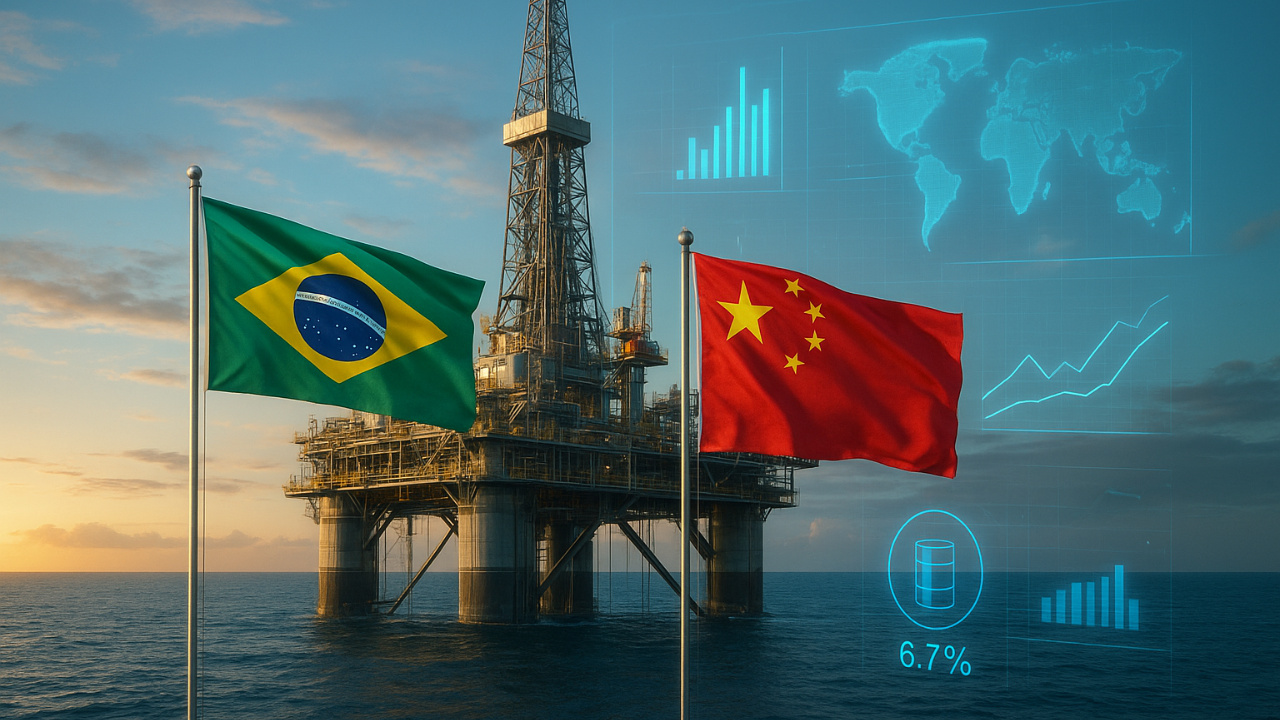
Three State-Owned Companies From China Expand Their Presence in Pre-Salt Fields and Already Account for 6% of National Oil Production. The Chinese Advance Reveals a Strategy That Combines Financial Return and Energy Security, Consolidating the Partnership With Petrobras and Transforming Brazil Into a Key Piece of the Global Energy Game.
The presence of China in the Brazilian oil sector has never been so significant. In just a few years, Chinese state-owned companies have tripled their share of national production, rising from 2% in 2021 to 6% in 2025. This advance confirms the consolidation of a long-term strategy that combines billion-dollar investments, energy security, and technological learning.
Currently, three major Chinese state-owned companies — CNPC (China National Petroleum Corporation), CNOOC (China National Offshore Oil Corporation), and Sinopec — are participating in strategic consortia with Petrobras, operating in high-productivity fields in the pre-salt, such as Búzios, Mero, and Tupi, in the Santos Basin.
With this movement, the Asian country becomes the third-largest foreign partner in Brazil’s oil production, behind only the United Kingdom and Petrobras itself.
-
Petrobras evaluates suspension of sales to distributors and considers canceling the cooking gas auction following guidelines from the Federal Government.
-
Lula reveals a masterstroke by Petrobras to undo a deal made by Bolsonaro, which involves the return of an important refinery that currently produces less than half of what was expected and makes Brazil dependent on international diesel.
-
A study confirms that the natural gas sector will reduce greenhouse gas emissions in Brazil by 0.5% and accelerate the energy transition by 2026.

-
Petrobras implements a severe adjustment and confirms a 55% increase in the price of aviation kerosene with a proposal for installment payments for the companies.


China’s Energy Dependence and the Strategic View of Brazil
The importance of this advance goes beyond profit. China is the world’s largest oil importer, consuming about 16 million barrels per day — a volume nearly equal to that of the United States. However, its domestic production, at 4.2 million barrels per day, covers only a fraction of demand.
This difference forces Beijing to seek stable new supply sources. Brazil, with robust reserves in pre-salt and relative political stability, emerges as a strategic bet. According to recent data, 44% of Brazilian oil exports in 2024 were destined for China, demonstrating the growing interdependence between the two countries.
Chinese Oil Companies Gain Strength and Diversify Operations in Pre-Salt
Chinese production in Brazilian waters reached 221.7 thousand barrels per day in August 2025, equivalent to 5.7% of total production. Although the percentage still seems modest, the growth rate is impressive. In just four years, companies from China have tripled their participation — and without haste, prioritizing quality and longevity of the fields.
In the megafield of Búzios, CNOOC and CNPC hold a combined 11.1% share, with 7.4% and 3.7%, respectively. Petrobras continues as the majority operator, but the Chinese companies play a strategic role in the operation, closely monitoring deepwater extraction technology.
Meanwhile, Sinopec operates differently: it invests through joint ventures with European companies. In the field of Tupi, for example, it partners with the Portuguese Galp, holding 30% of the joint venture responsible for 10% of the field. Sinopec is also present in another 11 smaller areas, consolidating its presence in about 35% of Brazil’s pre-salt fields.
“Dual Mandate”: The Strategy That Mixes Profit and Energy Security
Consultant Rivaldo Moreira Neto, infrastructure director at Alvarez & Marsal, defines the Chinese strategy in Brazil as a “dual mandate”. According to him, Chinese state-owned companies seek financial profitability and security of access to oil — two pillars guiding the country’s investments.
“Of course, China seeks profitability, but with a dual mandate,” Moreira explains. “On one hand, financial return; on the other hand, security of access to oil.”
This approach explains why Chinese companies prioritize megafields of continuous production, capable of ensuring supply for decades. By focusing efforts on assets like Búzios and Mero, China ensures stable supply and technical learning in regions of high operational complexity.
The Role of Petrobras and the Technological Partnership With the Chinese
Petrobras maintains a leading position in all major pre-salt fields but sees China as a strategic partner. The Chinese companies, although minority shareholders, participate as non-operators, meaning they observe and learn the processes without controlling extraction.
For the sector, this stance is a clear indication of Chinese interest in acquiring know-how in offshore exploration. “The pre-salt is a very particular province. It is not trivial to come to a new country and operate fields of this complexity,” says Rivaldo Moreira. “They are good at learning. They are here to understand and then apply what they learn elsewhere.”
The strategy is similar to that adopted by China in the automotive industry in the 1980s and 1990s, when it required joint ventures with foreign automakers. The result was a technological leap that transformed the country into the world’s largest producer of electric vehicles — and the same path seems to repeat itself in the energy sector.
From Learner to Protagonist: How China Wants to Dominate the Oil of the Future
The Chinese involvement in the oil industry is not limited to Brazil. Globally, Chinese state-owned companies are among the largest investors in new fields and extraction technologies. But it is in the Brazilian pre-salt that they find the ideal laboratory to evolve in deepwater exploration.
CNOOC, for example, has already surpassed in production in Brazil some of the largest independent national oil companies, such as Prio. CNPC, in turn, uses its local experience to fine-tune new projects in Africa and the Middle East, regions where it also seeks to diversify supply.
Despite the advance, not everything indicates unrestricted expansion. Sinochem, another Chinese state-owned company, sells its 40% stake in the Peregrino field, in the Campos Basin, for US$ 1.9 billion to Brazilian Prio. The decision reflects a strategic repositioning: less focus on mature assets and greater interest in long-term areas.
Months later, Prio bought the remaining 60% from the Norwegian Equinor, taking total control of the field for US$ 3.5 billion. However, Sinochem’s exit does not indicate a retrenchment but a shift in priorities — China wants to be where the future of oil is determined.
The strengthening of Chinese oil companies in Brazil reflects a profound geopolitical shift. While the country invests heavily in clean energy, such as solar and wind, it also secures a firm presence in global oil reserves.
This duality is part of Beijing’s strategic vision: to reduce external dependence without giving up energy security. In the Brazilian case, the partnership with Petrobras and mastery of deepwater exploration technologies reinforce China’s position as a protagonist in the new global oil order.








-

Uma pessoa reagiu a isso.