





 Portuguese
  English
  Spanish
  4 min of reading
  12 comments


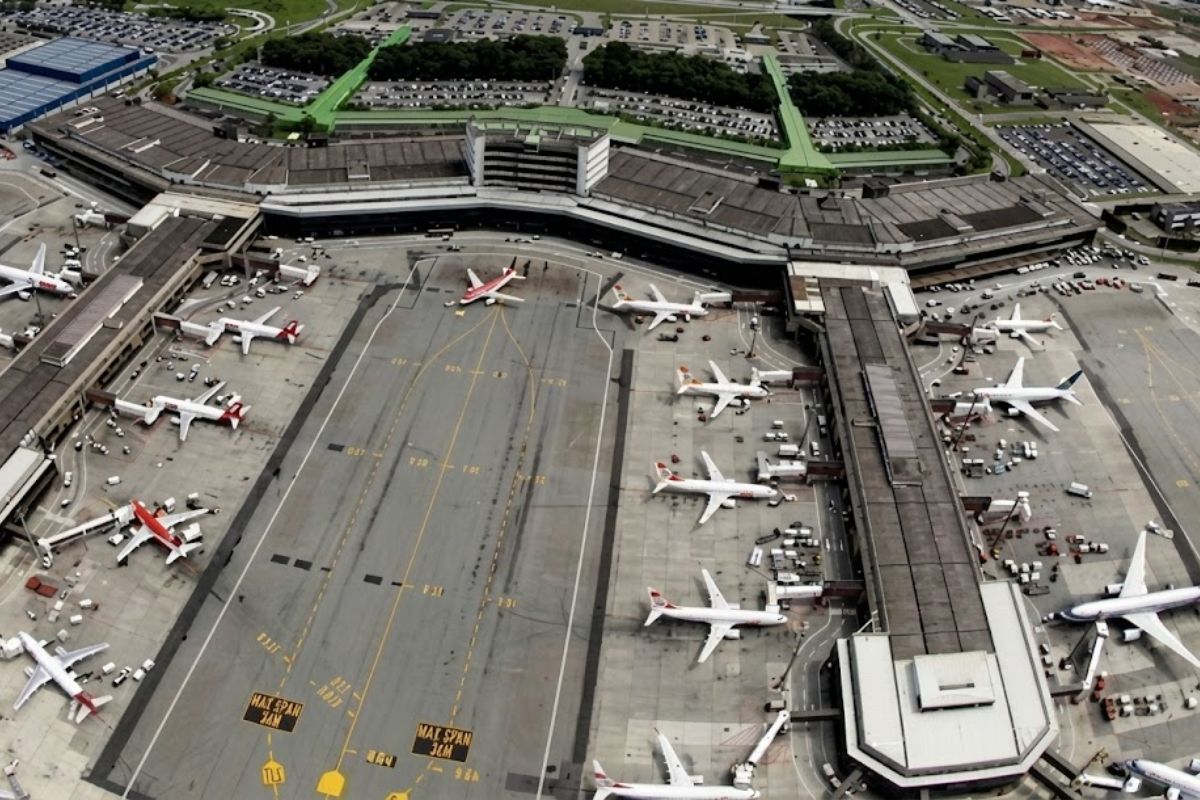


Billion-Dollar Plan Will Remodel Brazil’s Largest Airport By 2029, With Resources From GRU Airport and the Government, Terminal Expansions, Retrofit of Terminal 2, Improvements in Runways, Parking Lots and Baggage to Accommodate More Flights, Passengers and Ensure Historical Operational Efficiency in the Coming Years, After Four Decades of Operation
This Thursday (11), São Paulo Guarulhos International Airport, the largest airport in Brazil, launched a process that forecasts the largest investment in its history, over R$ 4 billion by 2029. The goal is to increase capacity and modernize the entire structure of the country’s main air hub, preparing the terminal to accommodate even more flights and passengers.
Of the announced amount, R$ 1.8 billion will come from the federal Investe+ Airports program and R$ 2.5 billion will be invested by the GRU Airport concessionaire, in partnership with the Ministry of Ports and Airports. According to the administration, this package represents the biggest transformation of the airport since its inauguration, more than 40 years ago, with a focus on operational efficiency and comfort for users.
Mega Investment Changes the Status Quo of Brazil’s Largest Airport

According to GRU Airport’s CEO, Osvaldo Garcia, the projected amounts correspond to the largest volume of investments since the terminal began operations.
-
Oil surged to $115 a barrel due to the war in the Middle East, and diesel in Brazil has already risen to R$ 7.45 per liter, while the United States…

-
Brazilian city bets on the business environment to generate jobs and attract investments in the energy sector — secretary reveals strategy at Macaé Energy 2026.

-
50 viaducts, 4 tunnels, 28 bridges, and 40 kilometers of bike paths: BR-262 in Espírito Santo will receive 8.6 billion reais for the largest engineering project in the state’s history, inspired by the Immigrant Highway in São Paulo.

-
Brazil produces too much clean energy and doesn’t know what to do with it: over 20% of solar and wind capacity was wasted in 2025 while investors flee and 509 renewable generation projects were abandoned in the last year.


He states that the concessionaire is conducting a profound transformation of the infrastructure, which includes terminal expansions, modernization of baggage systems, work on runways and parking lots, and the complete retrofit of Terminal 2.
In practice, the billion-dollar package aims to reposition Brazil’s largest airport to even higher service standards.
The goal is that the entire passenger journey, from check-in to disembarkation, will be impacted by more modern facilities, smarter flows, and more robust systems, reducing bottlenecks and wait times at one of the country’s most important gateways.
How Every Real Will Be Allocated By 2029
The financial design of the project shows that R$ 1.8 billion will be reallocated from the Investe+ Airports program, a public policy aimed at improving airport infrastructure.
Meanwhile, R$ 2.5 billion is part of the concessionaire’s own investment plan, integrating the airport’s concession contract and GRU Airport’s long-term planning.
These funds will be directed towards terminal expansion works, modernization of baggage systems, interventions on runways and parking lots, and the complete retrofit of Terminal 2, which handles a large part of passenger operations.
The expectation is that, by the end of the construction cycle, Brazil’s largest airport will be able to operate an even larger volume of aircraft and passengers, with gains in safety and agility.
Capacity, International Traffic, and Operational Efficiency
Data from the National Civil Aviation Agency shows that Guarulhos currently accounts for 15 percent of all national air traffic and that 29 percent of travelers passing through the terminal are foreigners.
These numbers reinforce the airport’s position as the country’s main international hub and explain why the plan focuses efforts on capacity and efficiency.
With the new investments, the plan is to remodel the facility to increase the flow of aircraft and travelers, without losing sight of the quality of operations.
According to the project, the idea is to prioritize the dynamics of operational efficiency, with more integrated processes, technology applied to baggage management, and better-sized parking lots.
All of this so that Brazil’s largest airport can absorb the growing demand, both domestic and international, with fewer lines and delays.
Congonhas Packed Exposes Climate Impact and Network Limitations
While the investment in Guarulhos aims for the long term, another important São Paulo terminal has felt, immediately, the effects of operational limitations due to unforeseen circumstances.
Due to the cancellation of at least six flights on Tuesday (16), Wednesday morning saw overcrowding at Congonhas Airport, in the southern zone of São Paulo, after weather conditions led to a temporary interruption of operations.
The concessionaire Aena reported that the impacts were resolved in a few hours and that all operational infrastructure and service were made available to passengers to reduce inconveniences.
Reports on social media indicate that some travelers had to be transferred between airports. The administrator’s guidance was that clients with scheduled trips verify the status of their flights directly with the airlines.
This episode at Congonhas reinforces how constant investments in infrastructure, technology, and capacity are crucial to reduce the effects of climate and operational events.
In a scenario of growing demand, especially at Brazil’s largest airport, comprehensive modernization projects, like that of Guarulhos by 2029, are set to become increasingly strategic for the Brazilian air network.
In your opinion, is this investment of R$ 4 billion enough to prepare Brazil’s largest airport for the increase in flights and passengers in the coming years?









GRU e CGH, estáo saturados…..
Será que até lá o aerotrem estará funcionando?
Quem somos nós imples mortais para opinar num problema desta complexidade onde até pessoas altamente capacitadas tem dificuldades em estimar custos e geralmente a abam gastando muito mais que o estimado, ser repórter requer um pouco mais de bom senso para fazer este tipo de perguntas aleatorias…