





 Portuguese
  English
  Spanish
  5 min of reading
  0 comments


Discover How Oil and Gas Investments Shape the Global Economy, from Their Historical Origins to the Opportunities and Challenges of the Sector Today.
Oil and gas investments have always played a central role in economic and political discussions around the world.
Indeed, whether in times of stability or crises, this sector moves billions of dollars and directly influences energy prices, the course of international trade, and the growth of producer and consumer countries.
Moreover, it generates jobs, develops technologies, and is present in the daily lives of billions of people, even if often in an invisible way.
-
The rise in oil prices could ensure an extra revenue of R$ 100 billion for the Federal Government, indicates a recent economic study.

-
Naturgy begins an investment of R$ 1.6 million to expand the gas network in Niterói and benefit thousands of new residences and businesses.
-
A major turn in the Justice system suspends tax increases and directly impacts oil and gas companies in Brazil by affecting costs, contracts, and financial planning, leaving uncertain what could happen to the sector if these costs had increased.

-
Brava Energia begins drilling in Papa-Terra and Atlanta and could change the game by reducing costs in oil while increasing production and strengthening competitiveness in the offshore market.

The Origin of Investments in the Sector
To begin to understand current investments in this sector, it is essential to look back in time. This is because oil gained economic importance in the 19th century when it was discovered that it could replace coal as the main energy source.
During the 20th century, oil and natural gas started to play a central role in the Industrial Revolution, in the development of major powers, and in geopolitical conflicts.
For example, in the two World Wars, particularly in World War II, oil was a vital strategic resource, as detailed by the International Energy Agency (IEA).
The control of oil reserves was directly linked to military strategies and post-war economic recovery.
In 1960, the creation of the Organization of the Petroleum Exporting Countries (OPEC) – as indicated on its official website – consolidated the role of producing countries to regulate global supply and prices. This action transformed the sector into a key component of international politics.
Over time, investments in the oil and gas sector evolved from simple profit opportunities to having increasingly significant political, environmental, and social implications.
Control over oil reserves became synonymous with global power, influencing alliances between countries and defining economic directions.
Additionally, technological advancements to explore oil in previously inaccessible locations:
Such as deep waters and Arctic areas, were only made possible through heavy investments in research and development.
According to the International Energy Agency (IEA), deep-water exploration grew significantly from the 2000s, driven by technological improvements that made accessing these reserves viable.
Thus, these advancements opened new frontiers for the sector and required financial partners willing to invest long-term.
What Drives Investments in Oil and Gas?
Despite the growth of renewable energy, oil and gas remain fundamental sources for energy generation in the world.
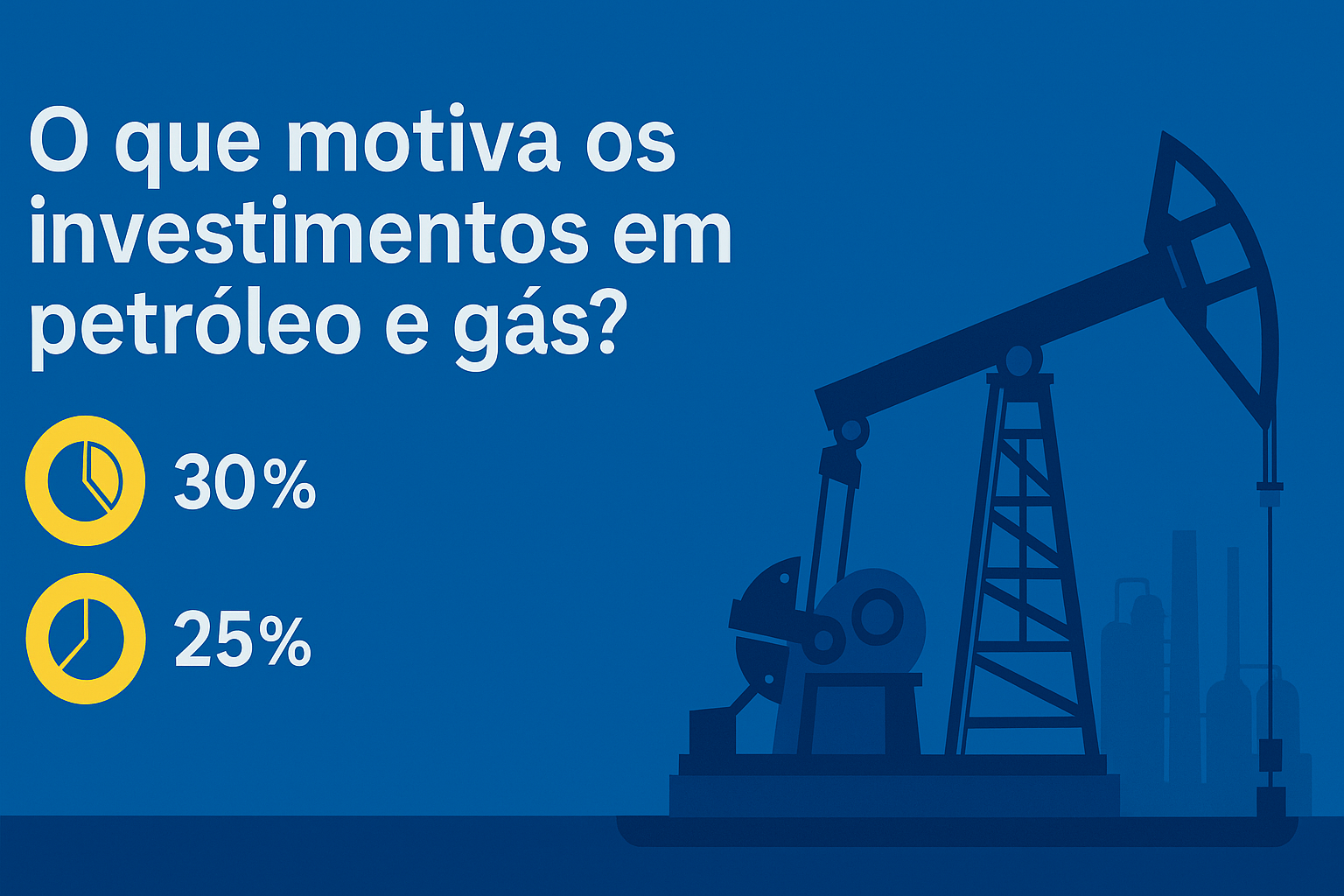
As highlighted by the BP Statistical Review of World Energy (2024), approximately 30% of global energy still comes from oil, while natural gas accounts for about 25%.
These sources power vehicles, airplanes, ships, heat homes, run factories, and produce raw materials for the chemical industry, including the manufacture of plastics, fertilizers, and medications.
Therefore, investing in this sector means betting on a complex production chain that goes from exploration and extraction to refining and distribution, including transportation, storage, and marketing.
Moreover, many countries depend on oil export revenues to keep their economies running, making this investment a key piece for national development.
Publicly traded companies, such as Petrobras, ExxonMobil, Shell, and Chevron, are part of major stock exchanges and attract investors interested in both dividend payments and the appreciation of their shares.
In addition to stocks, it is also possible to invest in oil through funds, futures contracts, and ETFs (exchange-traded funds), making the sector more accessible for different investor profiles.
Trends and Innovation in the Energy Sector
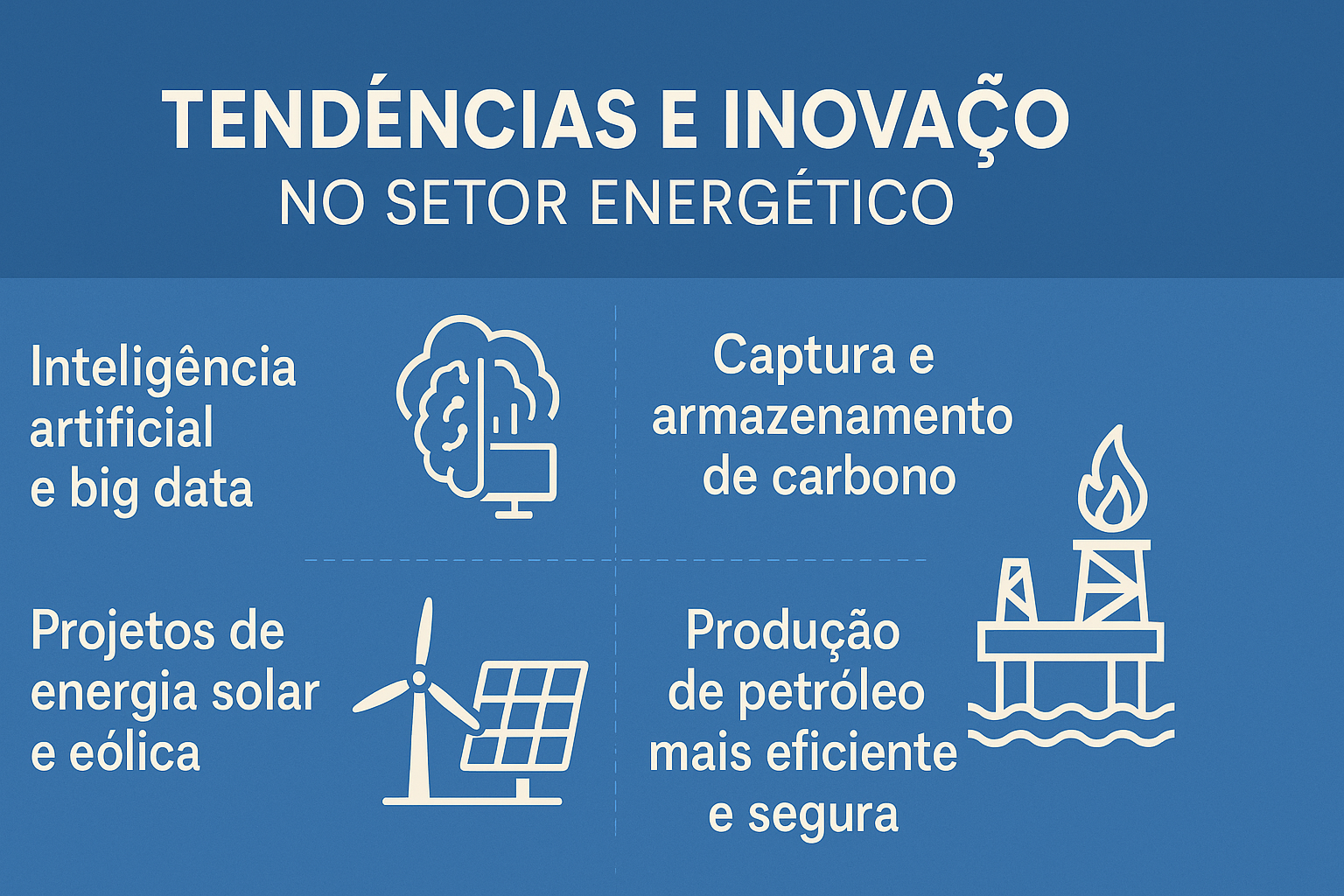
In recent years, companies in the sector have increasingly focused on innovation and sustainability.
An example is the use of artificial intelligence and big data to predict leaks, optimize drilling, and reduce waste.
Another important advancement is carbon capture and storage, which seeks to lessen the environmental impact of burning fossil fuels.
In addition, companies are investing in parallel solar and wind energy projects.
Seeking to position themselves in the clean energy market without abandoning the base that still ensures most of their profits: oil and gas.
In Brazil, initiatives such as the exploration of natural gas associated with oil have gained prominence.
Because gas has a lower environmental impact than coal and diesel oil, for example.
Natural gas can generate electricity with fewer harmful gas emissions, functioning as a bridge between fossil fuels and renewable sources.
Another important trend involves investments in technologies that make oil production more efficient and safe, minimizing risks of environmental accidents, which generate high costs for companies and society.
According to the International Energy Agency (IEA), investments in environmental technologies in the oil and gas sector have grown by about 12% per year since 2018.
A Sector That Remains Relevant

Despite changes and challenges, the oil and gas sector continues to be one of the pillars of the global economy.
Its role as an energy source, its influence on international markets, and its capacity for adaptation make oil and gas investments an attractive choice for many investors and governments.
For those looking to understand the world of investments, it is impossible to ignore the strategic importance of this industry.
Even in the face of pressures for sustainability and the urgent need to reduce carbon emissions, oil and gas still occupy a central space in the global energy matrix.
Additionally, the sector has shown the ability to reinvent itself, with companies betting on a gradual transition to less polluting energies.
But without giving up what oil and gas represent on a global scale.
Why This Topic Never Loses Relevance
Oil and gas investments involve not just profit. They encompass history, politics, science, innovation, and geopolitics.
Therefore, they require attention to the international landscape, consumer behavior, and the decisions of large organizations.
The future may point towards cleaner and renewable sources, but the present still heavily relies on oil and gas to keep the world functioning.
That is why understanding this sector is fundamental for anyone interested in finance, economy, and energy.
Whether you are a novice investor or someone looking to learn more about the energy market, this topic never loses relevance — and deserves constant monitoring.







Seja o primeiro a reagir!