





 Portuguese
  English
  Spanish
  5 min of reading
  0 comments


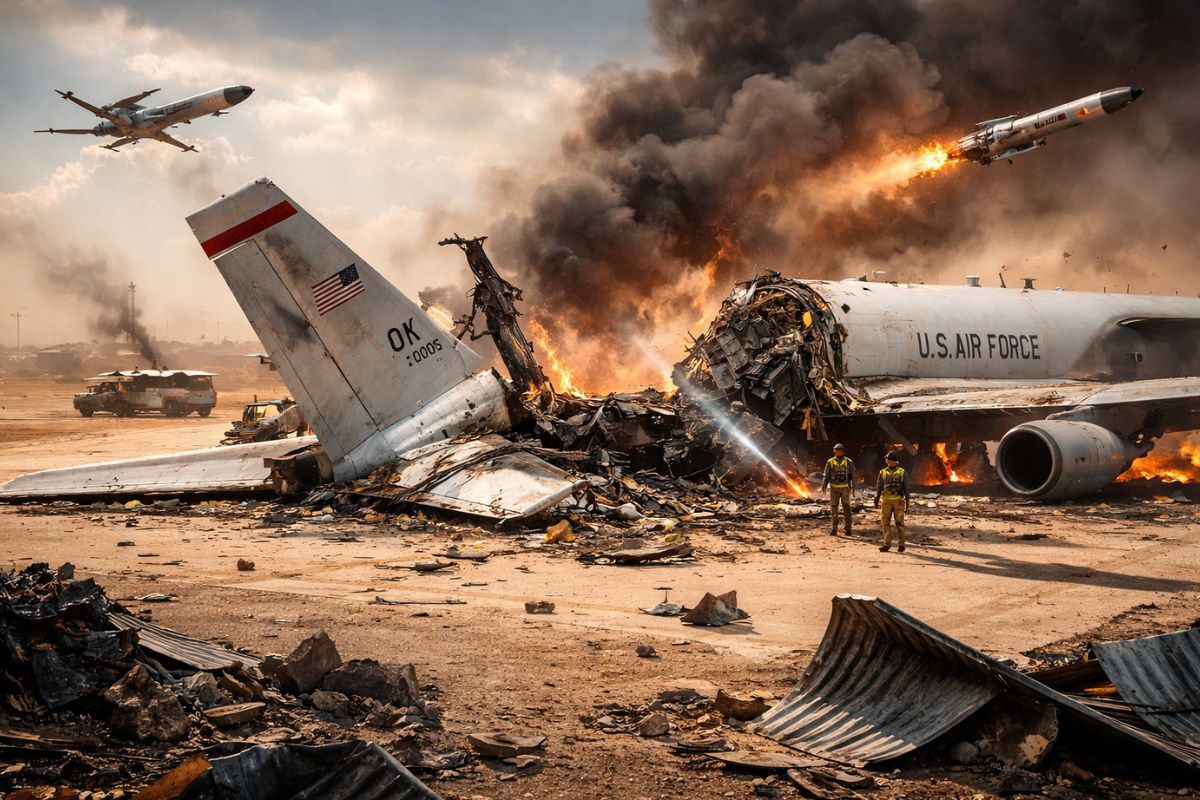
Verified images by AFP show an American spy plane E-3 Sentry split in half after an Iranian drone and missile attack on Prince Sultan Air Base in Saudi Arabia, which injured at least 12 soldiers and destroyed a 270 million dollar aircraft used to track threats hundreds of kilometers away, exposing the fragility of US bases in the Gulf region.
An American spy plane valued at 270 million dollars was destroyed by Iranian drones and missiles at Prince Sultan Air Base in Saudi Arabia on Sunday (29). Verified images by the AFP agency show the E-3 Sentry aircraft, one of the most advanced aerial surveillance systems of the United States, split in half on the runway after the impact. At least 12 American military personnel were injured, with two in serious condition. The attack is the latest in a series of Iranian offensives against US bases in the Persian Gulf region.
The E-3 Sentry is not an ordinary plane. It is part of the AWACS (Airborne Warning and Control System) and is capable of tracking drones, missiles, and aircraft hundreds of kilometers away. Before the attack, the US Air Force had about 16 aircraft of this type in operation. Losing one of them under the conditions it was lost exposes a vulnerability that the United States has been trying to minimize: US bases in the Gulf are within range of Iranian drones and missiles, and defense systems failed to prevent the destruction of the American spy plane.
What was the E-3 Sentry and why does its destruction matter so much

The E-3 Sentry is a military version of the Boeing 707 equipped with a huge rotating radar mounted on the fuselage. This radar allows detection of aircraft, drones, and missiles at distances greater than 400 kilometers, functioning as a flying air command center that coordinates combat operations and monitors airspace in real-time. It is one of the most powerful eyes the United States has in any theater of war.
-
If the USA were to go to war with Brazil, Washington’s greatest fear would not be the attack itself, but facing a vast territory, prolonged resistance, and a costly, chaotic, and unpredictable occupation.

-
In 2013, Nicaragua sold the concession for a canal to rival Panama to a Chinese billionaire who lost 85% of his fortune, disappeared, and was declared bankrupt. Now the project resurfaces with a new route, a new Chinese partner, and a cost of $64.5 billion.
-
The USA announces a mysterious billion-dollar vault project to store critical minerals, but what intrigues experts is not just the plan itself, but why Latin America, including Brazil, has entered the center of this global dispute against China.

-
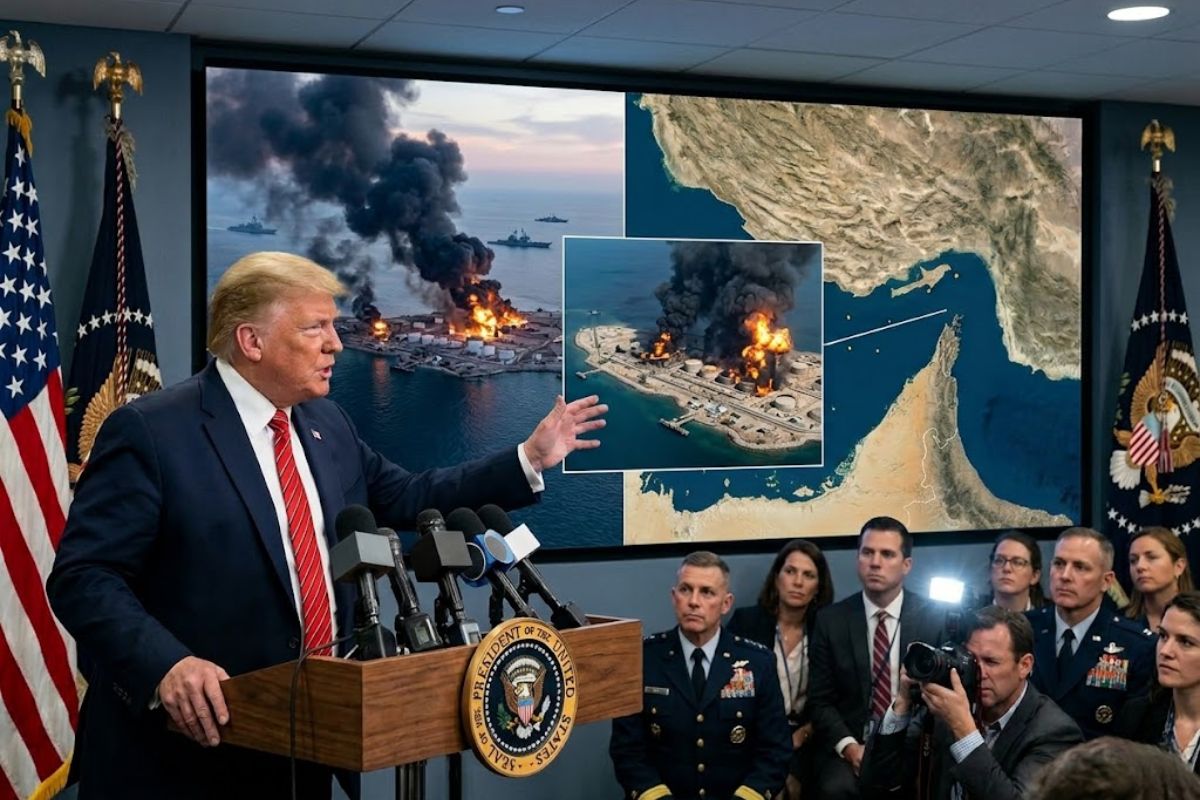
Trump Announces Bombing of U.S. Military Targets on Iranian Island Responsible for About 90% of Iran’s Oil Exports, Warns of Further Attacks if Navigation in Strategic Strait of Hormuz Is Threatened

With a unit cost of approximately 270 million dollars, the American spy plane E-3 Sentry represents a strategic investment that goes far beyond its financial value.
Each lost unit reduces the US capacity to monitor aerial threats in a region where Iranian drones and missiles are launched with increasing frequency. The fleet was already limited to about 16 aircraft; losing one in a direct attack on the base is a significant operational blow.
According to Al Jazeera, the E-3 Sentry destroyed in Saudi Arabia was parked on the ground when it was hit. Photos circulating on social media show the fuselage split in half, with debris scattered across the runway.
The image of one of the most advanced surveillance systems in the world reduced to twisted metal concretely illustrates what is at stake when US bases are exposed to saturation attacks.
How Iranian drones and missiles hit the base in Saudi Arabia
The attack on Prince Sultan Air Base was carried out with a combination of drones and missiles, according to reports from The New York Times and The Wall Street Journal.
This saturation tactic of launching multiple vectors simultaneously has been Iran’s standard strategy to overwhelm the defense systems of US bases in the region. The more targets the radars and interceptors need to track at the same time, the greater the chance that some will bypass the defenses.
Prince Sultan Air Base, located in Saudi Arabia, is used by American forces as an advanced operating point in the Persian Gulf.
In addition to the American spy plane E-3 Sentry, the attack also hit refueling aircraft stationed at the same base, expanding the operational damage beyond a single aircraft. The 12 injured military personnel were in the area when the projectiles struck the facility.
The incident raises a question that military analysts have been debating for months: are the missile defense systems deployed at US bases in Saudi Arabia and other Gulf countries sufficient to protect high-value assets like the E-3 Sentry? The answer, as evidenced by the facts, seems to be no at least not against saturation attacks with drones and missiles launched simultaneously.
The sequence of Iranian attacks against US bases in the Gulf
The destruction of the American spy plane in Saudi Arabia is not an isolated event. In recent weeks, Iran has carried out a series of offensives against US military structures throughout the Persian Gulf region.
According to reports from international media, attacks have targeted radar systems, missile defense batteries, drones, and aircraft at bases in Saudi Arabia, the United Arab Emirates, Bahrain, Jordan, and Kuwait.
The geographical scope of the offensives is what is most concerning. This is not a single attack on a single base, but a coordinated campaign hitting multiple installations in five different countries. This demonstrates that Iran has the capability to project force against US bases across virtually the entire Gulf a reality that changes the American strategic calculation in the region.
The offensives are part of Tehran’s response to American actions in the Middle East, amid an escalation of tensions that has already affected oil prices, disrupted maritime routes, and put allied governments under pressure. For the United States, protecting US bases spread across a region in active conflict against an adversary that uses cheap drones and missiles in increasing quantities is a logistical and financial challenge that does not have an easy solution.
What the destruction of the American spy plane reveals about modern warfare
The attack that destroyed the E-3 Sentry in Saudi Arabia is a concrete example of how asymmetric warfare works in practice. An Iranian drone or missile costs a fraction of the price of a 270 million dollar American spy plane. When the cheaper destroys the more expensive, the strategic equation is inverted: the attacker spends less to cause billion-dollar damage to the defender.
This logic has already been demonstrated in the war between Russia and Ukraine, where cheap drones destroy expensive tanks. But seeing an AWACS system one of the most valuable and protected assets of any air force being destroyed on the ground by Iranian drones and missiles elevates the debate to another level. If even the American spy plane is not safe within an allied base, what is?
The vulnerability of US bases in the Persian Gulf is now a fact documented by verified images, not an academic hypothesis. The 12 injured military personnel, the E-3 Sentry split in half, and the damaged refueling aircraft are proof that the American military presence in Saudi Arabia can be hit with real consequences and that Iran has the willingness and capability to do so.
With information from the portal of G1.
What do you think: do the United States need to reinforce their defenses at US bases in the Gulf or rethink the strategy of maintaining high-value assets like the American spy plane in such an exposed region? Leave your analysis in the comments this is one of the most relevant military debates of the moment.









Seja o primeiro a reagir!