





 Portuguese
  English
  Spanish
  7 min of reading
  2 comments


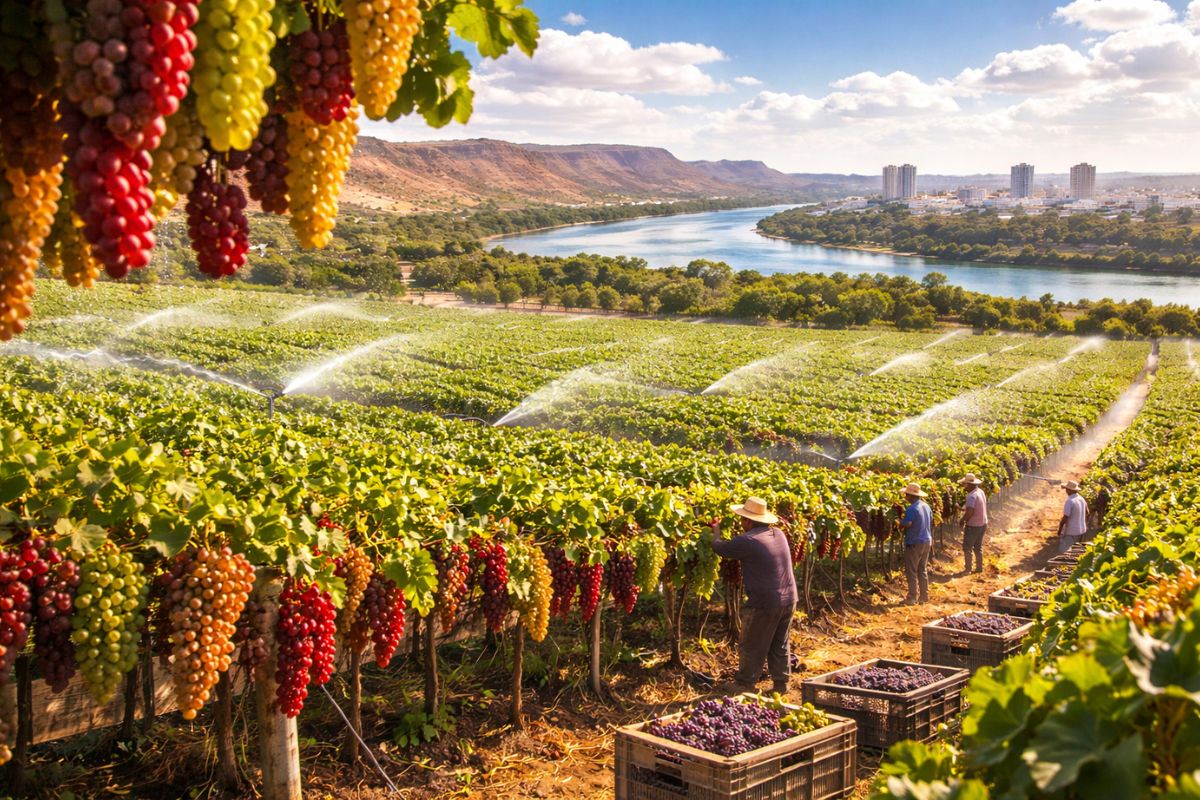


In The São Francisco Valley, The São Francisco Irrigation Takes Over The Caatinga, Creates A Sea Of Grapes With 40 Thousand Vines In Production And Helps Petrolina And Juazeiro Establish Themselves As A Fruit Export Hub
The São Francisco irrigation has taken over a stretch of Caatinga where it rarely rains, creating a sea of vineyards and allowing a family to care for 40 thousand grapevines that produce practically year-round, in the heart of the northeastern semi-arid region.
Between Petrolina and Juazeiro, this same São Francisco irrigation has helped transform the region into one of the largest fruit production and export hubs on the planet, where what was once seen as “dry land that yielded nothing” now supplies grocery shelves in Brazil and abroad with grapes, mangoes, and an extensive list of fruits.
From The Dry Caatinga To The Sea Of Irrigated Grapes
The original landscape is Caatinga, with native vegetation preserved in about 20 percent of the areas through legal reserves. Intense sun, little rain throughout the year, an annual average of a few hundred millimeters, and long dry periods. All of which, in theory, would dissuade any thoughts of a sea of grapes.
-
The sugar-energy sector advances with agricultural technology, but agricultural productivity still raises concerns.

-
The eggshell that almost everyone throws away is made up of about 95% calcium carbonate and can help enrich the soil when crushed, slowly releasing nutrients and being reused in home gardens and vegetable patches.
-
This farm in the United States does not use sunlight, does not use soil, and produces 500 times more food per square meter than traditional agriculture: the secret lies in 42,000 LEDs, hydroponics, and a system that recycles even the heat from the lamps.
-
The water that almost everyone throws away after cooking potatoes carries nutrients released during the preparation and can be reused to help in the development of plants when used correctly at the base of gardens and pots, at no additional cost and without changing the routine.


What changes this scenario is the São Francisco irrigation, which brings clean water from the river all year round to the farms. Instead of relying on rain, the vineyards depend on a drip system calculated to the millimeter, delivering water directly to the root and allowing for the production of quality grapes in the heart of the Caatinga.
Today, in the so-called São Francisco Valley, everything is planted: table grapes, mangoes, guavas, melons, acerolas, bananas, coconuts, cashews, pitaya, carrots, onions, tomatoes, and much more.
The Caatinga is no longer seen as “land that yields nothing” and is now recognized as one of the most productive places in the world when the river’s water is used with skill and responsibility.
How The São Francisco Irrigation Works In Practice

On the family farm, there are about 38 hectares planted, with approximately 100 grape plants per hectare, which yields around 40 thousand vines in production. All this area relies on a drip system directly connected to the São Francisco irrigation.
The water taken from the river is considered high quality, uncontaminated, with suitable mineral characteristics. It reaches the vineyards through hoses and drippers that release a constant flow, on the order of a few liters per hour at each point.
Every spacing, every drip rate, every minute of irrigation from the São Francisco is calculated so that the plant receives exactly what it needs without waste.
Along with the water comes the nutrition. All fertilization passes through the drip system in a management practice known as fertigation.
The soil, originally sandy, is corrected with organic matter and nutrients, creating an environment where the roots can develop vigorously. If the base isn’t prepared, it’s pointless to apply water, no matter how good the São Francisco irrigation might be.
Harsh Climate, Continuous Production
The climate there is tropical, hot, and dry. It gets very hot, rains little, and in recent years, the rainfall has concentrated over a few months, generally between November and April.
The rest of the year sees practically clear skies. For conventional rain-fed agriculture, these conditions would pose a significant obstacle.
Thanks to the São Francisco irrigation, this harsh climate becomes an ally. Many hours of sunshine mean many hours of “working light” for the plants, and the river’s water ensures they do not suffer from drought, provided that the management is done correctly.
The combination of intense sunlight, available water, and well-structured soil creates the perfect environment for successive cycles of grapes.
In practice, there is no single harvest. Once the producer prunes the vine, about 110 days later the vineyard is ready to be harvested again. By respecting the plant’s cycle, it is possible to schedule multiple harvests throughout the year, something inconceivable without the São Francisco irrigation in the semi-arid region.
Year-Round Grapes And Family Work

On the property, the foundation is table grapes. Various varieties developed by Brazilian research, such as Núbia, Melodia, Vitória, Isis, and others, many of which are from Embrapa, are cultivated.
Each variety has its own unique characteristics in color, flavor, texture, and presence or absence of seeds, designed to appeal to different markets.
Despite the technology, the heart of the system remains familial. Father, mother, and children share responsibilities between the field, irrigation, pest management, harvesting, and packaging.
The routine is 365 days a year, from dawn to dusk. There is no room for long breaks because the São Francisco irrigation keeps the plants active and the production cycle continuously going.
The harvesting is manual. Specific scissors cut the bunches, and out-of-standard berries are removed one by one and returned to the soil as organic matter.
In the packing house, the grapes are weighed, packed into bowls or boxes, receive barcodes, packaging dates, and are assembled onto pallets. Each person, in a workday, can put together more than a hundred boxes, and those who produce more earn bonuses.
From Vineyard To The World: Fruit Export Hub
The São Francisco Valley, bolstered by the São Francisco irrigation, ranks among the largest fruit producers and exporters in the world.
In terms of fruits, the region ranks among the top positions globally in production and export, and in the case of mangoes, the specific ranking may vary, but it remains among the big players, occasionally trailing behind traditional countries like Chile in certain aspects.
Besides grapes, the region accounts for a significant share of the mangoes exported by Brazil and boasts a diverse portfolio of fruits that reach demanding markets such as Europe and other international destinations.
It is the combination of climate, São Francisco irrigation, research, management, and family work that allows a stretch of Caatinga to be treated as a showcase for Brazilian agriculture overseas.
Petrolina and Juazeiro, two cities divided only by the river, have become synonymous with irrigated fruits. Much of what appears on the shelves of Brazilian and foreign supermarkets passes, directly or indirectly, through the productive structure of this region, supplied by the Velho Chico.
Sandy Soil, Active Microbiota, And Healthier Fruits

Behind the images of shiny boxes of grapes lies a quiet effort of soil. The foundation is a sandy soil, which alone could not support such production.
Therefore, the management combines São Francisco irrigation, nutritional supplementation, and reinforcement of the soil microbiota with biological products.
Beneficial fungi and bacteria are used to repopulate the soil and aid in the natural defense of the plants. With more fine roots, more root hairs, and better nutrient absorption, the vine becomes stronger, with greater immunity to pests and diseases.
When the plant is well-nourished, well-rooted, and well-irrigated, it spends less energy defending itself and more energy producing fruit.
The use of pesticides respects the residue limits required for export, and the producer emphasizes that the goal is to produce grapes that can be consumed freely, without fear, within safety standards.
The result is healthy, tasty fruits with sufficient quality to withstand markets that reject lots outside specification.
Economic Value And Responsibility For Food Security
The irrigation grape chain generates jobs at various points: in the fields, in the packing house, in transportation, in international logistics.
At the same time, it ensures a constant supply of fruits for the domestic market. If consumers do not plant or grow, someone on the edge of the São Francisco is doing that every day so that food does not run out on supermarket shelves.
This responsibility is clear in the words of the producers, who remind us how serious it would be to live in a country where food is lacking on the shelves.
The São Francisco irrigation, in this context, is not just an engineering project but a strategic tool for food security and the economy of the entire São Francisco Valley region.
In the end, what we see is a powerful synthesis: a perennial river, a resilient bioma like the Caatinga, São Francisco irrigation technology, and families willing to work 365 days a year transform a dry hinterland into a sea of grapes and one of the largest fruit export hubs in the world.
And you, looking at this sea of grapes in the semi-arid region, do you believe that the São Francisco irrigation is the best way to expand fruit production in Brazil, or do you think there are still adjustments and limitations needed for this model of irrigated agriculture?









Tem conta errada na matéria.
38 hectares x 100 = 3.800 pés.
Sim certamente.