





 Portuguese
  English
  Spanish
  5 min of reading
  0 comments


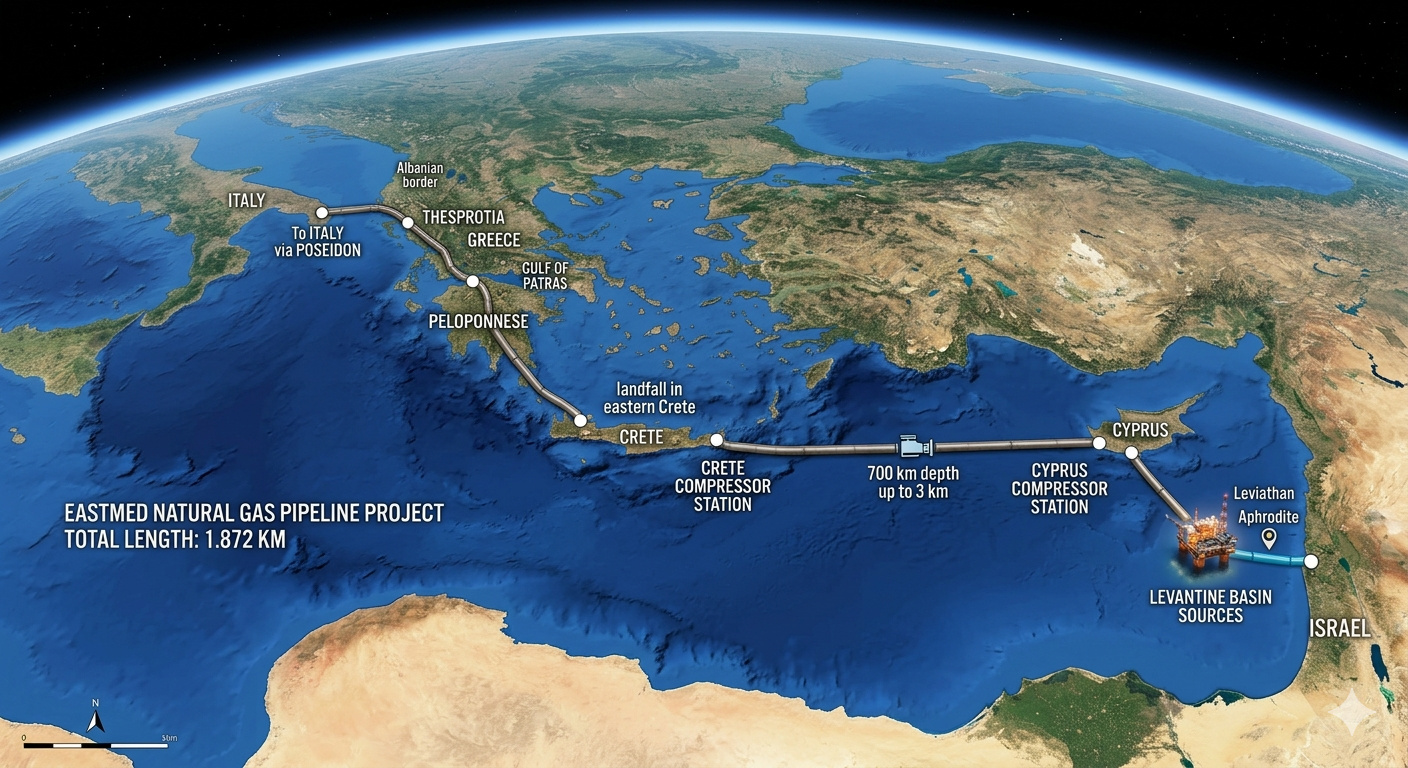
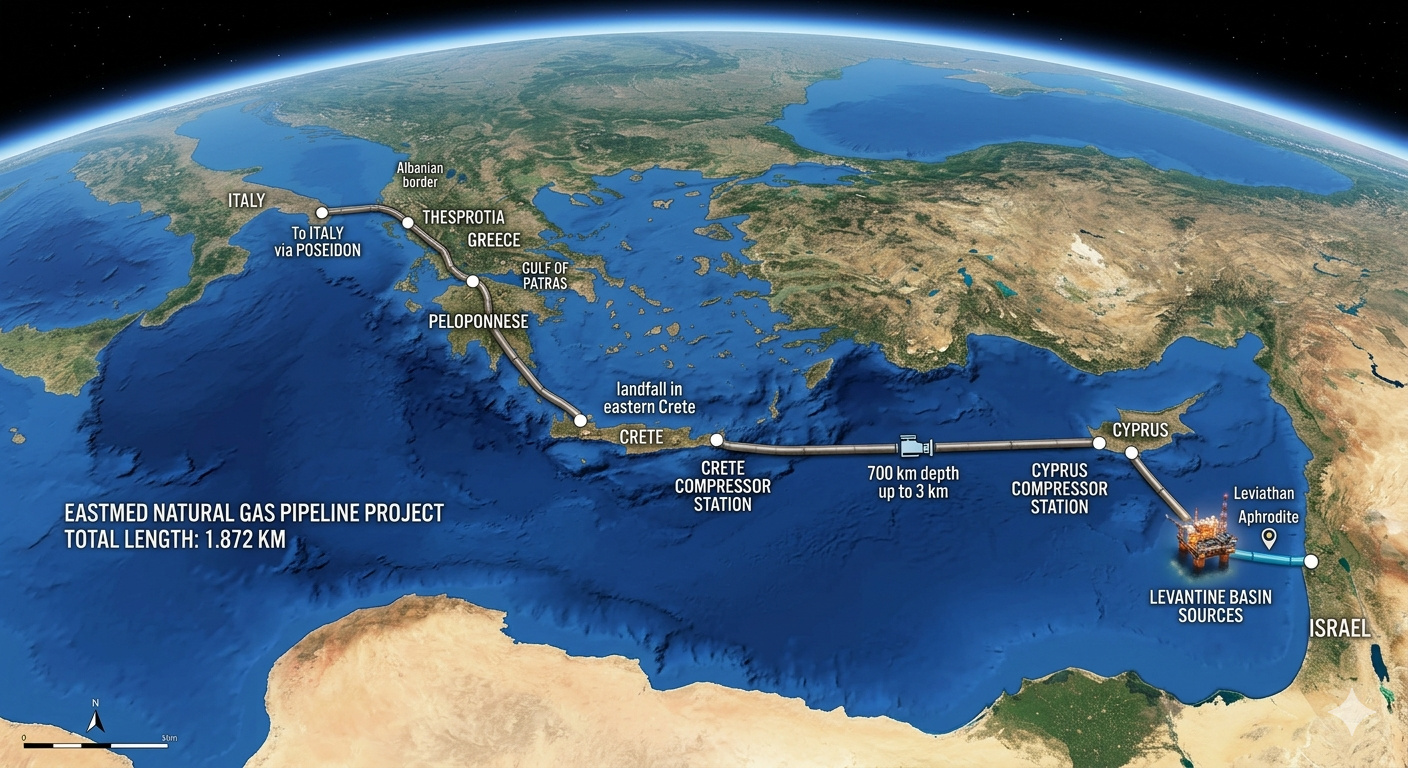
EastMed Pipeline of 1,872 km promised to bring gas from the Mediterranean to Europe, but dispute with Turkey stalled the project even with energy crisis.
The gas was there. The contracts were signed. The European funding was approved. The completion date was set for 2025. The project had a name, route, budget, and formal support from the United States, the European Union, and four governments. But the EastMed pipeline does not exist. Not a meter of pipeline has been installed. Not a cubic meter of gas has flowed from Israel to Europe via this route. And the energy crisis triggered by the war in Ukraine starting in 2022, exactly the scenario the project sought to avoid, was not enough to unlock it.
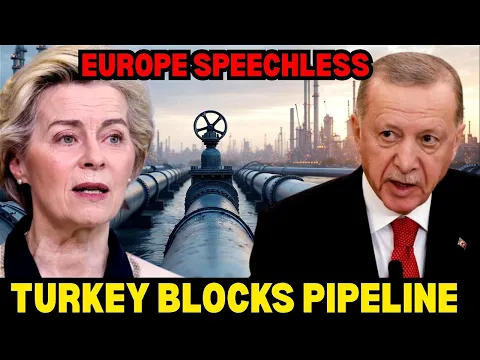
What paralyzed one of the largest energy infrastructure projects in the Mediterranean was not a lack of gas, nor funding, nor political support among the signatories. It was the action of a single country that did not sign the agreement and decided that the project could not move forward.
EastMed Pipeline: what it is, planned route, and importance for European gas
The Eastern Mediterranean concentrates some of the largest natural gas discoveries of the last decades. The Leviathan field in Israel has about 600 billion cubic meters. The Tamar field adds another 200 billion. In Cyprus, discoveries in block 10 indicate volumes between 140 and 230 billion cubic meters.
-
Israel, Greece, and Cyprus signed an agreement in 2020 to transport gas from the Mediterranean to Europe via a 1,872 km pipeline, but Turkey claimed sovereignty over part of the maritime route, and the project never materialized.
-
Abandoned house for 15 years disappears in the woods, shocks owner with unrecognizable scenery and is reborn in an intense transformation after almost 90 hours of work in just 10 days.
-
In just three hours, a natural stone floor transforms the entrance of the house with an organic effect, immediate drainage, and a sophisticated non-slip finish that doesn’t puddle water, dries quickly, and impresses with the final result.
-
‘Interlocking brick’ made of earth arrives in the construction industry with cost reductions of up to 40% on the project.
The energy resource exists on a relevant scale. The problem has always been logistical: transporting this gas to Europe. The EastMed was conceived as a direct solution. The project envisioned a 1,872 km pipeline, approximately 1,300 km underwater and 600 km on land. The pipeline would start from Israel, pass through Cyprus, continue to Crete, and reach mainland Greece, connecting to the European grid.
The estimated capacity was 9 to 11 billion cubic meters per year, representing a significant portion of European energy diversification. The initial cost was around €6 billion, with a maximum depth of up to 3.3 km — one of the most challenging sections ever designed for a pipeline.
History of EastMed: from European strategic project to signed international agreement
The EastMed began to take shape in 2013 when the European Commission classified it as a Project of Common Interest, ensuring access to funding and regulatory priority.
Between 2015 and 2018, over €34.5 million were allocated to technical and environmental studies. In March 2019, Israel, Greece, Cyprus, and Italy formalized political support for the project in Tel Aviv, with the presence of representatives from the United States. On January 2, 2020, the intergovernmental agreement was signed in Athens, consolidating the commitment among the countries.
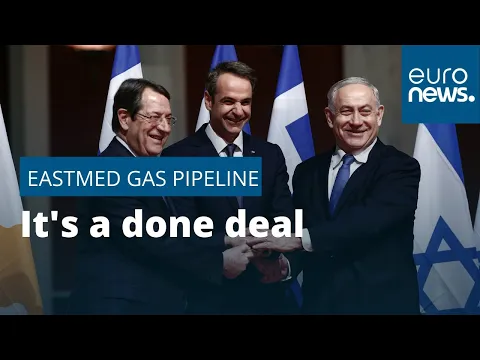

Israel ratified the agreement in July 2020. The final investment decision was expected in 2022, with completion scheduled for 2025.
Turkey and maritime dispute in the Eastern Mediterranean blocked the EastMed
The main breaking point occurred days before the formal signing of the project. In December 2019, Turkey and Libya signed a maritime delimitation agreement that redrew exclusive economic zones in the Eastern Mediterranean. This outline ignored the maritime projection of Greek islands like Crete, contradicting traditional interpretations of international law.
In practice, the area claimed by Turkey overlapped part of the planned route of the EastMed. This created a scenario of legal uncertainty. To move forward, the project would depend on Turkish authorization to cross contested areas, something Ankara made clear it would not grant.
The Turkish position has been consistent: no relevant energy project in the region should be implemented without its direct participation.
Gas crisis in Europe and withdrawal of US support weakens the project
European dependence on Russian gas reached about 40% before 2022. The EastMed was seen as a strategic alternative for diversification.
However, in January 2022, the United States withdrew formal support for the project, classifying it as economically unviable and incompatible with environmental goals.
Shortly after, the war in Ukraine drastically increased the urgency for new energy sources, but the EastMed had already lost international political support.
Moreover, Turkey became a strategic player within NATO during the conflict, which raised the diplomatic cost of supporting a project that excluded it.
Technical challenges of the EastMed pipeline: depth, cost, and seismic environment
The EastMed faced significant technical challenges, but not insurmountable ones. The depth of up to 3.3 km would place the project among the most complex ever executed in the offshore energy sector. The Eastern Mediterranean also presents significant seismic activity.
Costs have increased over the years, and independent analyses indicated that the necessary investment could exceed initial estimates.
Despite this, these factors are considered engineering and financing challenges — not absolute barriers.
Geopolitics of the Mediterranean: why the EastMed was blocked in practice
The blockage of the EastMed was essentially geopolitical. The exclusion of Turkey from the so-called Israel-Greece-Cyprus energy axis turned the project into a regional strategic dispute. Ankara interpreted the pipeline as an attempt to marginalize its influence in the Mediterranean.
By creating a contested maritime zone, Turkey introduced enough legal risk to deter investors and prevent the project’s advancement without resorting to direct military action. Regulatory uncertainty became an effective veto mechanism.
With the blockage of the pipeline, alternatives began to gain traction. Israel and Cyprus started to consider liquefaction infrastructure to export gas as LNG by ship. Meanwhile, projects like the EuroAsia Interconnector propose electrical integration among the countries.
These solutions avoid disputed areas, but do not offer the same scale or efficiency as a direct pipeline.
Energy paradox of Israel and the gas that does not reach Europe
Israel has reserves estimated at up to 2.2 trillion cubic meters of natural gas in its exclusive economic zone.
Despite this, it exports limited volumes, mainly to Egypt and Jordan, with some being re-exported as LNG to Europe. The absence of a direct route limits the country’s potential as a relevant energy supplier to the European continent.
The EastMed brings together all the elements of a major energy project: abundant resources, initial funding, political support, and clear demand. Yet, it remains unexecuted. The central reason is not in engineering or economics alone, but in the convergence of geopolitical, legal, and strategic factors that have never aligned stably.
The project has not been officially canceled. It continues to be listed as a Project of Common Interest of the European Union and is discussed in international forums. In practice, however, it remains paralyzed.
The Eastern Mediterranean and the power of a map in the geopolitics of gas
The case of the EastMed demonstrates that, in the 21st century, controlling energy resources does not depend solely on technical or financial capacity. The delimitation of maritime boundaries can be sufficient to block multibillion-dollar projects.
Turkey did not need to physically prevent the construction of the pipeline. It was enough to redraw the map. The legal uncertainty created was sufficient to stall investments, interrupt strategic decisions, and keep the project on paper.
The EastMed continues to exist in official documents. But, at the bottom of the Mediterranean, there is no trace of its construction.








Seja o primeiro a reagir!