





 Portuguese
  English
  Spanish
  7 min of reading
  0 comments


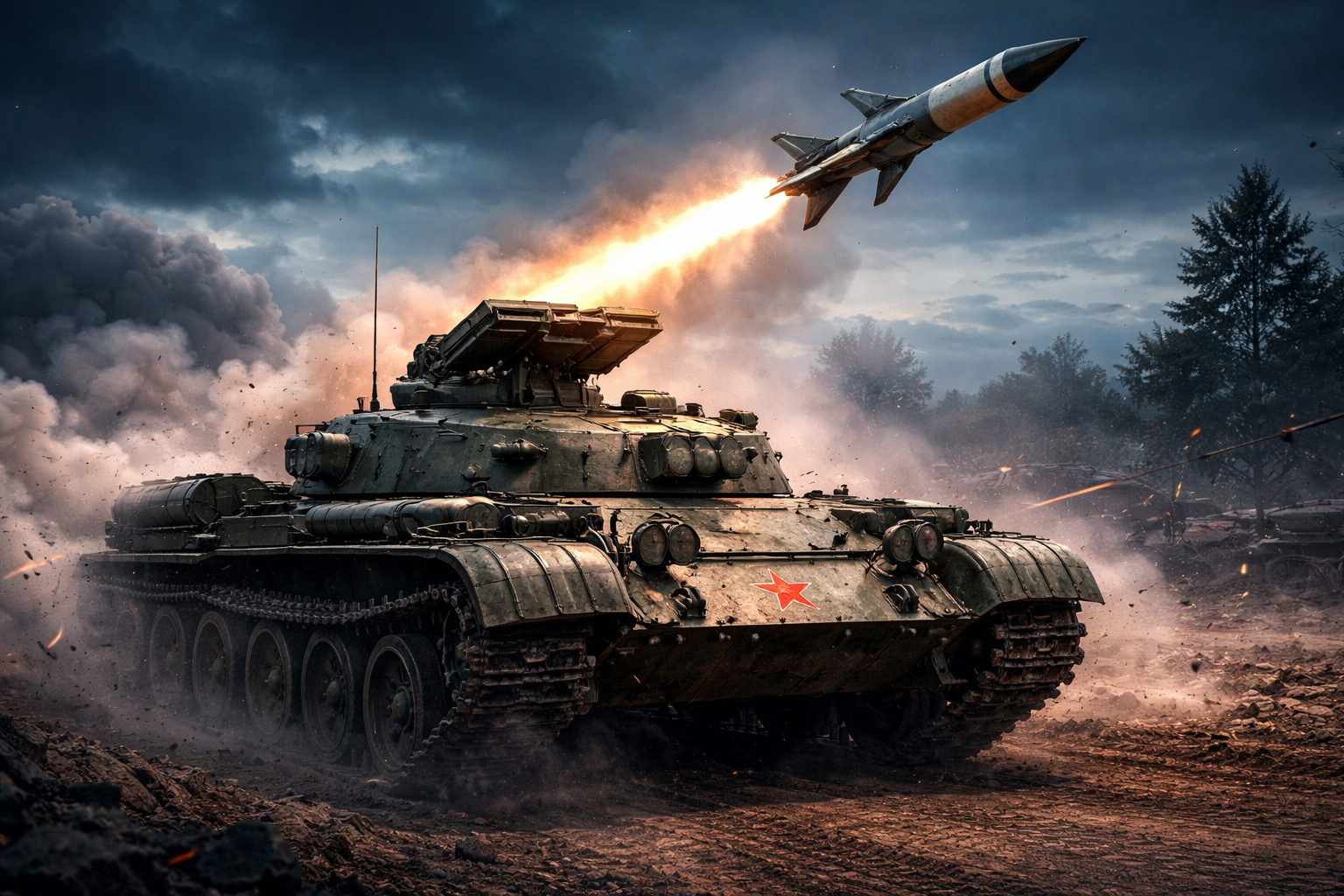
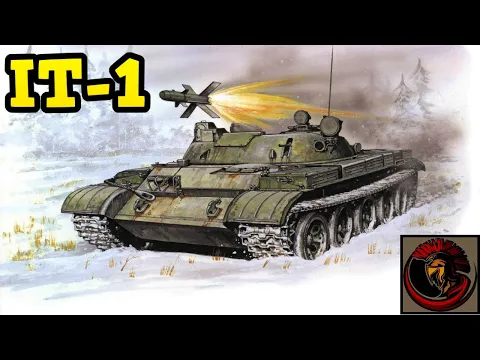
IT-1 Istrebitel Tankov: The Soviet Tank with Drakon Missiles Based on the T-62 that Replaced the Gun with ATGMs, Produced in the 1960s and Retired After a Few Years.
The IT-1 Istrebitel Tankov was a Soviet missile-destroyer tank developed in the 1960s using the T-62 tank chassis. The vehicle employed an unusual concept for the time: completely replacing the conventional gun with an anti-tank guided missile system. Its main armament was the 2K4 Drakon system, equipped with a pop-up retractable launcher installed in a low-profile turret. This mechanism allowed the missile to emerge from inside the turret only at the moment of firing.
The vehicle was produced between 1968 and 1970 by the Uralvagonzavod factory, with around 220 units built. It entered service in the Military Districts of Belarus and the Carpathians, operated by crews of three: driver, gunner, and commander. The IT-1 weighed approximately 35 tons, had armor equivalent to the T-62, and achieved a maximum speed of 50 km/h. The system could fire missiles even with the vehicle moving at up to 20 km/h.
Despite its innovative features, the vehicle had an extremely short operational life. It was retired from service around 1970, just five years after entering operation, due to tactical problems and technical limitations.
-
Spain surprises the world by erecting 62 artificial dunes, mixing sand with natural remains of posidonia, and causing the structure to lose only 1.4% of its volume in 1 year.

-
With 16 Bulava missiles, improvements in acoustic stealth, and a design focused on silent patrols, Russia’s nuclear submarine was born to ensure Moscow’s invisible retaliation and has become one of the pillars of its maritime strength.

-
‘Populous’ city in Rio among the worst in Brazil in national ranking and exposes silent development crisis.

-
Couple buys house in the South Zone of São Paulo, opens a hidden door in the garage, and finds a secret wine cellar with dozens of old wines forgotten since the 1970s.

The Concept of a Tank with Missiles Emerges in the Soviet Union in the 1950s
During the 1950s and 1960s, the military world experienced a true fascination with guided missiles, driven by technological advances after World War II.
In military aviation, some fighters even abandoned cannons altogether, relying exclusively on air-to-air missiles. Inspired by this trend, the Soviet Union began to explore the possibility of applying the same concept to tanks, replacing the gun with guided anti-tank missiles.
The first discussions about installing ATGMs (Anti-Tank Guided Missiles) on Soviet tanks began between 1955 and 1956.
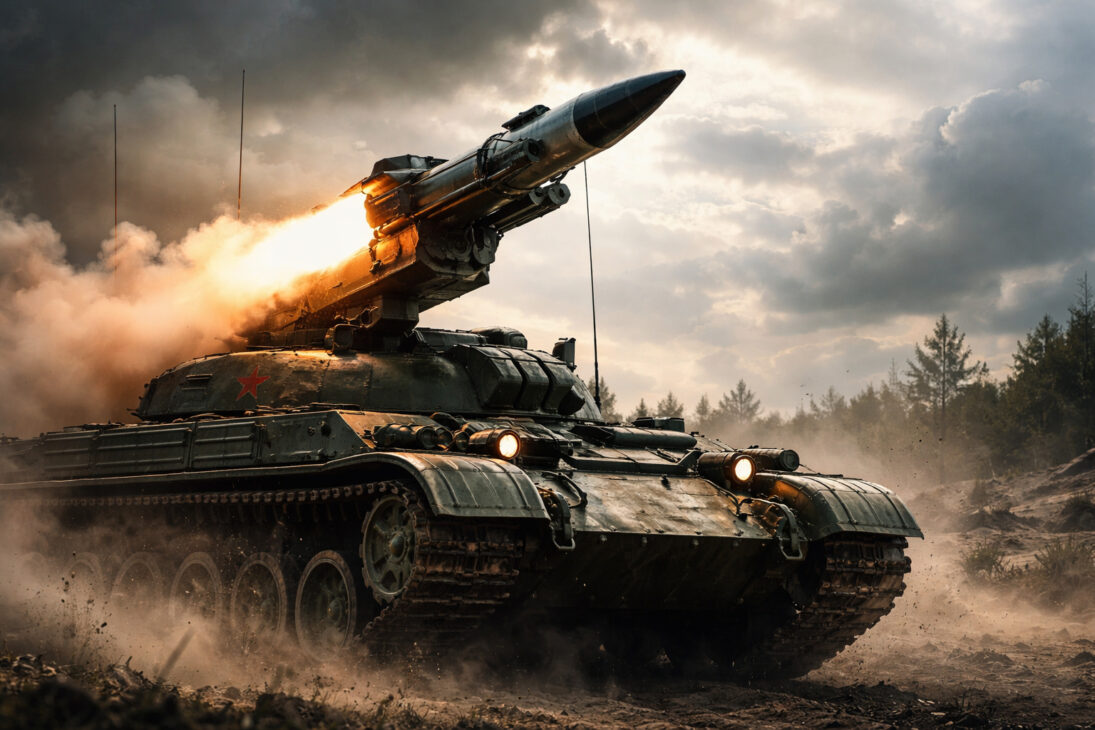
The goal was to create an armored vehicle whose main armament would be a guided missile, rather than just a secondary system. This approach differed from the French strategy of the time, which used external launchers mounted outside the armor.
The technical challenge was enormous. Missiles took up a lot of space inside the vehicle and the radio guidance system required complex and heavy equipment. Nevertheless, several experimental projects were initiated.
The Development of the Drakon Missile Went Through Several Design Bureaus
The development of the Drakon system began in 1955, but faced delays and changes of responsibility among different Soviet design bureaus.
Initially, the project was under the responsibility of OKB-16, which defined the overall appearance of the missile. Later, the program was transferred in 1959 to Bureau CKB-14, which conducted most of the development. The final result was the 3M7 Drakon guided missile, part of the complete 2K4 Drakon system.


The missile had a maximum range of 3,300 meters, although during night operations the effective range was much lower, as the operator needed to visualize the target. Even with infrared vision systems, the nighttime range was between 400 and 600 meters.
The T-62 Chassis Was Chosen as the Base for the Missile Tank Object 150
During development, the vehicle was designated Object 150. The choice of the T-62 chassis was logical, as the tank was already in mass production in the Soviet Army. This facilitated maintenance and logistics.
The engine was also the same as that of the T-62, allowing a maximum speed of about 50 km/h on the road. The total weight of the vehicle was around 35 tons, relatively light for a tank destroyer of the time.
The turret was completely redesigned to accommodate the retractable launcher for the Drakon missile. The low profile helped reduce the vehicle’s silhouette, making it harder to detect on the battlefield.
The 3M7 Drakon Missile Had SACLOS Guidance and a Cumulative Warhead
The 3M7 Drakon was approximately 1,240 mm long and had a caliber of 180 mm. The total weight of the missile was around 54 kg, including a cumulative warhead of approximately 5.8 kg. The solid-fuel motor accelerated the missile to about 220 meters per second.
The guidance system was semi-automatic radio command (SACLOS). The operator kept the aim on the target while the system transmitted commands to the missile during flight.
The HEAT warhead was capable of penetrating around 250 mm of armor inclined at 60 degrees, a value sufficient to destroy many Western tanks of the time, including models like the M48 Patton and the early M60.
However, the missile had a minimum range of 300 meters, creating a dangerous dead zone around the vehicle.
The Pop-Up Retractable Launcher Allowed Firing Missiles from Behind Cover
One of the most striking features of the IT-1 was its pop-up retractable launcher. During the firing sequence, a hatch on the turret’s roof opened, and the rail with the missile was hydraulically raised out of the turret. The missile’s wings then automatically unfolded before launch.
The missile was fired at a slight upward angle to reduce aerodynamic interference at the beginning of flight. The system allowed firing with the vehicle moving at up to 20 km/h, something relatively advanced for the time.
To avoid interference among different IT-1 vehicles, the system used seven frequencies and two control codes.
The Automatic Loader Stored Only 15 Drakon Missiles
The IT-1 carried a total of 15 3M7 Drakon missiles. Twelve of them were stored in an automatic loader inside the turret, while three were kept in an unarmored external box at the rear of the turret.
Each missile was stored in an elongated rectangular container. During loading, the missile was raised out of the turret, the container was discarded, and the fins opened before firing. Although relatively fast, this process left the vehicle exposed for a few seconds.
Another serious problem was the limited amount of ammunition. Conventional tanks carried between 40 and 50 shells, while the IT-1 had only 15 missiles.
The 520 kg Guidance System Caused Heat and Maintenance Problems
The biggest technical problem of the IT-1 was the missile guidance system. The equipment weighed about 520 kg and occupied a large part of the interior of the turret. In addition, it used vacuum tubes, a technology that was already beginning to become obsolete in the 1960s.
These tubes generated a large amount of heat inside the combat compartment and required constant maintenance.
If the system failed, the vehicle was practically defenseless. The only secondary armament was a coaxial PKT 7.62 mm machine gun with 2,000 rounds, insufficient against armored vehicles.
Production of the IT-1 Occurred Between 1968 and 1970
The Object 150 officially entered production in 1968, receiving the designation IT-1 Istrebitel Tankov, which literally means “Tank Destroyer-1”. Production took place at the Uralvagonzavod factory in Nizhny Tagil.
About 220 vehicles were manufactured between 1968 and 1970, although some sources indicate slightly lower numbers.
The IT-1 was designated for units located in the Military Districts of Belarus and the Carpathians, with the goal of supporting T-62 tank formations.
The 300 Meter Dead Zone Limited the Use of the Missile Tank
The most serious tactical problem of the IT-1 was the missile’s minimum range. During the day, the engagement window was between 300 and 3,300 meters. However, at night, the maximum range dropped to only 400 to 600 meters, leaving an extremely small combat window.
This meant that the vehicle could not adequately defend itself in close combat. Although tests conducted in 1964 showed that the IT-1 could destroy more enemy vehicles than conventional tanks in long-distance battles, these results depended on ideal conditions.
In 1969, the 9M14 Malyutka (AT-3 Sagger) missile entered service. This system was much cheaper, lighter, and easier to operate. It could be used by infantry or mounted on light vehicles.
Furthermore, the Malyutka did not require a heavy 520 kg guidance system like the Drakon. With similar performance and much lower cost, the new missile quickly rendered the IT-1 obsolete.
The IT-1 Was Retired from Service a Few Years After Entering Operation
The IT-1 was retired from service around 1970, after just a few years of use. The produced vehicles were converted into recovery vehicles, with the complete removal of the missile system.
The robust T-62 chassis continued to be useful for recovery and logistical support tasks. The IT-1 was never exported and never saw real combat.
The Legacy of the IT-1 Led to the Development of Tanks that Fire Missiles Through the Gun
Despite the failure of the concept of a tank exclusively armed with missiles, the Soviet Union did not abandon the idea of integrating guided missiles into tanks. The lessons learned led to the development of hybrid systems.
Later tanks such as T-64, T-72, T-80, and T-90 began to use 125 mm guns capable of firing guided missiles through the tube itself. This solution allowed the combination of conventional ammunition for close combat with guided missiles for distant targets.
The IT-1 is now remembered as one of the most radical experiments in Soviet military engineering. The vehicle demonstrated great technological ambition, including SACLOS guidance, firing on the move, and a range of up to 3,300 meters.
However, limitations such as 300 meter dead zone, limited ammunition, and high technical complexity rendered the concept impractical. Today, an example of the IT-1 is preserved in the Kubinka Museum, near Moscow, alongside other Soviet experimental projects.
It stands as a reminder that not all radical innovations become operational successes — but often it is through these experiments that the most efficient solutions for subsequent generations of military technology emerge.







Seja o primeiro a reagir!