





 English
  Francês
  Alemão
  Italiano
  Japonês
  Norueguês
  Portuguese
  Spanish
  5 min of reading
  0 comments


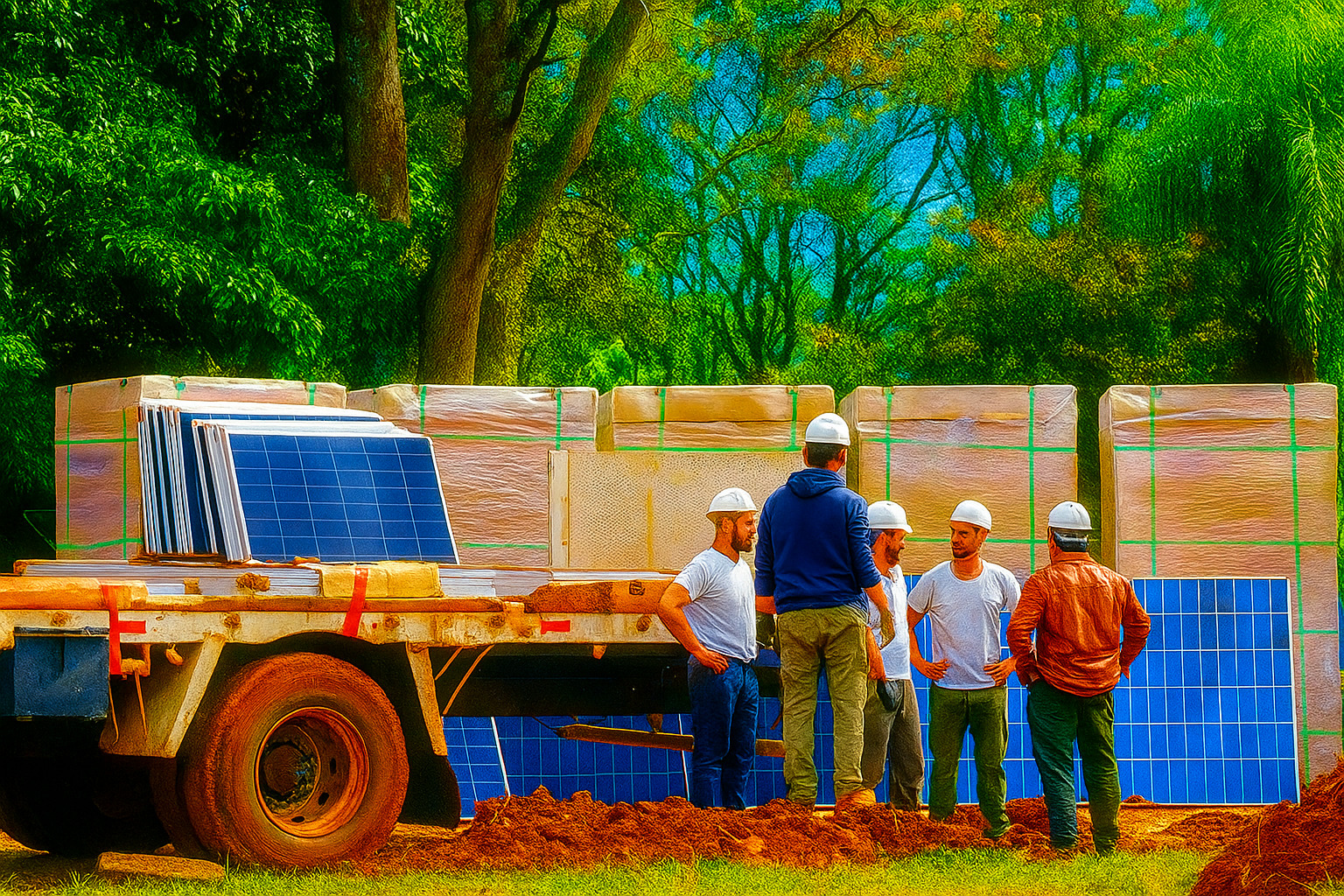
Discover How Itaipu Invests in Renewable Energy to Diversify Its Matrix and Double Its Clean Energy Production with a Focus on Sustainability and Innovation.
Since its inception, the Itaipu Hydroelectric Power Plant has represented a landmark in the integration between Brazil and Paraguay. Located on the Paraná River, this engineering giant began operations in 1984. Since then, it has continuously supplied a large part of the energy demand for both countries.
Currently, more than 85% of Paraguay’s energy and about 9% of Brazil’s comes from the plant.
However, times have changed. Over the past few decades, the climate crisis has intensified and demanded new solutions. In this regard, Itaipu has taken on a leading role and broadened its horizons.
-
Renewable energy advances over protected areas in Brazil, and a survey by the Energy Transition Observatory reveals silent impacts that challenge environmental conservation and pressure sensitive traditional territories.

-
Rio Grande do Sul accelerates energy transition: State invests in renewable technologies and consolidates decarbonization strategies and pathways to attract billions in new industrial investments.

-
With 160,000 m² of collectors, an area larger than 20 football fields, Silkeborg, in Denmark, hosts a solar thermal plant that heats 19,500 homes and could become the largest solar heating plant in the world.

-
A study reveals the expansion of renewable energy procurement in Brazil and shows how companies are taking advantage of opportunities to reduce expenses, ensure energy efficiency, and strengthen strategic environmental commitments.


Itaipu invests in renewable energy as a way to adapt to current demands and future needs. Thus, the company reinforces its commitment to sustainable development and technological innovation.
As the world seeks alternatives to fossil fuels, Itaipu is preparing to double its clean energy production. To achieve this, it relies on the combination of different renewable sources.
The company aims to harness the natural wealth of Brazilian and Paraguayan territory.
Solar Energy as a New Technological Frontier
First and foremost, it is important to understand how Itaipu started its journey towards energy diversification. Although its base remains hydroelectric, the company has taken an important step by investing in solar generation.
With the installation of 1,500 floating solar panels in its reservoir, Itaipu creates a hybrid production model, uniting water and sun.
Consequently, this innovation allows energy generation even during dry periods. At the same time, it reduces pressure on water resources and contributes to energy security.
As the project progresses, the expectation is that 10% of the reservoir area could be used to install solar panels, which would double the plant’s current capacity.
Additionally, the pilot project serves as a test bed. Thus, technicians evaluate the environmental impact, energy efficiency, and potential for replication in other parts of the country.
Therefore, this strategy demonstrates the company’s commitment to research, sustainability, and energy autonomy.
Green Hydrogen: Fuel of the Future
At the same time it invests in solar energy, Itaipu invests in renewable energy focusing on green hydrogen, a promising alternative.
Produced from the electricity of the plant itself, this fuel does not emit pollutants and can be used in different sectors, such as transportation and industry.
In this way, hydrogen production occurs within the Itaipu Technological Park (Parquetec), which conducts research in partnership with universities and innovation centers.
Currently, it is already possible to generate 1 kilogram of hydrogen per hour, enough to power a car for 150 kilometers.
Moreover, Itaipu will showcase its hydrogen-powered boat prototype at the COP30, a UN conference that will take place in Belém. Thus, the company demonstrates to the world that it is possible to replace diesel engines with clean solutions, especially in sensitive areas such as the Amazônia.
Therefore, by investing in this technology, Itaipu not only contributes to emission reductions but also stimulates the creation of sustainable production chains.
Thus, the company solidifies its position as a reference in energy innovation in South America.
Biogas: Energy Born from Waste
In addition to the sun and hydrogen, Itaipu also invests in renewable energy through biogas, an energy source that transforms organic waste into electricity.
Thus, the company utilizes food scraps and agricultural waste to generate biomethane and thermal energy.
For example, in Toledo (PR), a project supported by Itaipu and CIBiogás uses waste from 40,000 pigs to produce electricity.
As a result, about 1,500 homes are supplied with clean energy, while producers gain a new source of income.
Furthermore, the adoption of biogas follows the principles of the circular economy, as it transforms waste into resources.
This also reduces the environmental impacts caused by improper waste disposal and improves soil and water quality.
Thus, Itaipu’s proposal is to replicate this model in other rural areas, strengthening the decentralized generation of energy and promoting local development.
Through biogas, the company reinforces its presence in communities that have historically been left out of the traditional electrical system.
Modernization of the Treaty and Expansion of Activities
In order to allow Itaipu to operate more broadly in the renewable energy sector, it will be necessary to review the treaty signed between Brazil and Paraguay in 1973.
After all, the original document was limited to hydroelectric production.
In light of this, both countries have already begun dialogues to update the agreement. With this change, Itaipu will be able to trade solar energy, biogas, and hydrogen, as well as develop new projects in partnership with other institutions.
Thus, a potential update of the treaty will bring greater operational freedom and pave the way for even larger investments.
Consequently, the company will be able to extend its positive impact beyond the current concession area, reaching regions lacking energy infrastructure.
Therefore, the treaty revision appears as a crucial step to consolidate Itaipu’s role in the energy transition of the South American continent.
Itaipu Invests in Renewable Energy: Building the Future with Clean Energy
In light of so many advancements, it is evident that Itaipu invests in renewable energy with strategic focus and a vision for the future.
The company understands that only with a diversified and sustainable matrix will it be possible to ensure energy supply in the coming years.
Combining hydroelectricity, solar energy, biogas, and green hydrogen, Itaipu is building an innovative, efficient, and environmentally responsible model.
Although the path requires continuous effort, the achievements thus far demonstrate that the energy transition is underway — and that Brazil plays a prominent role in this scenario.
In addition to meeting current needs, this energy transformation also prepares the country for the challenges of tomorrow.
Through technology, research, and respect for the environment, Itaipu proves that it is possible to grow without destroying.
By transforming its operations and doubly its clean energy production, Itaipu reaffirms its commitment to the future.
In this way, it positions itself as a change agent, capable of inspiring other countries and influencing global policies in favor of renewable energy.









Seja o primeiro a reagir!