





 Portuguese
  English
  Spanish
  5 min of reading
  0 comments


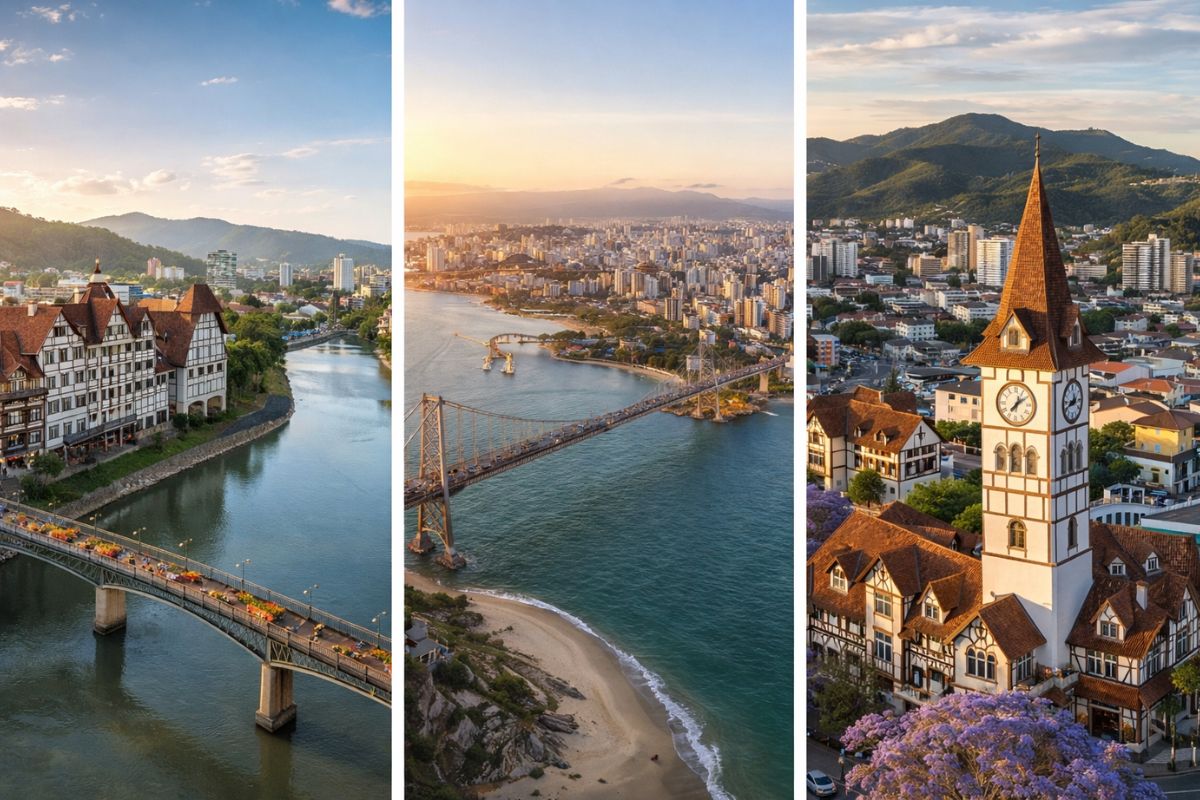
Santa Catarina, a southern state of Brazil, dominated the happiness ranking inspired by the UN’s World Happiness Report, with Jaraguá do Sul (8.94), Joinville (8.91), and São José (8.90) in the top three positions, evaluated across eight dimensions including safety, health, and economic stability.
When discussing quality of life in Brazil, the names that usually come up first are São Paulo, Rio de Janeiro, or Brasília. But a southern state has just completely dominated the country’s happiness ranking, placing three cities in the top positions with excellence scores above 8.9. Santa Catarina is the state with the best well-being indices in Brazil in 2026, according to a survey inspired by the UN’s World Happiness Report and published by Revista Bula based on auditable public data. Jaraguá do Sul leads with 8.94, followed by Joinville with 8.91 and São José with 8.90.
What makes this result even more significant is that the ranking does not only measure personal satisfaction. The study evaluated eight structural dimensions to measure the well-being of the population in the southern state and across the country, including personal safety (weighted at 16%), material and economic capacity (15%), health and longevity (15%), social support, freedom of choice, public integrity, livability, and community engagement.
These are not opinions. They are measurable data that explain why this southern state delivers a quality of life that major Brazilian centers cannot replicate.
-
Brazil on the radar of the space race in Latin America: what NASA’s new phase with the Artemis Program reveals about Alcântara, the best address in the world for rocket launches.

-
How a 100 m² rudder controls ships carrying 21 thousand containers and reveals the part that keeps the giants of the sea on course.

-
China is using colored laser lights on highways to prevent drivers from falling asleep at the wheel, and the technology acts as a silent alarm that is already reducing fatal accidents due to fatigue.

-
American couple renovates over 100-year-old castle in Texas and transforms historic building with Italian marble, mahogany panels, and eight fireplaces into a retreat that blends memory, grandeur, and comfort.

The three cities in the southern state that lead the happiness ranking

According to Revista Bula, Jaraguá do Sul, Joinville, and São José are not metropolises. They are medium-sized municipalities that have managed to balance economic growth with urban organization and the provision of essential services.
Jaraguá do Sul, with a score of 8.94, is the happiest city in Brazil according to the ranking, a locality known for its diverse industrial hub that generates qualified employment and maintains low unemployment rates. The combination of stable income and affordable cost of living creates conditions that larger cities do not offer.
Joinville, the largest city in the southern state of Santa Catarina, ranked second with 8.91. It is the largest industrial hub in the state and one of the cities with the best urban infrastructure in the southern region.
São José, with 8.90, completes the podium as part of Greater Florianópolis, offering proximity to the capital without the high cost of living of the island. The three cities in the southern state share characteristics that the ranking values: safety, employment, accessible public health, and efficient urban management.
The criteria that explain why the southern state leads in happiness
The ranking is not based on subjective perception. The eight criteria used measure concrete conditions that affect the daily lives of the population in the southern state and all the evaluated cities. Personal safety, weighted at 16%, is the most relevant factor.
Municipalities with low crime rates, like those in Santa Catarina that lead the list, directly benefit from this criterion. Material and economic capacity, weighted at 15%, assesses income, employment, and purchasing power of the population.
Health and longevity, also weighted at 15%, measure access to health services and life expectancy. The other criteria, social support, freedom of choice, public integrity, livability, and community engagement, complete a multidimensional assessment that captures what it means to live well in a city.
The southern state of Santa Catarina stands out because its highest-scoring municipalities deliver consistent results across all these dimensions simultaneously, not just in one or two.
Why medium-sized cities in the southern state outperform capitals in the ranking
The pattern identified by the study challenges the logic that large cities offer more quality of life.
Medium-sized municipalities have stood out for managing to balance economic growth with urban organization, something that metropolises with millions of inhabitants often fail to achieve due to traffic, violence, high housing costs, and overload on public services. The southern state of Santa Catarina exemplifies this pattern.
Jaraguá do Sul has just over 180,000 inhabitants. Joinville has around 600,000. São José, approximately 250,000. None of these cities face the scale problems that São Paulo, Rio de Janeiro, or Belo Horizonte encounter daily.
Commutes are shorter, health services are more accessible, safety is greater, and the cost of housing allows workers to live close to their jobs. The southern state proves that urban happiness does not depend on size. It depends on management, infrastructure, and balance.
Other cities in the southern state that appear in the happiness ranking
The dominance of Santa Catarina is not limited to the podium. In addition to the top three, other cities in the southern state also appear among the highest-rated in the country, such as Pomerode and Florianópolis, reinforcing the consistency of results in the region.
This is not an isolated case where a single exceptional city skews the average upwards. It is a state pattern where multiple municipalities deliver scores above 8.5, classified as excellent in well-being.
Florianópolis, the capital of the southern state, was already recognized as one of the cities with the best quality of life among Brazilian capitals. Its presence in the ranking confirms that the Santa Catarina model of urban development works both in tourist cities and industrial hubs.
Pomerode, known for its German cultural heritage and high social indicators, is another example of how the southern state has built an ecosystem where different city profiles can deliver well-being above the national average.
What the happiness ranking reveals about the future of Brazilian cities
The performance of the southern state in the ranking suggests a development model that can serve as a reference for the rest of the country. Efficient infrastructure, low crime rates, access to quality public services, and economic diversification are the pillars that support the results from Santa Catarina.
None of these factors are exclusive to the southern state. They are management and investment choices that other regions can replicate.
The analysis indicates that the determinants of urban happiness in Brazil are more structural than emotional. Safety, income, health, and decent housing weigh more than climate, landscape, or entertainment.
The southern state demonstrates that when these basic elements are resolved, the happiness of the population is reflected in measurable indicators. For Brazilians considering moving to another city in search of quality of life, Santa Catarina offers not only beautiful beaches but also concrete data that justify the move.
Do you live in Santa Catarina or have you ever thought about moving to the happiest southern state in Brazil? What weighs more in your quality of life assessment: safety, employment, or housing cost? Share in the comments. Rankings like this generate important debates about what it means to live well in Brazil.






Seja o primeiro a reagir!