





 Portuguese
  English
  Spanish
  6 min of reading
  0 comments


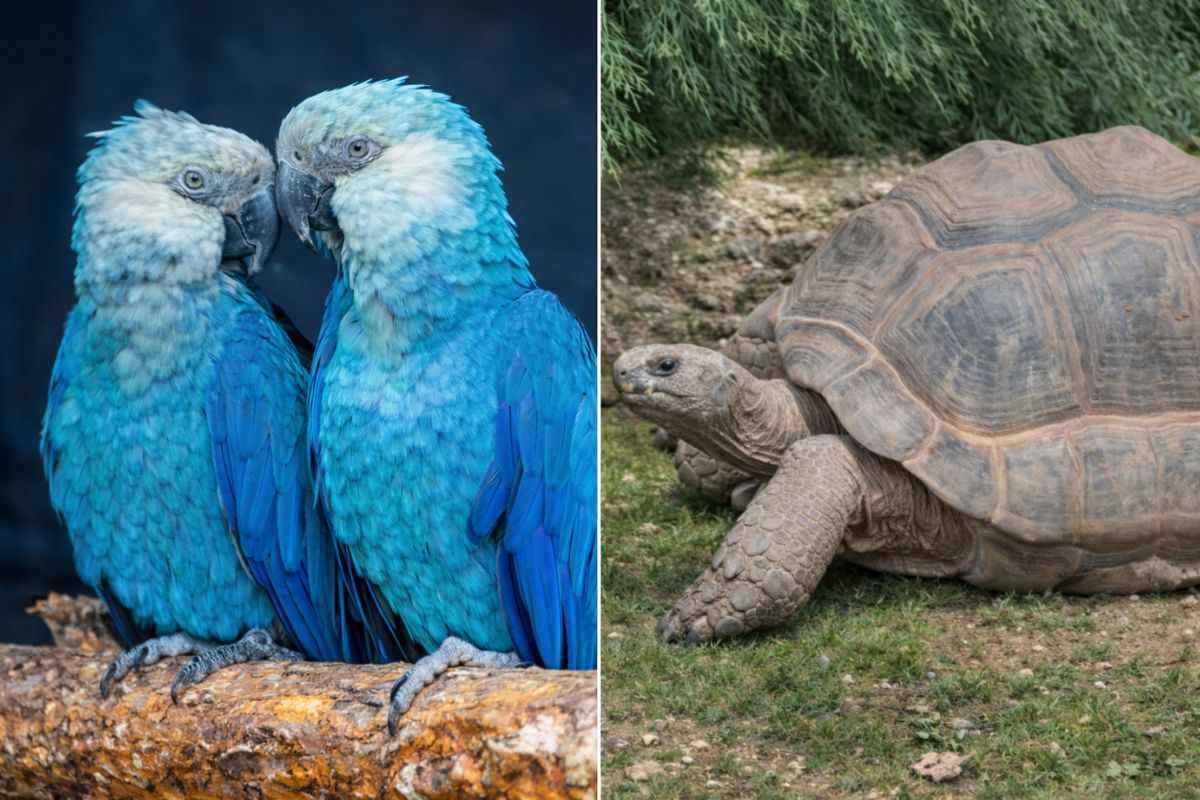
In A Conservation Center, Giant Tortoise And Blue Macaw Bring The Aldabra Giant Tortoise And The Caatinga Blue Macaw Closer To The Conservation Of The Blue Macaw And The Conservation Of Endangered Species.
The encounter between giant tortoise and blue macaw seems unlikely, but says a lot about how we deal with endangered species. On one side, one of the largest tortoises on the planet, with a saddle-shaped shell and the ability to live about 150 years. On the other, a bird symbol of the Caatinga, which almost disappeared from Brazil and today depends on centers abroad and an international project to return to its original biome.
In this scenario, giant tortoise and blue macaw meet in highly controlled facilities, with strict biosecurity, sanitized water, and professional management, far from the romantic image of “animals loose in the wild.” The story of these animals shows that serious conservation requires science, structure, and difficult decisions, not just good intentions.
A Giant Tortoise That Never Leaves Its Shell

The first part of this story begins with a giant tortoise from Aldabra, considered the second largest land tortoise in the world, right after the Galápagos tortoises.
-
From sertanejo star to international investor: Ana Castela invests millions in a mansion in the USA, creates a themed accommodation in Orlando, and shows that the “boiadeira” also wants to grow away from the stage.

-
The 10 most stunning motorhomes in the world: a $3 million trailer with a rooftop nightclub and garage for a Ferrari, “palaces on wheels” with Italian marble, private cinema, and five-star hotel luxury for billionaires.
-
Trump wanted to spend $400 million on the White House, but the courts prohibited the million-dollar construction.

-
How the Egyptians erected giant structures like pyramids, temples, and obelisks without modern technology, cranes, or engines still amazes the world and reveals the power of engineering based on ramps, levers, ropes, and colossal organization.

It impresses with its size, robustness, and a characteristic that many people still do not understand well.
Unlike what many drawings suggest, the giant tortoise never leaves its shell. Its spine is fused to the shell, which is literally part of its skeleton.
There is no scene of the animal “escaping from inside” to walk around. This shell is both the home and the body, a rigid shield that accompanies the animal throughout its life.
The most accepted theory to explain the presence of these giants on islands like Aldabra is that their ancestors arrived floating on rafts of vegetation from the South American continent.
Over time, they became isolated, grew, and occupied niches that only a giant tortoise could fill.
Saddle-Shaped Shell And A 150-Year Metabolism
A detail that draws attention in many Aldabra individuals is the structure called “saddle” on the shell, a bump at the front that completely changes how the animal feeds.
When the saddle is taller, the tortoise can lift its neck more and reach higher, bushy vegetation, and not just the low grass.
In other subspecies or populations, with a lower saddle, the reach is smaller and the diet tends to consist of grasses and low vegetation. The design of the shell defines the menu and the ecological role of the animal.
These giant tortoises can live about 150 years, with a slow metabolism and a tranquil life. They eat a wide variety of vegetables, legumes, and fruits, including leaves, pumpkins, bananas, beets, carrots, watermelons, and hibiscus flowers.
Calcium is also essential, and calcified structures of mollusks help in the calcification of the shell and the skeleton. When the tortoise becomes decalcified, the shell starts to form pyramids and loses the expected smooth shape.
In Brazil, we have much smaller tortoises, such as the species carbonaria and denticulata. The denticulata grows larger, but none reach the size of the giants from Aldabra or Galápagos.
This makes the giant tortoise a living reminder of how evolution, isolation, and time can produce truly extreme animals.
Behind The Scenes Of A Center That Carries Water, Biosafety, And Conservation Seriously
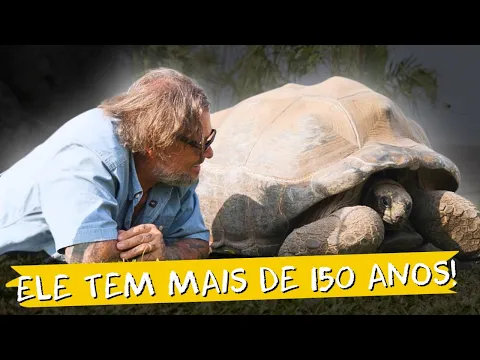

The giant tortoises mentioned in this account live in facilities that are not open to the public, and this is not by chance. There, the concern is not to set up a walk-through zoo, but rather to create an environment of conservation and well-being.
Water, for example, undergoes a rigorous process. It is sanitized and regularly monitored in the laboratory, to ensure quality for both the animals and the people who circulate there.
Laboratory tests verify that sanitization does not affect the animals and that the water remains safe, within ideal parameters.
These backstage details help to understand that when talking about giant tortoises and blue macaws within a serious project, there is no room for improvisation.
The structure is designed to reduce risks, avoid diseases, control environmental quality, and keep the focus on conservation, not on spectacle.
Blue Macaw: A Brazilian Heritage That Needed Foreign Help
The second part of the story involves the blue macaw, a bird native to the Brazilian Caatinga, which has become a symbol of one of the country’s most sensitive conservation cases.
For years, as the species disappeared from nature in Brazil, it was foreign centers that maintained viable populations of blue macaws in captivity, ensuring that the species did not completely vanish.
This still generates controversy, but it is a fact mentioned directly: Brazilian heritage ended up being better managed abroad than here during certain periods.
At the visited center, linked to the Vantara project, there are about 12 pairs and two additional females, totaling 26 individuals of blue macaw.
Like other psittacines, this bird can live over 50 years and takes a few years to start breeding, entering the reproductive phase around 4 or 5 years of age.
Many people in Brazil still confuse the Caatinga blue macaw with other species, such as the blue-and-yellow macaw from the Amazon and Pantanal or the Lear’s macaw.
The blue macaw, however, is typical of a biome often forgotten, the Caatinga, one of the six major Brazilian biomes.
The Project To Bring The Blue Macaw Back To Brazil

Vantara acts as a partner of the Brazilian government in the conservation of the blue macaw. The declared role is twofold. On one hand, to keep birds in captivity with a high standard of biosafety and management.
On the other, to be a platform for coordination among the different conservation partners, where the best ways to eventually free these birds back to Brazil are discussed.
The idea is for the project to be linked to the reintroduction site in the species’ original biome. The blue macaw is Brazilian, and the ultimate goal is for it to fly again in Brazilian territory, under controlled conditions, with subsequent monitoring and long-term follow-up.
The account itself acknowledges that, in the past, the reintroduction process had failures. There were releases with few birds, sanitary problems such as the circulation of circovirus, deaths, and planning failures.
The criticism is clear: many policies were too romantic and not technical enough, focusing on the act of releasing the animal, and paying little attention to monitoring, disease, and the viability of populations over time.
Conserving blue macaw is not just opening a cage and saying “bye, little bird.” The key to success lies in monitoring, in habitat protection, in disease control, and in the integration of captive conservation and conservation in the natural environment.
Between Giant Tortoise And Blue Macaw: Romantic Conservation Or Real Conservation
When we bring together giant tortoise and blue macaw in the same story, what emerges is a strong contrast between discourse and practice.
On one hand, we see giant tortoises and rare birds kept in enclosures with biosafety structure, water tests, technical management, and long-term planning, in an environment that is not thought of as a tourist attraction, but as a conservation base.
On the other, the memory of Brazilian policies often marked by romantic conservation, focusing on feelings of pity and the discourse of “poor little animal in a cage,” without understanding the critical role of ex situ conservation.
Keeping an animal in captivity in a well-structured center, with serious protocols, can be just what ensures it still exists when the natural environment is ready to receive it back.
Giant tortoise and blue macaw are, in this context, two living reminders that conservation requires realism, humility, and partnership.
Realism to recognize past failures. Humility to learn from those who have made concrete advances, even if abroad. And partnership to build solutions that unite Brazil and foreign institutions in the same direction.
In your opinion, is Brazil prepared to treat the conservation of species such as giant tortoise and blue macaw with the same seriousness here, or do we still stumble too much on romantic discourses and little real structure?






-

-

-

-

16 pessoas reagiram a isso.