





 Portuguese
  English
  Spanish
  6 min of reading
  43 comments


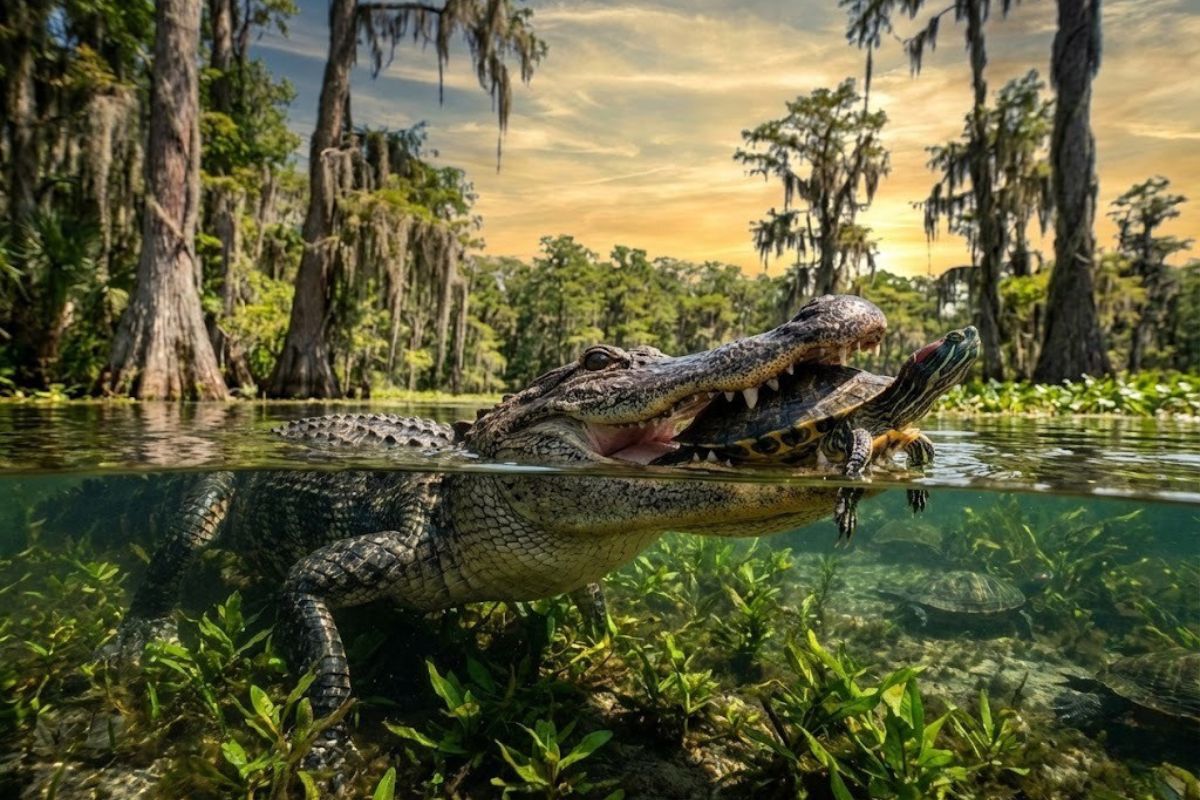


Recovered Alligators Have Returned to Dominate Wetlands in Florida and Louisiana and Have Begun Predating Invasive Red-Eared Slider Turtles Linked to Turbid Water, Algae, and Pathogens. Besides Bites, The Simple Presence and Fake Alligator Baits Have Already Knocked Down Their Sunbathing and Reproduction Quickly.
The Alligators have returned as masters of swamps and marshes in the United States and, along with this return, an unexpected side effect has emerged: the decline of one of the most problematic invaders for urban lakes and flooded areas, the red-eared slider turtle.
What seems like an improbable plot turns into a concrete sequence of impacts: fewer turtles invaders sunbathing and laying eggs, less pressure on aquatic plants, clearer water, less algae bloom, and a brake on the circulation of diseases that these turtles can carry and spread.
How The Red-Eared Slider Turtle Became A Global Problem

The red-eared slider turtle spread around the planet as a “cheap pet,” with hatchlings sold for low prices, easy to transport and simple to keep at first.
-
Xiaomi launched a 10-kilogram washing machine for less than R$910.00, so slim that it fits inside a kitchen cabinet with only 15 millimeters of clearance, featuring 24 washing programs and voice control.

-
April begins with above-average heat and irregular rains in Brazil as El Niño warms the Pacific and exceeds 80% probability for the second half of 2026, with a risk of frost in the mountains and a winter that may repeat the extremes of 2023.

-
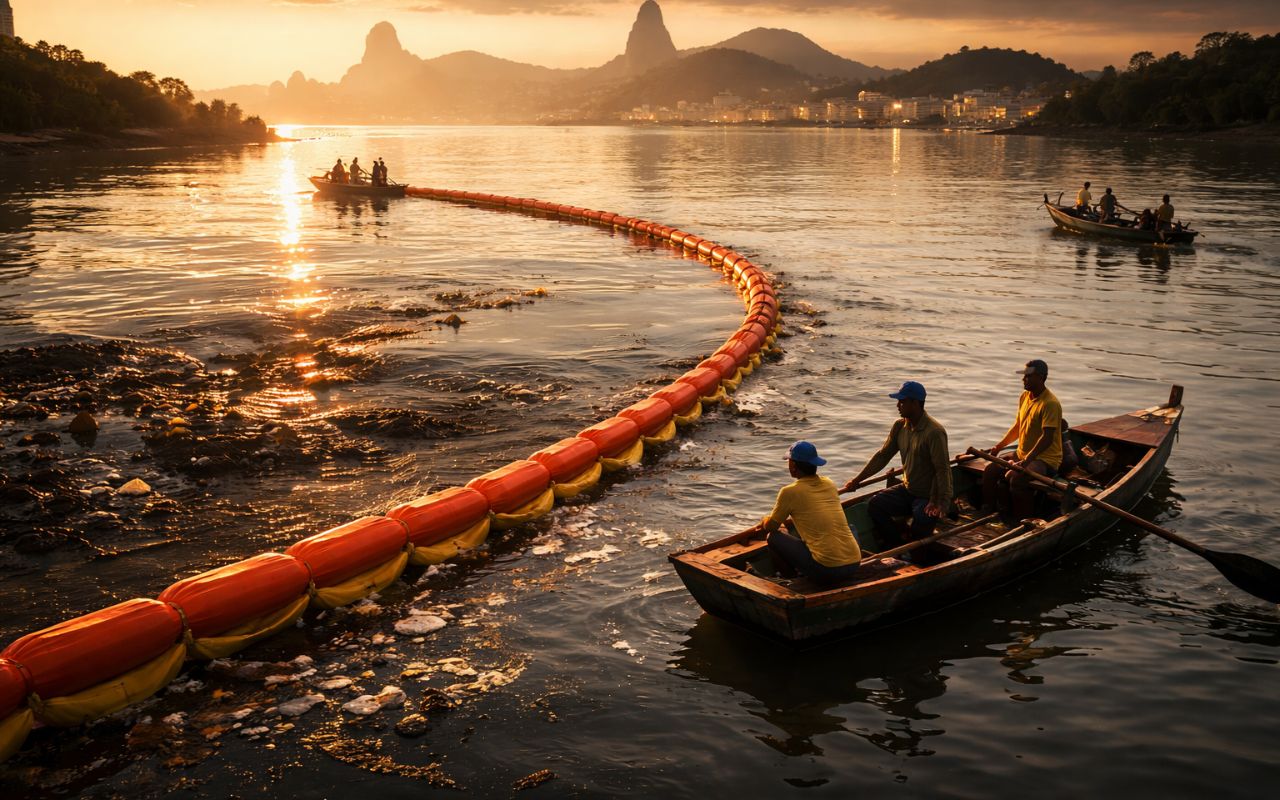
A barrier made with hair strands is used to clean the Guanabara Bay and employs simple technology to contain oil and waste.
-
The oceans are darkening all over the planet – what is happening?

The catch is that the beginning doesn’t last long: that animal that fit in a minimal aquarium soon grows and begins to require a large structure, with a tank of hundreds of liters, as well as a lot of food and constant cleaning.
When the routine becomes burdensome, many people choose the quickest route: they release the turtle into lakes in parks and public areas.
From there, the invader establishes itself on almost every continent, dominating urban ponds, and in some places, it begins to represent 80% to 95% of the turtles seen in the water.
The Push Of The Illegal Market And Releases “Out Of Compassion”

An old ban, aimed at reducing sanitary risks, ended up changing the trade without ending the circulation.
The sale of turtles smaller than 10.2 cm was banned in 1975, but this pushed part of the market into parallel schemes.
The result is gigantic: between 5 and 10 million hatchlings still enter circulation each year, through ads and fairs.
Besides abandonment, there is another engine of dispersion: rituals of release “out of mercy,” where animals are thrown into channels and lakes to supposedly generate merit.
In practice, this places millions of turtles in environments out of place, amplifying competition, ecological pressure, and disease risk.
Why This Invader Dominates So Quickly

The advantage of the red-eared slider turtle is a mix of longevity, high reproduction, and aggression for space.
It can live 30 to 40 years as a pet and 50 to 70 years in the wild. And a female can lay 20 to 30 eggs per season, repeating this for decades.
Even a few loose individuals can sustain a population long enough to outlast entire human generations.
There is also an urban accelerator: temperature can influence the sex of the hatchlings. In urban areas, soil and water tend to be 2°C to 5°C warmer, which favors the birth of more females.
In some park lakes, this pushes the population to something like 90% to 95% females, creating an expansion factory.
What Happens To Native Turtles And Water Quality
The damage is not limited to “the fight for space.” In small lakes, the presence of 15 to 20 invaders is already described as sufficient to depopulate native turtles by over 80% in a few years.
The first blow is in “sunbathing,” which is not leisure, but survival. Sunbathing regulates body temperature, reduces parasites, and aids in digestion.
The invaders occupy the best spots and push the natives into the water. Just losing one hour a day of sun can already reduce the reproduction of natives by up to 40%.
Then comes the food. The invader eats everything, from plants to small aquatic animals. In tests, it has consumed 70% to 90% of the offered food, leaving natives malnourished in a short time.
And there is an even more direct damage: invaders also attack eggs and hatchlings, with recorded destruction of nests reaching 95% in certain scenarios.
When the invader grows, the lake also changes. It bites off shoots, roots, and young aquatic plants, reducing the “natural filter” of the environment.
The water becomes murkier, light penetrates less, algae multiply, and oxygen decreases, pushing fish and other organisms into a stress scenario.
The Invisible Risk: Pathogens And Diseases Circulating In The Ecosystem
Another critical point is sanitary. The invader can carry and spread microorganisms capable of affecting other species.
In outbreaks associated with aggressive pathogens, the effect can be quick and devastating for local populations, transforming a lake into a disease hotspot instead of a balanced habitat.
Therefore, the problem is not just biodiversity. It is also ecosystem health and water quality.
Why Catching “By Hand” Almost Never Solves
The idea of removing all invaders seems simple, but the practice turns into a war of resistance. They can stay submerged for 45 to 60 minutes, bury themselves in the mud, and vanish with noise or vibration. Even large cleanup efforts capture dozens when the lake harbors hundreds.
Traps can remove many individuals in a season, but reproduction quickly replenishes the population.
And there is a side effect: traps also catch native turtles, requiring sorting and return while the main problem continues regenerating.
The Turnaround: Alligators Return And The Invader Loses Its Advantage

This is where the Alligators come as the missing piece. Their return was not planned to “hunt invasive turtles.” It was a consequence of decades of protection after a period of intense hunting, drainage of wetlands, and persecution.
The species reached its limit and was formally listed in 1967, undergoing a long recovery process until it began to spread strongly again.
When the Alligators reappear in swamps, marshes, and waterways, they put pressure on the invader in two ways.
The first is direct: a bite capable of crushing shell and preying on juveniles and adults. The second is even more impactful in the daily life of the lake: the psychological effect.
The invaders, especially those that came from urban environments, tend not to have the same “danger map” as the native species that have coexisted with alligators for a long time. The result: they continue climbing on trunks and vulnerable banks and pay the price.
With alligators present, the population of invaders can decline by 35% to 60%, not just through predation but also because they start avoiding the best sunbathing spots, mate less, and lay fewer eggs.
In some scenarios, just the “shadow” of the predator already reduces reproduction by about 50%.
Fake Alligators: The Bait That Scares, Measures, And Accelerates Recovery
When it became clear that fear is part of control, teams tested fake alligators in urban lakes: simple floating models, artificial heads, and versions with cameras to monitor behavior.
The effect observed was quick: in 2 to 3 weeks, in 12 urban lakes, the sunbathing spots previously dominated by the invader saw a decrease of 80% to 90% in the presence of the red-eared slider turtle. Meanwhile, native turtles continued using their usual areas without the same level of retreat.
This distancing changes the lake indirectly: with fewer invaders grazing on aquatic plants and pressuring the food chain, the water begins to clear, plants reappear, and the lake’s edge returns to functioning as a nursery for small fish.
What This Story Reveals About “Fixing” Ecosystems
The strongest point is that the solution did not come from chemistry or an impossible total capture operation. It appears when the ecosystem recovers an essential piece: a predator that reorganizes behavior, reproduction, and habitat occupancy.
The Alligators do not “erase” the invader from the map overnight, but they make its life more difficult, slow down the pace of expansion, and return space to native species and to the water quality itself.
In your opinion, using real alligators and fake alligators as continuous pressure is the smartest way to control invaders in urban lakes, or does this open up other concerns that few people are seeing?






Isso e bom ela e uma espécie cardápio do jacaré o predador chefe do lago,mesmo sendo invasora ela se adapitam ao ambiente e se torna parte da **** alimentar,ao invés de ser o desequilíbrio total,agora suas população seram devoradas e sobrará às mais ágeis e apostas e mesmo elas ainda seram prendadas quando derem bobeira,e sua reprodução será lenta e natural pois agora não e uma espécie sem controle,igual o javali no Brasil que não têm predador e reproduz sem medo.
Pois é, jacarés em lagos urbanos são ótimos para o convívio com banhistas aos domingos e feriados, piqueniques familiares, onde crianças, mulheres e jovens podem tomar sol ‘a vontades ‘a beira dos lagos. Boa orientação, essa reportagem, hein?
Método perfeito e natural…usar Jacarés reais e jacarés falsos como pressão contínua é o caminho mais inteligente para controlar invasoras em lagos urbanos!!!
Como os lobos reintriduzidos no aeque de Yelestone equilibraram o ecossistema…o mesmo irá ocorrer com onoassar do tempo.