





 Portuguese
  English
  Spanish
  5 min of reading
  0 comments


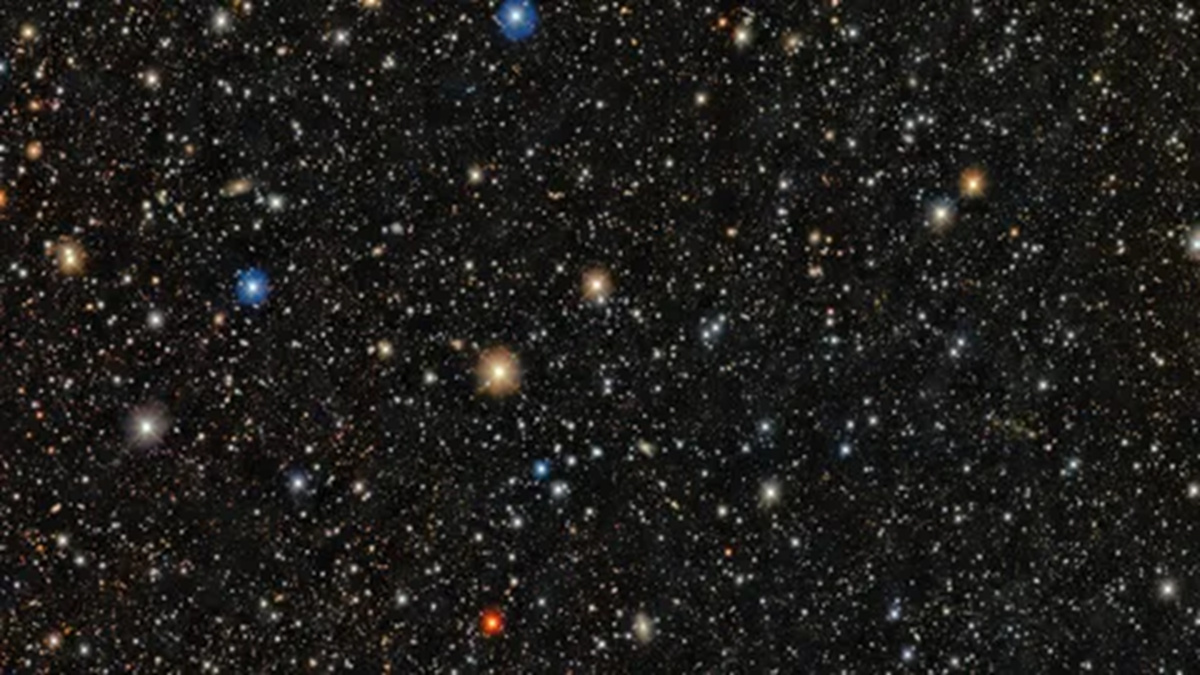
The discovery of about 300 ancient galaxies with massive scars and brightness above expected challenges current models of universe formation and reinforces astronomers’ doubts about what happened in the first moments after the Big Bang
Astronomers have identified more than 300 distant galaxies in the universe with marks described as massive scars, without a defined apparent cause so far. The set of objects, observed with the support of the Hubble and James Webb space telescopes, has begun to challenge the current understanding of how the first cosmic structures emerged and evolved after the Big Bang.
This discovery adds to a sequence of recent results that have expanded the observational capacity of the deepest regions of the cosmos. With new instruments and more advanced sensors, astronomy has begun to see further back in time and space, revealing phenomena that until recently were obscured by space dust or beyond the reach of previous technologies.
These 300 structures have been described as objects too bright for what current models can explain about the early moments of the cosmos. If confirmed as galaxies, they may indicate that the primitive universe was much more violent and explosive than initially thought.
-
Haiti’s capital is experiencing an energy and construction crisis, facing blackouts, a blocked port, and buildings at risk after years of instability and a significant earthquake.

-
Government unlocks R$ 554 million for a highway that has been requested for decades and accelerates the duplication of BR.

-
Without bricks, without cement, and without endless construction: the cardboard house that is assembled in modules and can be moved.

-
Billions of barrels on the equatorial margin could lead Amapá to double its oil production in Brazil — the state aims to enter the route of companies in the Campos Basin, attract investments, and boost jobs and businesses in the oil and gas sector.

Hubble and Webb expanded the reach of the universe
The Hubble marked the first major stage of space observation of the deepest regions of the cosmos through a telescope placed outside Earth. Its ability to analyze visible and ultraviolet light allowed for images comparable to human vision, but with much greater range and detail.
This advancement paved the way for observations of a universe still in its infancy, offering astronomers images of the cosmos from 13.4 billion years ago. From this material, it became possible to expand the mapping of remote areas and deepen the investigation into the formation of the first structures in space.
The James Webb Telescope elevated this process to another level by operating with sensors optimized to capture infrared light. This characteristic allowed observations beyond large plumes and clouds of space dust that had blocked the view of older regions of the universe for generations.
As a result, Webb began to reveal what was happening even before what Hubble could already record, reaching images of the cosmos from 13.5 billion years ago. The expansion of this horizon transformed the search for answers about the origin and evolution of the universe into an even more intense research front.
Recent discoveries have made space stranger
The combination of new technologies and continuous observation has produced a succession of discoveries described as decisive for astronomy. Among them, Webb allowed tracking a huge asteroid that dangerously approached the Moon’s orbit, expanding the range of detections in strategic regions of space.
Another recent milestone came with the first image of a black hole, obtained through the Event Horizon Telescope project. The initiative brought together various existing radio telescopes and transformed the planet into a virtual dish the size of Earth, in an operation considered unprecedented.
The advancements also helped reveal phenomena of difficult interpretation, such as tiny red dots crossing the cosmos at about 965,000 kilometers per hour. These dots, according to NASA, are actually distant stars that exploded in a violent death of epic proportions.
The sequence of these findings reinforced the perception that the night sky holds more complex processes than previously thought. Amid distant cosmic explosions, excessively bright objects, and structures whose origin remains unexplained, the universe has presented an even more challenging scenario for astronomers.
The 300 galaxies with scars challenge explanations
The most recent case gained prominence in an article titled “NASA’s Webb Telescope has just found 300 galaxies that challenge explanations,” published in ScienceDaily. The text reports the identification of about 300 distant galaxies with evidence of massive scars that intrigue researchers.
These objects are not treated as common stars, but as candidates for some of the oldest galaxies formed in cosmic time. The central problem is that they appear too bright in light of what current understanding admits about the emergence and evolution of the cosmos.
Researchers from the University of Missouri classified these celestial bodies as “cosmic rule breakers.” The expression summarizes the difficulty in fitting these records into the parameters accepted so far for galactic formation in the early moments of the universe.
The observations were made using the James Webb Telescope, whose infrared reading allowed for the detection of very distant galaxies. From this work, astronomers concluded that these objects seem to have formed with much more energy and in a much shorter period than current knowledge can explain.
What these scars may indicate about the universe
The presence of these massive scars in hundreds of objects raises the possibility of extreme processes in the early times of the cosmos. If the 300 records are indeed confirmed as galaxies, the picture will suggest that the primitive universe experienced a more explosive, intense, and violent phase than previously believed.
This hypothesis directly alters the reading of how the first cosmic structures took shape after the Big Bang. Instead of an evolution compatible with what current models can describe, the data would point to faster, more energetic, and still poorly understood mechanisms.
The potential impact of this discovery does not appear in isolation, but alongside other mysteries that remain without definitive answers. Among them is the enigma of dark energy, cited as part of the set of questions that show how much is still left to understand about the early days of the universe.
The accumulation of observations made by Hubble and Webb reinforces that the investigation of the cosmos has entered a phase of accelerated expansion, but still surrounded by fundamental gaps. The deepest images already obtained have revealed a universe full of unexpected signals, the full meaning of which remains open.
First days after the Big Bang remain without definitive answers
The discovery of galaxies with scars emerges at a time when astronomers are still trying to decipher the basic processes that shaped the universe nearly 14 billion years ago. The combination of excessive brightness, rapid formation, and massive marks on these objects increases the pressure on existing models.
At the same time, the very instruments responsible for these observations show how the field has changed since the launch of Hubble and then James Webb. The growing reach of these missions has allowed for a deeper look into space and, in doing so, revealed a larger set of unanswered questions.
With nearly new discoveries emerging daily, astronomy has come to coexist with a paradoxical situation: the more the universe is observed, the harder it becomes to reduce its phenomena to simple explanations. The 300 galaxies with scars synthesize this moment by bringing together in a single finding unusual brightness, apparent violence, and absence of a clear cause.
This scenario keeps open one of the central questions of current cosmology: how these objects formed and how they may change the understanding of the origin of the universe. For now, the marks found in hundreds of distant galaxies remain one of the most disturbing signs ever revealed by the new human eyes turned toward the cosmos.









Seja o primeiro a reagir!