





 Portuguese
  English
  Spanish
  3 min of reading
  0 comments


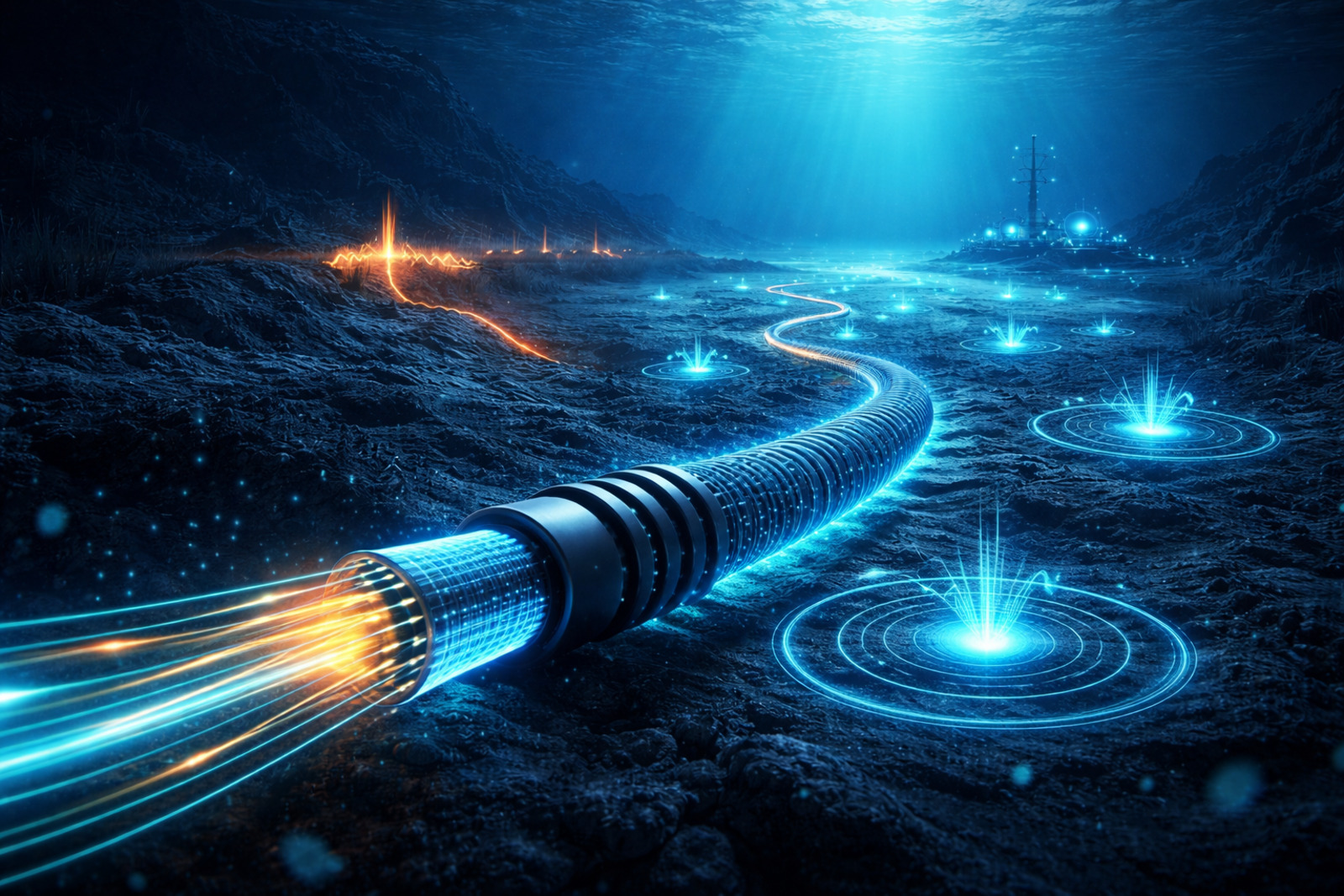
Network with 5,700 kilometers of cables in Japan transforms optical fibers into seismic sensors and strengthens alerts against earthquakes and tsunamis in the ocean
Researchers in Japan have begun using submarine cables as sensors to detect earthquakes and tsunamis, leveraging installed infrastructure to capture vibrations and enhance alerts to the general population.
How cables became sensors
The technique is called Distributed Acoustic Sensing, or DAS. The method sends laser pulses through optical fibers. When a vibration deforms the fiber, part of the light returns through Rayleigh backscattering.
By reading these reflections, scientists transform a single cable into thousands of virtual seismometers distributed along the structure.
-
In Mexico, a 3,000-year-old Maya site with the dimensions of an entire city may have been built as a colossal map of the cosmos, created to represent the order of the universe and reveal how this people organized space, time, and rituals.
-
Japan wants to build a solar ring of 10,900 kilometers on the Moon to continuously send energy to Earth.
-
Weighing almost 1 ton, with temperatures of up to 3,000°C, the ability to launch 10,000 fragments within a radius of 1 km, capable of penetrating concrete and melting steel, Turkey’s terrifying bomb emerges as one of the most destructive non-nuclear weapons ever presented.

-
After a submarine disappeared beneath the “Doomsday Glacier,” scientists announce a new monstrous machine capable of operating at 3,000 meters depth to return to the heart of the ice and investigate a threat that could raise sea levels worldwide.

This allows for locating tremors and measuring their intensity with a resolution of a few meters.
Why Japan invests in this system
Japan is located in one of the most tectonically active regions on the planet. The Pacific plate slides under the Eurasian plate. The Nankai Trough concentrates megathrust earthquakes and devastating tsunamis, including the one in 2011.
Since 2022, the country has invested in a submarine monitoring network with about 5,700 kilometers of cables on the seabed. The structure connects 150 stations with seismometers and pressure gauges.
This infrastructure allows for real-time monitoring of seismic activity and improves conditions for tsunami alerts.
Difference from traditional methods
Conventional seismometers operate at specific points, installed in specific locations. In contrast, DAS creates a continuous mesh of sensors along the cables, using the same infrastructure.
In the traditional model, the installation cost is high for each unit. In the cable system, coverage is distributed over kilometers, with metric resolution and suitable application for ocean depths.
This difference reduces a limitation of underwater monitoring. Instead of a few isolated points, readings occur continuously, covering remote areas without real-time monitoring.
Practical use in alerts
Institutions like JAMSTEC and the Japan Disaster Prevention Institute integrate data from the cables into national alert systems. The network covers areas like the Nankai Trough, central to tsunami risk.
In this system, early detection of primary waves, the P-waves, can anticipate the arrival of a tsunami by up to 20 minutes. This extends the available time for public warnings and emergency measures.
After the tragedy of 2011, the improvement of alert systems included the construction of this submarine network. Today, it allows for immediate evacuation of coastal areas and halting of trains and highways when a tremor is detected.
Submarine cables: results already observed
International tests with submarine cables have shown significant results. In a Google cable with 10,000 kilometers in the Pacific, more than 20 earthquakes with a magnitude greater than 5 and 30 storms were detected.
In Japan, the N-net network demonstrated the ability to identify tremors quickly enough to issue alerts about 20 seconds before the arrival of the strongest waves in certain locations.
The benefits are not limited to seismology. The same infrastructure can monitor ocean currents, ship noises, and the passage of whales, expanding knowledge about the ocean.
Complement to seismometers
Even with advancements, DAS does not completely replace conventional seismometers. On land, traditional instruments remain essential.
In the ocean, however, submarine cables fill a gap in continuous and detailed monitoring.
The combination of submarine cables, buoys, satellites, and land-based seismometers forms a robust early warning system.
In Japan, this integration saved lives during the tremors of 2025 and 2026, with a quicker response.
The Japanese experience shows how telecommunications infrastructure gains a new function in monitoring earthquakes and tsunamis.
By uniting different technologies, the country strengthens its prevention capacity against permanent risks at sea.
With information from BMC News.







Seja o primeiro a reagir!