





 Portuguese
  English
  Spanish
  5 min of reading
  0 comments


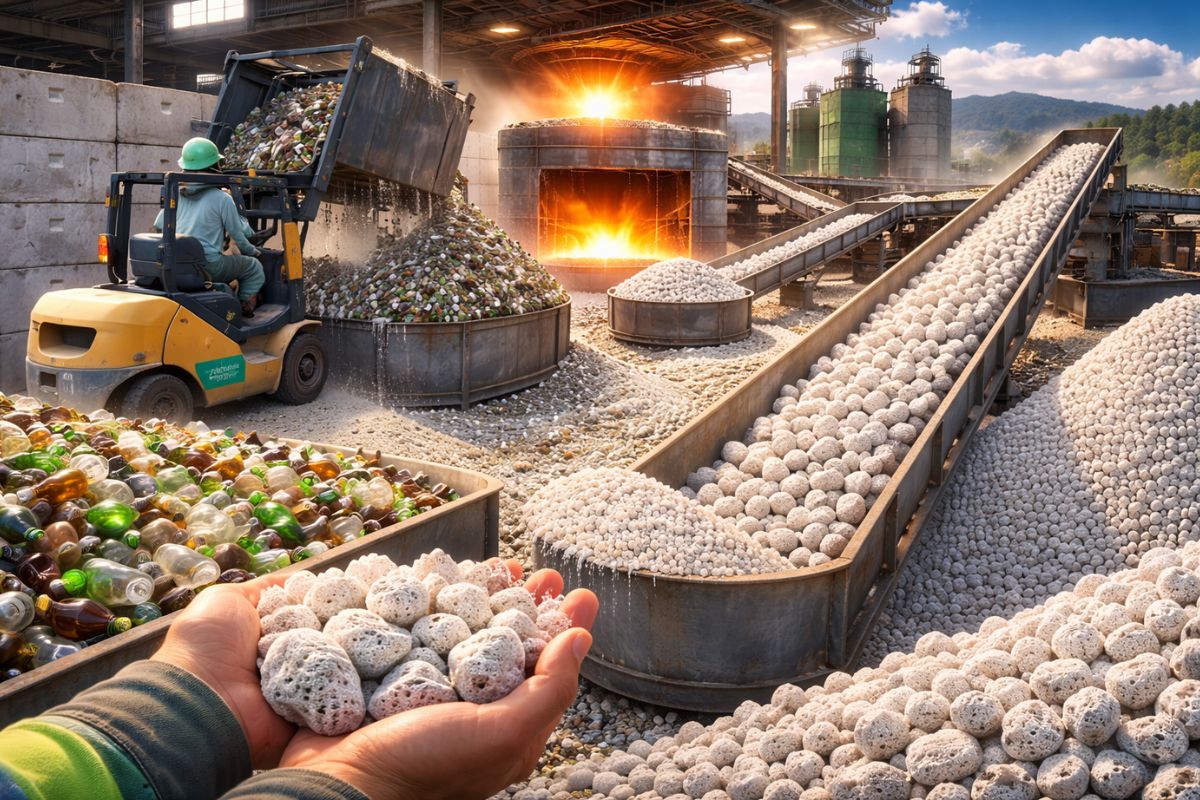
In Hiroshima, the glass waste that used to go to landfills undergoes crushing, drying, burning, and expansion until it transforms into Super Sol, a lightweight and foamy material applied in civil engineering, landscaping, agriculture, and domestic uses.
The waste repurposed by Cocco Co., Ltd. shows how discarded glass bottles can gain a new industrial function without returning to the traditional packaging recycling cycle. Instead of ending the journey in disposal, this glass enters a technical process that creates a new material with its own characteristics.
In Hiroshima Prefecture, Japan, the company works with used glass bottles from beverages and food to produce the so-called Super Sol. The result is a material often described as a type of artificial pumice, obtained from the crushing, burning, and expansion of discarded glass.
Glass that would go to waste finds another destination
-
Alone in the forest for 11 days, an indigenous teenager from Acre recounts how he changed his path, got lost in the dense jungle, and survived on wild fruits, water, and calm until he found a way out and was rescued.
-
Psychology has discovered that adults who describe themselves as “non-creative” almost always trace this belief back to a single moment in childhood when someone evaluated what they did instead of asking what it meant, and the wound was so small that they confused it with a personality trait.

-
Archaeologists found a 440-year-old silver coin buried under the ruins of a church in the Strait of Magellan, and it revealed the exact location of a Spanish colony where 300 people were abandoned and died of hunger in the place that the English renamed Puerto del Hambre.
-
Elected for the 9th time as the happiest country in the world, Finland has created a program that offers a free 7-day trip with all expenses paid for foreigners to learn how to live like Finns, including a companion, sauna, lake, and complete disconnection from their cell phones.


In Japan, about 1 million tons of glass bottles are produced annually. Part of this volume, especially in the case of some colored bottles, cannot enter the conventional recycling flow and ends up going to landfills.
It is precisely at this point that Cocco Co., Ltd.’s proposal gains strength. The company directs this glass waste to a repurposing process that not only attempts to recover the original packaging but also creates a different raw material with applications in various areas.
Super Sol is born from the transformation of discarded glass

Super Sol is presented as a lightweight and foamy material made from discarded glass bottles. The logic is simple in concept but requires a precise industrial sequence to transform waste into a usable product.
Instead of treating glass merely as worthless waste, the factory converts this material into a product that can serve civil engineering, landscaping, agriculture, and also domestic applications. This expands the potential use of a waste that could otherwise go to permanent disposal.
Process begins with collection, drying, and removal of impurities
The production of Super Sol begins with the collection of discarded glass bottles. After that, the raw material undergoes complete drying using the residual heat from the furnace, an important step to prepare the material before grinding.
Next, the process includes the removal of impurities. Plastic caps, labels stuck to the glass, and other unwanted residues are removed before and after crushing, so that the raw material proceeds with more uniformity to the following stages.
Crushing reduces glass to fine particles
After the initial cleaning, the glass enters the crushing stage. The broken bottles are ground until they reach a particle size of approximately 200 microns, using ceramic spheres.
Then, this crushed material is also screened to maintain the standard of glass powder. This particle size control helps prepare the base of Super Sol, which will later receive additives before proceeding to the burning line.
Burning between 800°C and 900°C makes the material expand
After mixing with additives, the glass powder is placed in the burning line. It is at this stage that the material undergoes temperatures ranging from 800°C to 900°C and expands, forming the lightweight and foamy structure that characterizes Super Sol.
This is the central moment of the transformation. What started as waste from discarded bottles takes on a new physical form, with properties that allow its use in different areas.
Recycled material goes to construction, gardens, and agriculture

Super Sol is primarily used as a civil engineering material, but it is not limited to that. The base sent shows that it can also be applied in landscaping, agriculture, domestic uses, and even as safety gravel.
This variety helps explain why the material attracts attention. It is not just about recycling for the sake of recycling, but about creating a new product with practical utility in different sectors, enhancing the industrial value of repurposed waste.
Discarded solar panels also serve as raw material
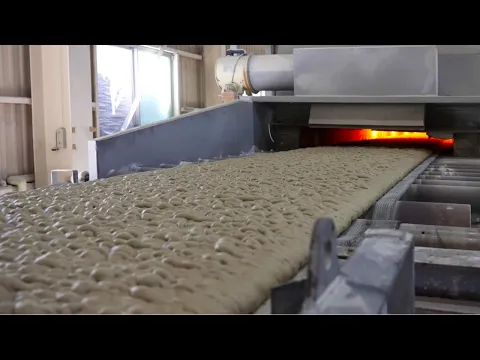

In addition to glass bottles, the company also utilizes glass from discarded solar panels as raw material for Super Sol. In this case, the aluminum structures removed from the panels are recycled as aluminum material, while the glass goes for repurposing.
The process also includes specific steps, such as blasting small steel spheres to remove the glass from the surface of the panels. Then, the panels without glass are sent for smelting, where silver extraction and recycling occur.
Recycling shows that waste can become an industrial resource

The case of the factory in Hiroshima helps to show that waste does not need to be seen merely as the final stage of disposal. When there is sorting, processing, and industrial application, waste can gain a new function and transform into input for other sectors.
In the case of Super Sol, this change occurs with a material that exits disposal and re-enters the productive cycle in another format. Bottles that would go to waste end up converted into a lightweight, expanded, and useful product, with concrete applications in construction, gardens, and agriculture.
Hiroshima transforms waste into material with a new function
The experience of Cocco Co., Ltd. summarizes this logic well. Instead of limiting repurposing to the more traditional model, the company creates a route where discarded glass becomes a different material, with its own identity and broad use.
By crushing, drying, cleaning, burning, and expanding the glass, the factory shows how waste can be repositioned as an industrial resource. And, in the case of Super Sol, this process also delivers a product that circulates through quite distinct areas, from construction to cultivation.
Do you think this type of solution for waste should gain more space in other industries as well?






Seja o primeiro a reagir!