





 Portuguese
  English
  Spanish
  6 min of reading
  0 comments


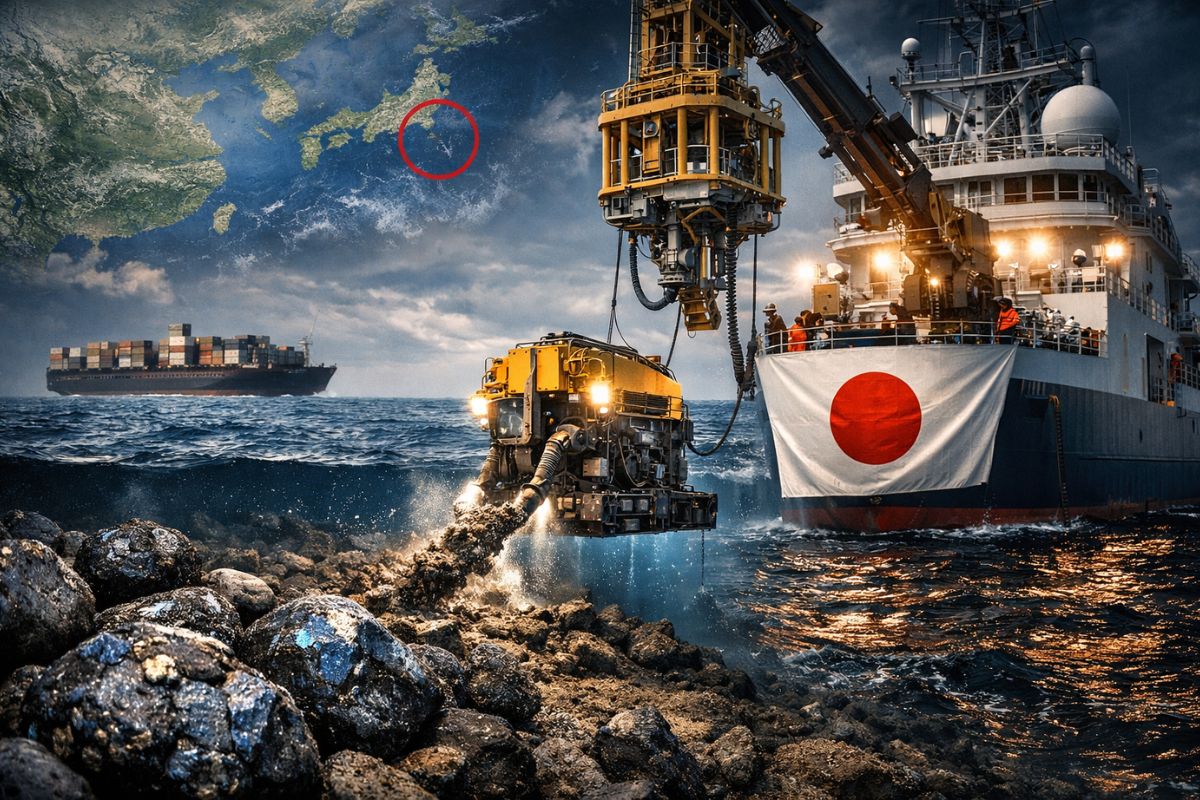
In Test Mission, The Government Says It Collected, On February 1st, Sediments With Rare Earths At 6,000 Meters From The Sea Floor. The Collection Near Minami Torishima, In The Exclusive Economic Zone, Will Be Analyzed And Could Reposition Japan In The Face Of China And The Race For Critical Minerals.
Japan announced that it collected sediments with rare earths at a depth of 6,000 meters in the seabed, during a test mission conducted on Sunday (Feb. 1, 2026) and disclosed by the government on Monday (Feb. 2, 2026). According to spokesperson Kei Sato, the details will still undergo analysis, including the exact amount of rare earths contained in the sample.
The operation was conducted by the deep-sea drilling research vessel Chikyu, which departed in January towards the remote Minami Torishima in the Pacific. The announcement comes amid a larger supply dispute, with Japan trying to reduce dependence on China for minerals considered strategic for industry and defense.
What Has Been Done At Sea And What Has Not Been Proven Yet

The collection described by the government is, above all, a test of capacity: reaching an extreme depth, retrieving material from the seabed and bringing the sample back with enough integrity for laboratories to measure composition and potential. This is why the announcement itself sheds light on the next stage, which is the analysis: what exists there, in what concentration, and with what technical viability.
-
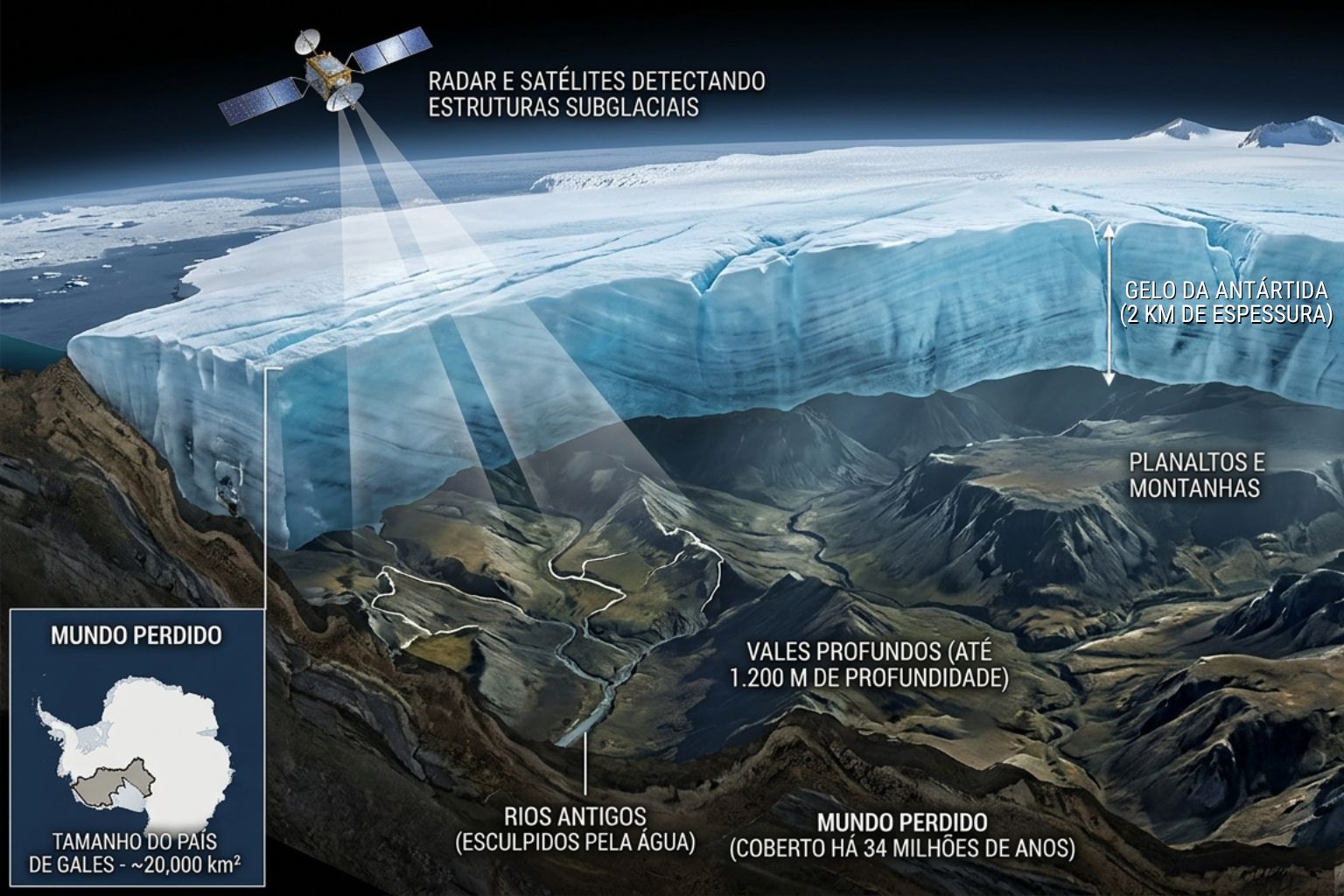
Satellites and radars revealed, beneath 2 kilometers of ice in Antarctica, a lost world the size of Wales, with rivers, valleys 1,200 meters deep, and plateaus sculpted by water, frozen for 34 million years, when the continent had temperate forests and was part of a supercontinent that included South America.
-
A 2 kg exoskeleton with an 800-watt motor and artificial intelligence that predicts movements in 2 milliseconds reduces the load on the legs by up to 30 kg, increases strength by 40%, and allowed an 84-year-old woman to climb mountains without falling behind.

-
The Senna Tower in Balneário Camboriú is using stakes considered unique in the world that go down 40 meters and are driven 5 meters into the hardest rock on the planet, with technology approved by the same engineer who designed the Burj Khalifa.

-
The drought may be pushing a much larger crisis than just a lack of water; in addition to affecting crops, reservoirs, and cities, it can also help strengthen bacteria that no longer respond well to antibiotics.

This detail indeed makes a difference. “Finding” rare earths in sediments is not the same as having a production flow. Between the sample and a regular supply lies a long road: deposit characterization, operation repetition, method standardization, cost evaluation, and political decisions about risks and benefits. Even so, the symbolism is enormous, because it points to an alternative route in a sector where “who supplies” weighs as much as “how much it costs.”
Why 6,000 Meters Is A Turning Point
Working at 6,000 meters imposes a package of challenges that do not appear on the surface: extremely high pressure, slow logistics, the need for robust equipment, and minimal margin for error. Each step, from drilling to lifting the material, demands fine control and repeatability. In other words: it’s not enough to go down once; it’s necessary to be able to go down consistently.
Another technical point is the difference between “material with the presence of rare earths” and “ready-to-use supply chain.” Even when a deposit is large, the bottleneck is often in extraction, separation, and processing. It is at this juncture that the story gains geopolitical weight: if Japan proves it can continuously extract rare earths from the region, it is not just adding a supplier; it is changing the vulnerability of its own industrial system.
What Are Rare Earths And Why Have They Become Instruments Of Power
The term “rare earths” refers to a set of 17 metals described as difficult to extract from the Earth’s crust, used in products ranging from electric vehicles to hard drives, wind turbines, and missiles. This cross-cutting use shifts the topic from mining directly to industry, as the lack of a specific component can halt entire production lines.
Therefore, the discussion is not just about having “reserves.” It is about reducing the risk of disruption, ensuring predictability of contracts, and sustaining key sectors when the international environment becomes more tense. In such markets, price matters, but the “risk of running out” can matter even more — and it is at this point that rare earths cease to be common commodities and become tools of economic security.
Why The Announcement Happens Now: China, Pressure, And “Dual Use”
The Japanese government framed the collection as part of an attempt to reduce dependence on China, which appears as the world’s largest supplier of rare earth elements.
The timing also coincides with a political escalation: after Prime Minister Sanae Takaichi suggested in November that Tokyo could respond militarily to an attack on Taiwan, Beijing intensified pressure and blocked exports to Japan of items described as “dual use,” with military potential.
In this environment, an operation like Chikyu’s gains dual significance. For the domestic audience, the message is “reduce fragility.” For the outside world, the message is “pursue autonomy.”
And this is precisely why the topic divides opinions: for some, it is a defensive response to supply risks; for others, it is another chapter in the race for critical minerals that could intensify regional competition.
Minami Torishima And The Size Of The Economic Bet
The area around Minami Torishima, in Japan’s exclusive economic waters, is described as holding more than 16 million tons of rare earths, an estimate attributed to Nikkei and regarded as the 3rd largest global reserve.
This number alone helps to explain why the operation was announced as “unprecedented” and presented as an achievement of economic security and maritime development.
But the transition from “potential” to “production” is what truly defines impact. A large reserve does not eliminate central questions: what is the useful concentration? What is the cost per ton of usable material? What are the operational and environmental limits? And, most importantly, what is the technological maturation timeline to move from a test to a routine extraction?
What Could Change In Practice: Industrial Chain, Diplomacy, And Risk
If Japan proves continuity, the consequence is not just internal. A new source of rare earths tends to affect contracts, inventory strategies, and investment decisions in sectors such as energy, technology, and defense.
The cascading effect may be silent, but profound: companies start negotiating with more alternatives, governments recalibrate alliances, and the topic gains more momentum in economic diplomacy.
At the same time, there is an important limit: any real advancement needs to pass public and political validation.
An associate researcher at IISS, Takahiro Kamisuna, quoted by AFP, summarizes the core of the debate: successfully extracting continuously in the region could guarantee domestic supply for key sectors. This phrase seems simple, but it carries the weight of the “if” and this “if” depends on science, cost, governance, and social acceptance.
The Less Discussed Factor: Seabed, Responsibility, And Transparency
Deep-sea operations often encounter an inevitable point: environmental impacts and uncertainties.
Even without going into details beyond what has been disclosed, it is reasonable to understand that any expansion of this type of initiative requires rigorous evaluation, monitoring criteria, and a clear decision on limits. Without this, the discussion becomes just a geopolitical duel, losing the layer of responsibility that should accompany any intervention in the marine environment.
Also for this reason, the stage of “analyzing the details” is so important: it serves not only to quantify rare earths but also to determine whether there is a technically sustainable, economically defensible, and politically acceptable path.
In such a sensitive topic, transparency becomes part of the project, as it sustains legitimacy in front of allies, adversaries, and public opinion itself.
Conclusion: The Sample Is Small, The Potential Impact Is Great
Japan has placed in the water and brought from the sea floor a signal that it wants to reduce dependence and expand maneuvering room in a sector that defines who sets the pace in technology and defense.
For now, the story is still in the phase of sampling and analysis, but the simple fact of having reached 6,000 meters changes the tone of the debate: it is no longer just about importation; it is about capacity.
If the extraction of rare earths in Minami Torishima progresses, what should Japan’s priority be: supply security at any cost, or a model with environmental brakes and total transparency? Would you trust a strategy that depends on the seabed? And, in your view, what weighs more: reducing dependence on China or avoiding a new global race for critical minerals without control?





-

-

-

-

-

-

78 pessoas reagiram a isso.