





 Portuguese
  English
  Spanish
  5 min of reading
  0 comments



After Decades of Megaprojects, Japan Changes Course: Cuts Billion-Dollar Urban Projects and Invests Heavily in Robotics, Automation, and Solutions for an Increasingly Aging Population.
In Tokyo, Japan, the change began to become clear from 2010, when reports from the Cabinet Office of Japan and the Ministry of Economy, Trade and Industry (METI) officially recognized a structural problem: the country had spent over US$ 60 billion on large urban projects, artificial islands, port expansions, and linear works in the previous decades, but was now facing demographic stagnation, accelerated aging of the population, and decreasing economic returns from these megaconstructions. From this period, political and budgetary decisions began to prioritize a different path: less concrete, more technology.
The End of the Era of Large Linear Works in Japan
During the 20th century, Japan was a global reference in heavy engineering. Projects like artificial islands, maritime airports, planned cities, and urban expansions over the sea marked post-war reconstruction and the economic boom of the 1970s to 1990s.
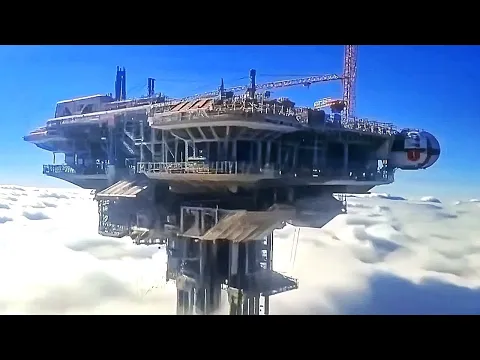

Works like the Kansai International Airport, built on a gigantic landfill in Osaka Bay, and entire neighborhoods built on coastal areas symbolized this ambition.
-
Motorola launched the Signature with a gold seal from DxOMark, tying with the iPhone 17 Pro in camera performance, Snapdragon 8 Gen 5 that surpassed 3 million in benchmarks, and a zoom that impresses even at night.

-
Satellites reveal beneath the Sahara a giant river buried for thousands of kilometers: study shows that the largest hot desert on the planet was once traversed by a river system comparable to the largest on Earth.

-
Scientists have captured something never seen in space: newly born stars are creating gigantic rings of light a thousand times larger than the distance between the Earth and the Sun, and this changes everything we knew about stellar birth.

-
Geologists find traces of a continent that disappeared 155 million years ago after separating from Australia and reveal that it did not sink, but broke into fragments scattered across Southeast Asia.

However, from the 2000s, these projects began to reveal hidden costs. Kansai Airport itself, for example, required billions of additional dollars in structural reinforcements due to soil subsidence. Studies from METI and the Ministry of Land, Infrastructure, Transport and Tourism (MLIT) showed that maintaining large linear structures and landfills began to consume disproportionate resources compared to the economic benefits generated.
US$ 60 Billion Invested and Decreasing Returns
According to data compiled by the Cabinet Office of Japan, only between the late 1990s and the first decade of the 2000s, the country directed over US$ 60 billion toward large-scale urban projects, including new port areas, coastal industrial zones, and metropolitan expansions. This volume of investment was designed for a continuously growing society.
The problem is that the demographic reality changed. In 2010, Japan began an irreversible process of population decline, accompanied by unprecedented aging.
Today, more than 29% of the Japanese population is 65 years or older, according to official government data. This drastically reduced the demand for new cities, extensive neighborhoods, and infrastructure aimed at territorial expansion.
The Demographic Shock That Redesigned National Priorities
The aging population is not just a statistical fact in Japan; it directly affects the economy, the labor market, and the country’s fiscal sustainability.

Reports published by the Cabinet Office between 2011 and 2015 indicated that maintaining the strategy of large physical works would mean immobilizing capital in underutilized structures, while resources would be lacking for critical areas like health, long-term care, and industrial productivity.
In light of this scenario, the Japanese government officially began to advocate for a paradigm shift: investing in technologies that replace scarce labor and increase efficiency, rather than physically expanding urban territory.
The Strategic Turn: Robotics and Automation at the Center of the Budget
From the 2010s onward, documents from METI began to classify robotics and automation as essential infrastructure, on the same strategic level as highways and ports had been in the past. Japan already had a strong industrial base in this sector, but investment gained national scale.
Programs like the Robot Strategy, officially launched in 2015, channeled billions of dollars into the development of industrial robots, elderly assistance robots, autonomous logistics systems, and service automation. The declared objective was clear: to compensate for the reduction in the human workforce without relying on large-scale immigration.
Technologies Focused on Aging Population

One of the clearest focuses of this new policy is the development of specific technologies for an aging society. The Japanese government began to fund projects for robotic exoskeletons, remote monitoring systems for the elderly, support robots in hospitals and nursing homes, and home automation solutions.
According to METI, these investments are not seen as social expenditures, but as economic strategy. The logic is simple: reduce costs in health and long-term care while creating a new exporting industrial sector capable of generating high-skilled jobs and revenues.
Less Artificial Cities, More Artificial Intelligence
Another central axis of this change was the prioritization of artificial intelligence and digital automation. Instead of financing new urban expansions, Japan began to direct resources to smart cities, based on sensors, data analysis, and optimization of existing infrastructure.

Reports from the Cabinet Office published after 2018 show that public policy began to emphasize the reuse and optimization of urban space, rather than creating new neighborhoods. Intelligent transportation systems, automated energy management, and digital networks largely replaced the logic of ongoing physical expansion.
The Silent Abandonment of Large Linear Works
Unlike other countries, Japan has not officially announced the “end” of large works. The process has been silent and gradual. Budgets allocated for large-scale linear projects have been reduced, while financing lines for robotics, automation, and AI have grown year after year.
Data from METI indicate that, between 2012 and 2022, direct public investment in advanced technologies consistently grew, while spending on new urban expansions remained stable or in real decline, adjusted for inflation.
A Change Forced by Reality, Not by Ideology
It is important to highlight that this shift was not motivated by environmental or ideological discourse. According to analyses by the Japanese government itself, this is a pragmatic decision. Building new cities, artificial islands, or extensive urban axes in a country that is losing population means creating expensive assets that are difficult to maintain and yield diminishing returns.
By investing in robotics and automation, Japan seeks to extract more value from each remaining worker, maintaining its global industrial competitiveness even with fewer people of working age.
The Global Impact of the Japanese Decision
The Japanese change is beginning to influence other developed countries facing similar challenges. Reports from universities and international organizations cite Japan as a real laboratory of transition between an economy based on heavy physical infrastructure and one centered on technology, automation, and efficiency.
Japanese companies in robotics, industrial sensors, and automated systems are already exporting solutions to Europe, South Korea, and even emerging countries facing skilled labor shortages.
Japan Post-Megaprojects
By slowing down large linear works and redirecting billions to technology, Japan has not abandoned engineering — it has redefined.
Concrete has made way for code, cranes have given way to robots, and territorial expansion has been replaced by increased productivity.
This change, clearly initiated from 2010, shows how a highly urbanized country, with limited territory and an aging population, chose to reinvent its development model. Less visible than a concrete city in the desert, but possibly much more decisive for the country’s economic future.








-

-

-

-

14 pessoas reagiram a isso.