





 Portuguese
  English
  Spanish
  6 min of reading
  0 comments


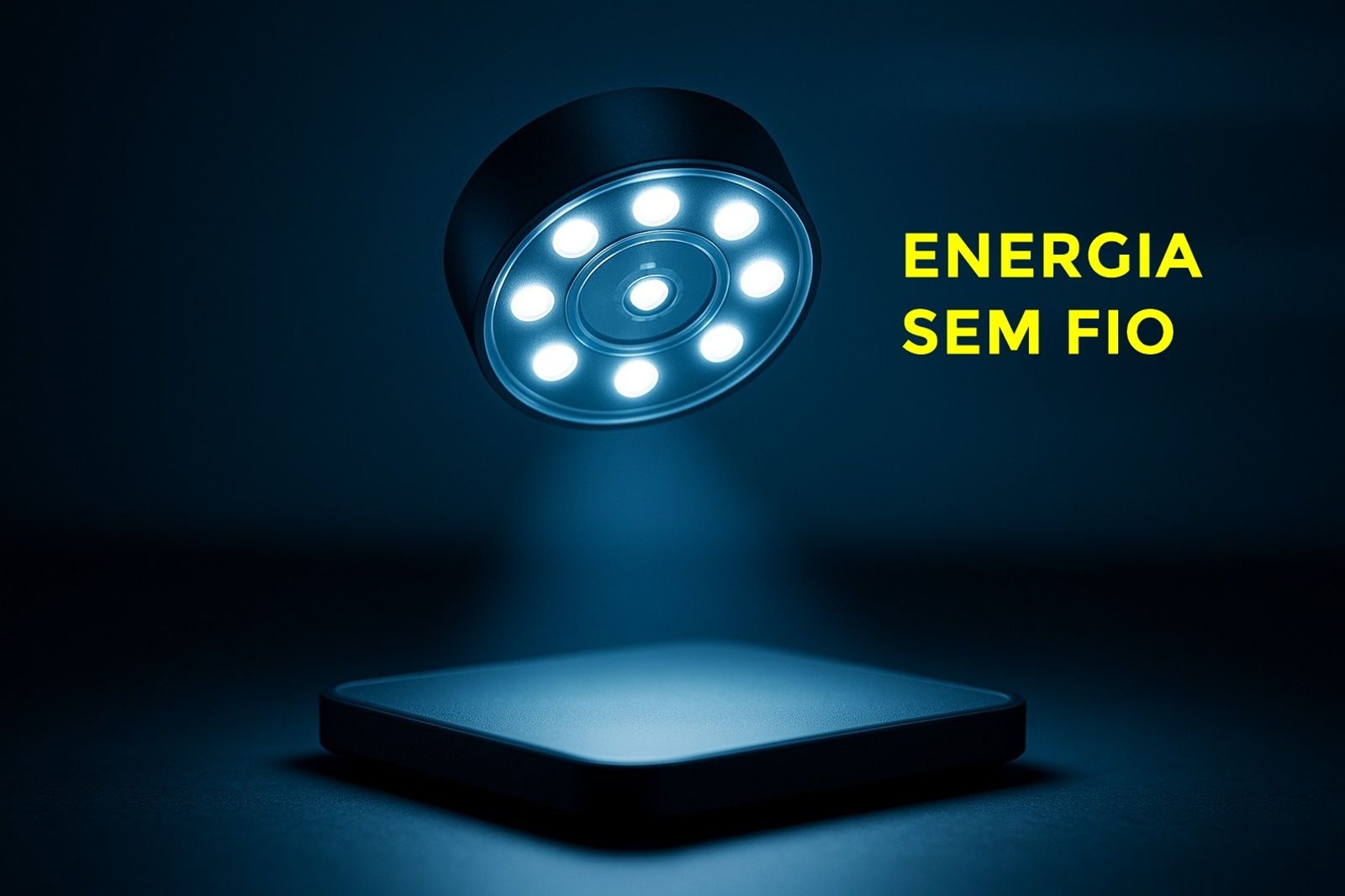
Scientists from the Institute of Science Tokyo Create Optical System with LEDs and Artificial Intelligence Capable of Providing Wireless Power to IoT Devices in Indoor Environments, Even in the Dark, Reducing Batteries, Cables and Electronic Waste
Researchers in Japan have developed a system that transmits energy completely wirelessly using LED light. The technology emerged from the Institute of Science Tokyo and can power IoT sensors in indoor environments with stability up to 5 meters, even in low light or complete darkness. The group claims that the solution reduces the use of batteries, decreases the need for cables, and helps cut electronic waste.
The scientists explain that the system utilizes computer vision and artificial intelligence to locate multiple receivers simultaneously. The technology identifies each device, continuously adjusts the beam, and maintains the power supply without interruptions. The project emerges as a safer alternative to lasers and radiofrequency methods.
The team notes that the advancement fits into a rapidly growing landscape of connected devices. By 2025, the world is expected to have between 20 and 21 billion IoT devices, with projections exceeding 40 billion before 2030. Each sensor requires power to function, and relying on batteries and cables incurs costs and scaling challenges.
-
How the terraforming of Mars can transform the planet: artificial aerosols can increase the temperature by up to 35°C in 15 years, creating conditions for liquid water.

-
Scientists drilled nearly 8,000 meters into the ocean floor above the fault that caused the 2011 tsunami in Japan and discovered that a layer of clay 130 million years old was responsible for making the wave much worse than any model had predicted.

-
Thousands of years after causing the largest eruption of the Holocene, one of the world’s largest supervolcanoes is rebuilding itself beneath the sea south of Japan, receiving new magma and alarming scientists with its transformation.

-
China has activated a magnet 700,000 times more powerful than the Earth’s magnetic field that operates for over 200 consecutive hours while consuming little energy, and now the world wants to know what Beijing plans to do with this technology in 2026.

Why Batteries and Cables Do Not Keep Up with the Pace of IoT
Traditional power supply methods, such as batteries and wiring, are starting to show limits in dense IoT networks. Batteries run out, require frequent replacements, and generate hazardous waste. In small sensors installed in hard-to-reach places, maintenance becomes a constant problem.
Wiring also imposes barriers. It fixes the position of devices, complicates renovations, and increases installation and maintenance costs. In industrial environments, extra wires represent points of failure, accident risks, and disrupt operational routines.
With millions of sensors measuring temperature, presence, air quality, or machine operation, simply managing power sources creates a logistical and environmental obstacle. This reality drives solutions that provide energy at a distance without relying on manual replacements.
What Wireless Optical Transmission Offers
Optical energy transmission uses light to send power through the air. The receiver converts this light into electricity through small photovoltaic modules installed on the sensors. Instead of outlets or wiring, there is an LED emitter capable of directing the beam precisely.
Laser-based systems have been the most studied so far due to their high power density. However, they require stringent precautions to protect eyes and skin. International documents such as the ICNIRP guidelines and the IEC 60825-1 standard set exposure limits that make the use of lasers difficult in offices, homes, and everyday environments.
In the European Union, Directive 2006/25/EC also defines safety standards for artificial optical radiation. Laser transmission is possible, but requires extremely narrow margins to avoid risks.
LEDs offer significant advantages. They operate at lower power density, are easier to modulate, last longer, and facilitate compliance with exposure regulations. The technical challenge was to ensure sufficient power over long distances and stability when ambient lighting changes.
How the LED System Works with Day and Night Mode
The system developed by Tomoyuki Miyamoto and Mingzhi Zhao directly addresses the issues of distance losses and variations in ambient light. The architecture uses three central elements that work together to identify receivers and automatically adjust the beam.
Adaptive Optics with Dual Lens
The emitter utilizes two lenses that work together. One liquid lens adjusts the focal distance as needed. The other shapes the final beam. This combination alters the size of the light spot according to the distance and the size of the photovoltaic receiver.
At short distances, the beam remains concentrated. At several meters, it opens enough to maintain appropriate energy levels without exceeding safety limits. The adjustment occurs even in completely dark environments.
Dynamic Pointing with Motors and Depth Camera
The beam is not fixed. It is directed by a motorized reflector that moves on the horizontal and vertical axes. Two stepper motors control this rotation. A depth camera with RGB and infrared sensors identifies where the receiver is located and detects exactly where the beam is arriving.
This information allows the controller to readjust the reflector in real time. This corrects deviations if something moves in the environment or if the receiver changes position. Continuous alignment prevents failures in energy transmission.
Retroreflectors and Computer Vision with AI
Each receiver has retroreflective blades that return light to the source. When the camera projects infrared light, these blades create a well-defined outline. A neural network based on the SSD algorithm analyzes this shape.
The artificial intelligence identifies each receiver, separates the active photovoltaic area, and ignores background objects. This process eliminates the need for menus, manual calibration, or complex adjustments. The system operates automatically from the first use.
Performance with Multiple Devices and Different Distances
In laboratory tests, the auto OWPT system powered receivers of various sizes placed at different distances, achieving up to 5 meters. Measurements were taken with the environment illuminated and also in complete darkness. The switch between receivers occurred without noticeable interruptions.
This characteristic allows a single emitter installed on the ceiling to power multiple devices within the same area. These include presence sensors, small actuators, smart tags, emergency buttons, and low-power medical devices in hospital rooms. The system avoids wiring and eliminates frequent battery recharges.
How This System Fits into the Wireless Energy Ecosystem
The advancement by the Tokyo group contributes to a scenario where optical solutions already exist commercially. Some companies utilize infrared to power smart locks or information panels with hundreds of milliwatts and ranges close to 10 meters.
Other researchers are working to keep transmission within safe irradiance limits similar to those adopted in photobiomodulation. The idea is to provide useful energy without exceeding recommended limits for human tissues.
The proposal by Miyamoto and Zhao differentiates itself by using LEDs from the start, integrating artificial vision and AI for tracking the receivers, and targeting dense indoor environments like smart factories and offices. With private 5G networks and IoT management platforms, the system can act as another component of the infrastructure of connected buildings.
Potential in Buildings, Homes, and Factories
The environmental benefit of the technology is evident in waste reduction. Instead of relying on a technological breakthrough, it reduces the number of batteries, trips for maintenance, and the need for cables.
Less Waste and Less Maintenance
A large portion of IoT uses lithium or alkaline batteries. In commercial and industrial centers, this results in constant replacements and hazardous waste. The OWPT allows for the creation of devices with smaller batteries or even no batteries at all, using storage solutions like supercapacitors. The reduction of maintenance visits and transport decreases environmental impacts.
Sensors in Previously Inaccessible Places
Without cables and without frequent battery changes, it becomes feasible to install sensors in spaces where it was not worth it before. False ceilings, corners of warehouses, cold chambers, and areas between machines can now receive continuous monitoring. This improves the control of lighting, air conditioning, and processes.
More Efficient Buildings
In offices, hospitals, or universities, sensors powered by OWPT help adjust ventilation according to actual occupancy, reduce airflow in empty areas, control natural light, and detect insulation failures. These are existing functions, but they gain reach with wireless power.
Less Infrastructure in Industrial Environments
In factories, sensors identify failures in motors, compressors, and production lines. The OWPT reduces construction and wiring in places with vibration, dust, or risk of wire breakage. This diminishes interruptions and the use of copper.
Responsible and Safe Design
For the technology to have a real impact, the system must consider overall efficiency, safety of light exposure, and cybersecurity. The emitter must consume less energy than the savings generated by the elimination of batteries. Installations must adhere to optical exposure limits in environments with workers for long periods. Digital integration needs to follow security standards applied to the rest of IoT.
Overall, systems like the LED OWPT with AI point to a model of battery-free IoT indoors. They allow for discreet sensors powered by a controlled beam of light with intelligence. They do not solve the entire climate emergency, but reduce consumption and waste at a critical point in modern IoT. In a world with billions of small devices, every improvement makes a difference.










-

Uma pessoa reagiu a isso.