





 Portuguese
  English
  Spanish
  6 min of reading
  1 comment


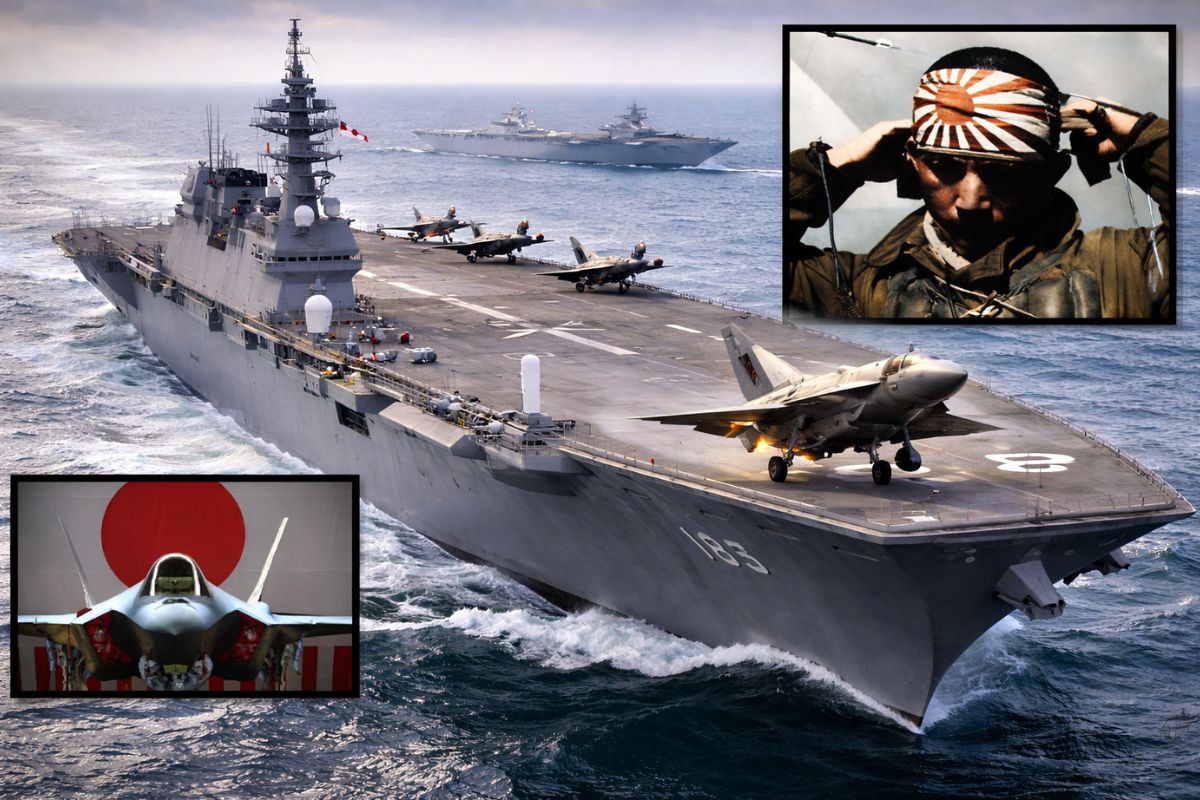


The Return of the Japanese Aircraft Carrier Combines Naval Modernization, Revision of Post-War Political Limits, and Regional Pressure in the Pacific, While Izumo and Kaga Enter the Final Phase to Operate F 35B Fighters and Expand Tokyo’s Maritime Deterrence Capacity in a Movement Closely Watched by China
The return of the aircraft carrier to Japan’s strategic vocabulary is no longer a historical hypothesis but a concrete step in a military shift in the Pacific. With Izumo and Kaga in the final stretch of modernization to operate F 35B fighters, Tokyo crosses a boundary that has remained sensitive for over eight decades.
The weight of this decision lies not only in the ships’ hulls but in what it represents for the region. The image of embarked fighters operating from Japanese ships reignites memories of World War II, alters political signals for allies and rivals, and expands the debate on how far the reinterpretation of the country’s defensive posture goes.
The Return That Affects Memory, Strategy, and Political Language

Talking about the Japanese aircraft carrier today means not just describing a military platform.
-
Motorola launched the Signature with a gold seal from DxOMark, tying with the iPhone 17 Pro in camera performance, Snapdragon 8 Gen 5 that surpassed 3 million in benchmarks, and a zoom that impresses even at night.

-
Satellites reveal beneath the Sahara a giant river buried for thousands of kilometers: study shows that the largest hot desert on the planet was once traversed by a river system comparable to the largest on Earth.

-
Scientists have captured something never seen in space: newly born stars are creating gigantic rings of light a thousand times larger than the distance between the Earth and the Sun, and this changes everything we knew about stellar birth.

-
Geologists find traces of a continent that disappeared 155 million years ago after separating from Australia and reveal that it did not sink, but broke into fragments scattered across Southeast Asia.

It means touching upon a historical layer that, for decades, has been treated as a political and constitutional limit. Therefore, the current movement produces repercussions far beyond the technical sphere of the navy.
The change in posture is linked to a strategy to strengthen Japanese forces amid a more pressured regional environment.
Japan begins to signal deterrent capability, not just coastal defense and escort, in a Pacific marked by naval disputes, tension surrounding Taiwan, and recurring threats from North Korea.
Why Japan Bet on Aircraft Carriers Before and Why It Lost This Capability

In the first half of the 20th century, Japan invested in aircraft carriers as a response to the combination of geography and diplomatic limitations imposed by the Washington Naval Treaty of 1922 and the London Treaty of 1930. With restrictions on large battleships, naval aviation became a strategic loophole for projecting power at sea.
When the Pacific War began in December 1941, the Japanese aircraft carrier strength was presented as one of the most modern in the world. There were 10 aircraft carriers in total, with six large fleet units operating in an integrated manner. This concentration of embarked air power helped transform the Japanese navy into a tactical reference at that moment.
Akagi and Kaga became symbols of this phase. Both originated from projects originally linked to other types of warships and were converted into aircraft carriers in the late 1920s. Each could carry about 70 aircraft and formed the core of the offensive at Pearl Harbor.
Then came units like Shokaku and Zuikaku, built with a focus on embarked operations, with high speed, robust air capacity, and better overall performance. Still, the Japanese advantage could not withstand the set of factors that changed the war in the Pacific.
Midway, Industry, and Pilots Explain the Fall of the Old Japanese Force
The turning point began with intelligence and production. The United States deciphered the Japanese naval code JN25 and exploited this advantage at Midway in 1942, where Japan lost four aircraft carriers in a single battle, including Akagi and Kaga. It was an operational and symbolic shock that altered the naval balance in the Pacific.
At the same time, the industrial difference weighed decisively. While the United States was able to accelerate the construction of new classes of aircraft carriers and escort ships, Japan faced difficulties in replacing losses. The capacity to replace ships, aircraft, and pilots determined the pace of the war.
There were also internal issues with design and doctrine. Fragile damage control systems and vulnerabilities in fuel handling increased the risk of fires and explosions.
In pilot training, Japan kept veterans in continuous combat, while the United States cycled experienced pilots to train new crews. The result was a loss of accumulated experience, precisely when the war required rapid replacement.
What Changed After 1947 and Why Tokyo Resumed Its Engagement with This Limit
After Japan’s surrender, the 1947 Constitution consolidated the renunciation of war and restricted the maintenance of offensive military capability. For decades, aircraft carriers were classified in the Japanese political debate as offensive weapons, incompatible with the dominant interpretation of the post-war order.
This did not mean military immobility. The Japanese navy underwent intense modernization, but with a focus on maritime defense, escort, anti-submarine warfare, and protection of routes. The central point is that aircraft carriers remained a politically prohibited word, even in a technologically advanced naval force.
The regional scenario, however, changed rapidly. Chinese naval growth and North Korean nuclear threats increased pressure on Tokyo to revise priorities.
The reinterpretation of the defensive posture gained momentum, and the return of aircraft carriers began to be treated as part of a deterrence strategy and coordination with allies.
Izumo and Kaga in the Final Stretch and the Technical Leap to Operate F 35B
Izumo and Kaga did not emerge as super attack ships comparable to the large nuclear aircraft carriers of the United States. They were initially designed as helicopter carriers but are undergoing profound transformation to operate F 35B fighters, a model designed for short takeoff and vertical landing.
The described changes are structural and not cosmetic. The flight deck has been adapted to withstand the extreme heat of exhaust gases, exceeding 1000 degrees, generated by the F 35B during vertical landing operations. Without this thermal reinforcement, regular operation would be unfeasible.
The hangars are also being expanded, and the bow has received significant alterations for a squarer shape, aiming to improve wind flow and parking space on the deck. The concept brings these ships closer to arrangements seen in amphibious assault vessels adapted for airborne operations.
Even without catapults and arrestor wires, and classified as light aircraft carriers, Izumo and Kaga gain significant operational weight. A ship capable of employing F 35B fighters represents true embarked air power, impacting surveillance, rapid response, and military presence in the Pacific.
The Message to China and the Effect on the Balance of the Pacific

Beijing’s reaction is understandable from two perspectives. The first is historical because the return of Japanese aircraft carriers touches deep scars from the war. The second is strategic, and perhaps more immediate, because a Japanese force with embarked aviation raises barriers to maritime dominance projects in the region.
In the Taiwan Strait and disputed areas of the Western Pacific, the presence of Japanese ships capable of operating embarked fighters changes the risk calculation, response times, and aerial coverage. It is not just a national symbol; it is a piece that can integrate into a regional architecture of containment alongside the United States.
This does not mean that Japan is reproducing the American model of super aircraft carriers. What is underway is a different logic, with smaller means, regional function, and strong deterrent value. Still, Japan’s re-entry into this field ends a long phase of taboo and opens a new stage of military and political debate in Asia.
The Japanese return to the world of aircraft carriers combines historical memory, geopolitical calculation, and technological adaptation at a time of rising tension in the Pacific. Izumo and Kaga, as they approach operations with F 35B, show that Japan has stopped treating this topic as a closed past and has begun to incorporate it into contemporary strategic planning.
If you were in Tokyo’s position, with Chinese pressure at sea and the North Korean threat on the radar, would you consider the return of aircraft carriers a necessary defensive measure or a step that could further increase regional tension in the Pacific?








Japón junto con corea del Sur deben y tienen que apostar por estar unidos, junto con también Australia, Nueva Zelanda, Filipinas, Vietnam, Tailandia y Taiwán, y cualquier nación que se sienta amenazada, por China,rusia o corea del Norte, como también India debe de estar en este eje.
Pues todos a una el dragón chino, junto con el oso soviético y si lacayo corea del norte, NO tendrán nada que hacer.
Hay que mandarle un mensaje cuanto antes.
De disuasión.
Y la guerra híbrida con los barcos pesqueros como ellos hacen todos a una, hay que pagarles con la misma moneda. Así sabrán que no hay tú tía.