





 Portuguese
  English
  Spanish
  6 min of reading
  2 comments


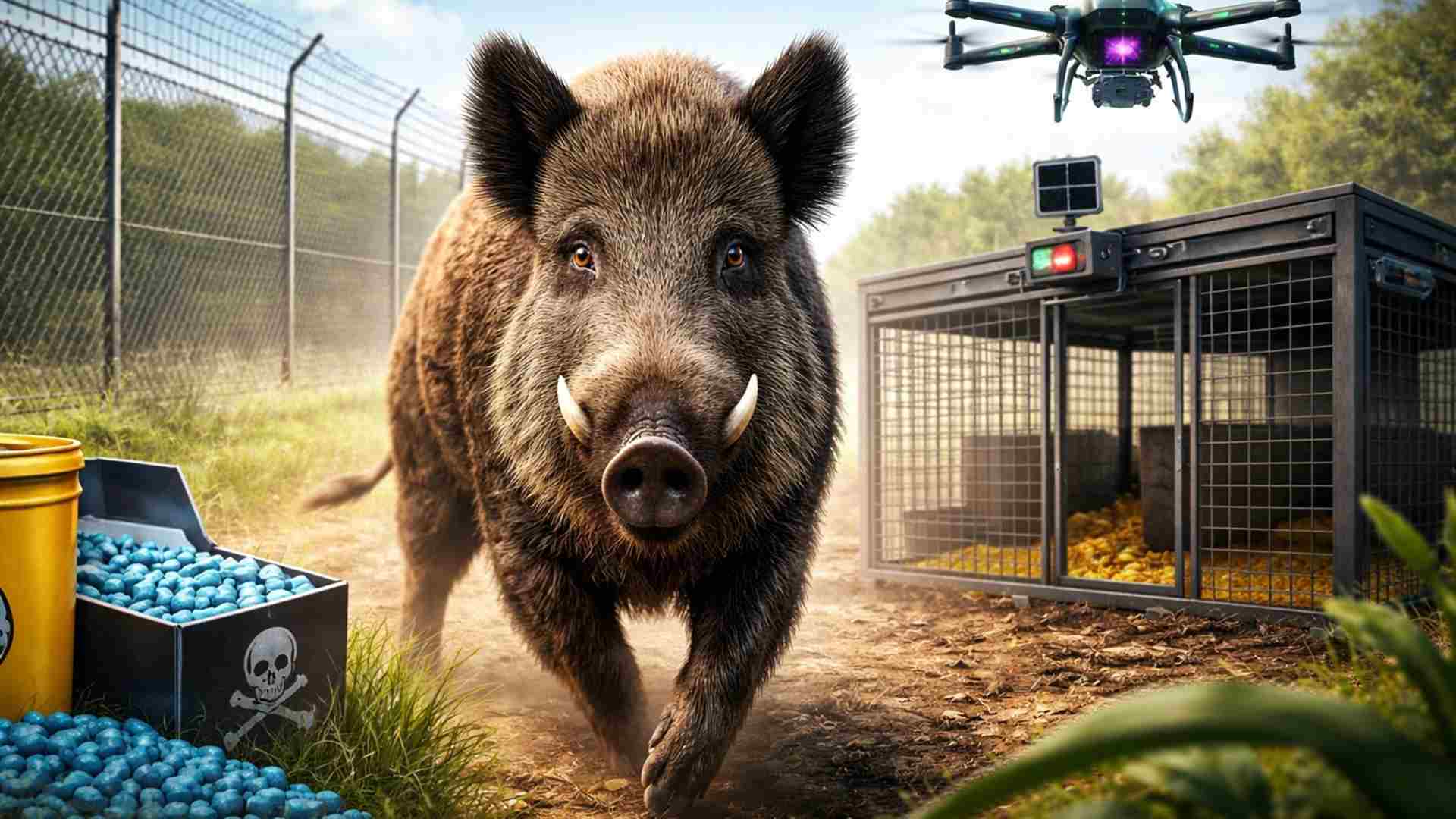


The Expansion of the Wild Boar as an Invasive Species Led Governments in Europe, Oceania, and North America to Adopt, Between 2000 and 2025, a Set of Technical Strategies That Include Sanitary Surveillance, Large-Scale Trapping, Regulated Baits, GPS Tracking, and Even Physical Fences to Reduce Environmental, Agricultural Impacts and Risks to Pig Farming
Governments in Europe, Oceania, and North America Adopted, Between 2000 and 2025, Various Methods to Contain the Invasive Wild Boar.
These methods combine national programs, sanitary surveillance, large-scale trapping, GPS tracking, regulated toxic baits, and physical barriers, with direct impacts on agriculture, biodiversity, and animal health.
Integrated National Programs Transform the Wild Boar into a Permanent Public Policy Issue
In the United States, the wild boar has ceased to be treated merely as a local pest and has become part of a structured federal program. The National Feral Swine Damage Management Program, coordinated by the USDA APHIS, has been operating continuously since the 2000s.
-
With a cost per shot close to zero, the DragonFire laser could change naval warfare in 2027 and provide British ships with nearly unlimited defense against drones.

-
A British startup creates tires that generate electricity in electric vehicles when passing over potholes, speed bumps, and cracks.

-
Scientists have created robots made with living cells that have their own nervous system, swim on their own, explore the environment, and self-organize without any genetic engineering, and now they want to do the same with human cells.

-
Students create a solar-powered ambulance that operates without a plug, without fuel, and still keeps medical equipment running in remote areas.


The program coordinates field actions, population monitoring, sanitary surveillance, applied research, evaluation of results, and coordination with states and farmers.
The official objective is to reduce economic, environmental and sanitary damages caused by the wild boar.
USDA documents indicate that the integrated approach emerged after it was found that isolated actions, such as unplanned recreational hunting, were ineffective in reducing populations sustainably over the years.
Official reports indicate that the wild boar causes direct damage to agriculture, contaminates conservation areas, and poses a risk of disease spread affecting commercial pig farming, a strategic sector for North American exports.
The logic adopted by the federal government is to treat control as a permanent public policy, with budget, regional goals, performance indicators, and periodic review of strategies employed in each territory.
This model is also found in national initiatives in Australia and New Zealand, where multi-year plans define priority areas, permitted methods, and execution timelines, rather than ad hoc responses to localized outbreaks.
Sanitary Surveillance and Disease Control Guide Wild Boar Management in Europe
In the European Union, the spread of African Swine Fever has profoundly altered wild boar management. The species has become a significant epidemiological vector, requiring coordinated responses among the environment, agriculture, and animal health.
Technical guidelines from the European Commission establish active surveillance in wild boar populations, with systematic testing of carcasses found, monitoring of sick animals, and standardized collection and disposal protocols.
The documents recommend that trained teams conduct regular searches for carcasses in affected areas, reducing the duration of contaminated material in the environment and decreasing the likelihood of viral transmission.
International animal health organizations emphasize that inadequate practices during hunting or removal, such as transport without sanitation or improper disposal of remains, can accelerate disease spread between regions.
Therefore, population control in Europe is often accompanied by strict biosecurity rules, including equipment cleaning, movement restrictions, and detailed records of operations conducted.
The strategy is not limited to reducing the number of animals but aims to disrupt transmission chains, prioritizing areas close to commercial farms and natural movement corridors of the wild boar.
Large-Scale Trapping Aims to Remove Entire Sounders and Reduce Population Replenishment
Trapping is one of the most common tools in government programs. Technical manuals from the USDA and Australian agencies highlight the importance of capturing entire groups, known as social sounders.
According to the documents, partial removal tends to be inefficient, as survivors maintain a high reproductive rate and quickly recolonize the area. Therefore, pen traps are prioritized in planned operations.
These traps allow for the capture of dozens of individuals in a single action, provided there is a prior food attraction period and monitoring via cameras to identify the ideal moment to close.
In New Zealand, regional programs with local elimination goals combine trapping with ground shooting assisted by thermal sensors, especially in hard-to-access areas or dense vegetation.
Public reports indicate that trap efficiency increases when there is spatial planning, continuous use, and integration with other techniques, preventing the population from reorganizing after targeted interventions.
Despite their effectiveness, the official guides acknowledge operational limitations, such as installation costs, maintenance needs, and the risk of behavioral learning by animals over time.
GPS Tracking and the Use of the So-Called “Judas Pig” Expand the Detection of Hidden Foci
Another strategy documented in official programs is the use of captured individuals equipped with GPS collars or VHF transmitters, technically known as “Judas pig.”
The technique relies on the social behavior of wild boars, which tend to seek out other individuals after being released. Monitoring their movements allows for the location of sounders that had not been detected by traditional methods.
USDA manuals describe the method as a complementary tool, especially useful in extensive, forested areas or with low visibility, where direct detection is limited.
The documents also highlight that effectiveness depends on the choice of animal, the monitoring period, and integration with field teams capable of acting quickly after locating the groups.
Internal studies indicate that tracking reduces search costs and increases the rate of finding residual foci, being more suitable when the goal is to completely eliminate a population in a defined area.
The agencies themselves warn that the method does not replace other actions and requires constant evaluation to avoid excessive dependence on individuals that may change their behavior over time, becoming less predictable.
Regulated Toxic Baits Expand the Scale of Control but Require Rigorous Governance
Australia has developed and regulated the use of sodium nitrite baits for wild boar control, described in official technical materials as highly lethal to the target species.
The product was authorized after efficacy studies and risk assessment, with specific guidelines on application, containment, and mitigation of impacts on non-target wildlife and domestic animals.
Government guides emphasize that using baits requires detailed planning, including assessing the environment, restricting human access, and post-application monitoring.
In the United States, the debate over baits includes warfarin-based products. In Texas, the substance has been classified as a limited-use pesticide for wild boars, with state regulations effective from January 31, 2024.
Authorities emphasize that the scale expansion provided by baits increases regulatory responsibility, necessitating oversight, operator training, and clear protocols to prevent misuse.
The technical literature points out that, without adequate governance, environmental and social risks may outweigh the benefits, which is why several countries restrict the use to official programs or supervised operations.
Sanitary Fences and Physical Barriers Aim to Contain Dispersion in High-Risk Contexts
In situations of high sanitary risk, some countries have adopted physical barriers as part of their containment strategy. The most well-known case is Denmark, which built a fence along the border with Germany.
Public reports indicate that the structure is approximately 68 to 70 kilometers long, about 1.5 meters high, with a buried section to prevent the passage of wild boars.
The construction was completed between 2019 and 2020 and is part of a package of measures aimed at preventing African Swine Fever, considered a direct threat to the Danish pig farming chain.
Environmental studies associated with the project acknowledge side effects, such as impacts on the movement of other species, but indicate that the decision prioritized reducing economic and sanitary risks.
Scientific research emphasizes that fences do not eliminate the problem alone and must be combined with population control, surveillance, and management of human factors, such as transport and waste disposal.
Still, the use of physical barriers demonstrates how, in specific contexts, governments opt for infrastructure solutions to reduce the likelihood of wild boar dispersion in strategic corridors.
An International Pattern Based on a Combination of Methods and Continuous Evaluation
The analysis of official programs and technical documents reveals a consistent pattern. No country relies on a single tool to contain the invasive wild boar. Control is treated as a continuous and adaptive process.
The most effective strategies combine direct removal, territorial intelligence, sanitary surveillance, regulation of inputs, and, in some cases, physical infrastructure, adjusting methods according to population density and local risk.
The governments themselves acknowledge that failure often occurs when actions are episodic, poorly coordinated, or disconnected from broader sanitary and environmental objectives.
Outside of Brazil, the wild boar is framed as a structural problem, requiring long-term planning, a clear legal basis, and integration between science, operation, and oversight, not merely emergency responses.
This set of international experiences shows that reducing invasive populations involves less improvisation and more continuous technical management, with costs, goals, and responsibilities clearly defined.









Tem que adequar a alimentação pra agricultura familiar….legalizar a caça pra aproveitar a carne do **** abatido…carne e alinhamento….não se joga comida fora…ainda mais proteína da carne
Tem que adequar a caça a