





 Portuguese
  English
  Spanish
 8 min of reading
  29 comments


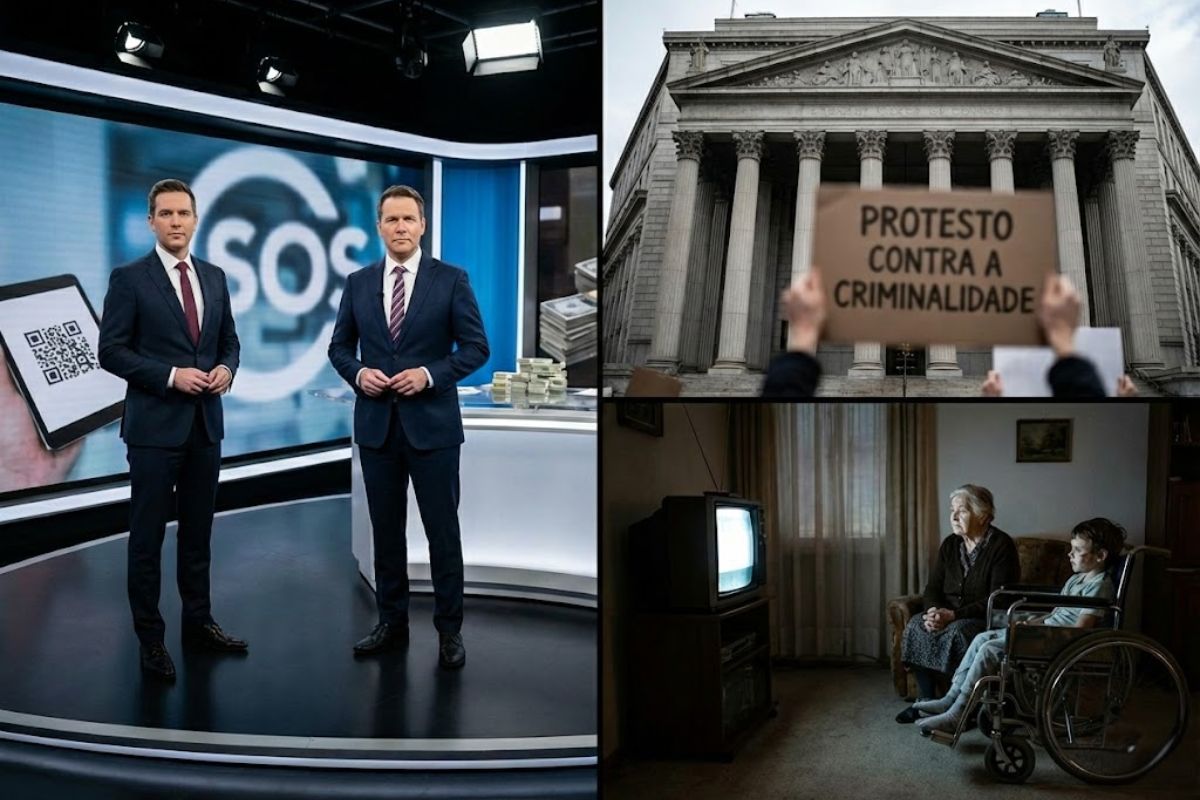


In Salvador, A Fake Pix Scheme In Bahia General Balance Put Marcelo Castro In The Center Of Accusations Of Donation Diversion, Used Vulnerable Families To Collect Money In Open Network And Exposes Failures Of Justice When Delaying The Trial Of One Of The Largest Television Scams Recently In Brazil Today
A fake Pix scheme in Bahia General Balance, led by reporter Marcelo Castro, used vulnerable families as an emotional appeal and diverted donations via Pix on national television, while part of the money never reached the victims.
Almost two years later, the families are still waiting in court for compensation for the money that never arrived and for the public humiliation they suffered, while the case continues to be delayed for bureaucratic reasons. The trial that could hold those involved accountable for diverting resources via fake Pix, in the name of those who needed it most, has been postponed again, this time due to lack of physical space to accommodate all parties in the courtroom.
The Fake Pix Scheme In Open Network

The case came to light through a segment of the program Bahia General Balance, hosted by reporter Marcelo Castro.
-
Unemployment rises again to 5.8% at the beginning of 2026, raising alarms about the end of temporary positions and its impact on the Brazilian job market.
-
Document organization can cut invisible costs in small businesses, a simple step that prevents waste, rework, and losses in daily operations.

-
Chinese giant worth nearly R$ 4 billion that manufactures cables for electric cars, solar energy, and robotics wants to open a factory in SC.

-
Many employers do not know, but the law guarantees domestic workers a 25% increase in salary during trips, 50% for overtime, 20% for night shifts, and 17 additional benefits that can lead to labor lawsuits if not paid.


In different editions, the show presented stories of families in extreme vulnerability, asking for donations to cover medical treatments, adapted equipment, lawyers, and basic expenses.
However, on screen, the Pix key displayed was not that of the victims, but of members of the very group under investigation.
According to an internal investigation by Record Bahia and the police, the fake Pix scheme operated for 1 year and 5 months, always with the same logic: dramatic stories, strong emotional appeal, great exposure of the characters, and a donation key that directed money to accounts controlled by journalists and intermediaries.
While the public believed they were directly helping vulnerable families, up to 75% of the amount raised was reportedly diverted.
Surveys indicate that campaigns raised over R$ 543 thousand in donations, with over R$ 407 thousand supposedly pocketed by the group, far exceeding the R$ 400 thousand diverted. Twelve families were identified as direct victims of the fake Pix scheme.
Miguel, Leukodystrophy And The Broken Promise


One of the stories that encapsulates the human impact of the scam is that of Jucileide and her son Miguel, 17 years old, a victim of a rare neurodegenerative disease, leukodystrophy.
In an advanced stage, the condition took away Miguel’s ability to walk, and the family needed an adapted wheelchair to ensure some comfort and mobility.
Lacking resources, Jucileide agreed to expose her son’s routine in open network.
Marcelo Castro went to the family’s house, did the report, and announced that the case would be included in the donation segment.
But, just before going live, he warned that the Pix displayed on the screen would not be the mother’s, citing “bureaucratic issues” and the risk of the bank blocking transfers.
She trusted him. Months later, she discovered that R$ 45 thousand had been raised in Miguel’s name, but only R$ 10 thousand reached the family.
“I was a victim of distortion, I was a victim of theft, I felt violated, used, not just me, but especially my son,” summarized Jucileide.
Miguel died six months ago, and the photo of the young man now represents for his mother a mix of nostalgia, pain, and memory of the exposure he was subjected to in open network while others profited from the fake Pix.
Augusto, The Forced Rehearsal And The Pain In Front Of The Cameras
Another emblematic case is that of Lucileide and her son Augusto, 21 years old, who has hydrocephalus, a spinal malformation, and cannot walk.
The family asked for help on the program to acquire a motorized tricycle that would give the young man a minimum of independence.
What shocked the mother the most, however, was the approach of the team.
She reports that the reporter insisted that her son crawl on the floor in front of the cameras and that she herself cry in a forced manner, all to enhance the emotional impact of the report and increase the volume of donations.
“Let him crawl because that will bring more audience,” she claimed to have heard.
The public responded, as expected, with great solidarity. From the R$ 30 thousand raised from the case, only R$ 6 thousand were passed on to the family, who live in a simple house and continue facing the same daily limitations.
What should have been an act of empathy turned into a double violence: emotional, due to the staged exposure, and financial, due to the diversion of resources.
Other Victims: Lawyer, Robbery And Drama With Autistic Child
The list of those affected by the fake Pix scheme does not stop at Miguel and Augusto.
Maria de Fátima sought the segment to try to resolve a pension issue related to her deceased husband, needing money to hire a lawyer.
More than R$ 27 thousand were donated in her name, but only R$ 3 thousand reached the widow’s account. She reports having developed health issues after the scam, with severe pain and visible emotional distress.
Meanwhile, Larissa was robbed alongside her daughter, who has autism spectrum disorder, and also became a character on the program.
The reporter promised to set up a donation action to help her get back on her feet. During the live broadcast, however, Larissa was prevented from announcing her own Pix key.
Marcelo informed that “a trusted person from inside” would be used to receive the amounts.
Donations exceeded R$ 17 thousand that day. However, when Larissa checked the receipt, she saw that only R$ 3 thousand had been passed on, despite the significant media coverage and messages from people in various states saying they had contributed.
“People from São Paulo, so many people talking to me… I stopped and thought: how could it be only R$ 3 thousand?” she recalled. The answer came with investigations: the rest would have been held in the internal circuit of fake Pix.
How The Fake Pix Mechanism Worked
According to the police, the scheme was structured into three main cores:
- Marcelo Castro, responsible for making the reports and approaching vulnerable families
- Jamerson Biriba, the program’s editor-in-chief, who authorized the inclusion of third-party keys on screen
- Lucas Costa Santos, an operator who helped co-opt families and intermediaries who lent accounts
During the airing of the segment, a Pix key was placed on screen, but the code belonged to members of the group, never to the victims.
The money sent by viewers went into one of these accounts and was then dispersed through bill payments, credit cards, and deposits to various participants.
Nine intermediaries have been identified, many of whom are residents of Salvador communities.
One of them, Jackson da Silva de Jesus, was located by the report in a barbershop.
Clearly nervous, he stated that he did not know what the Pix would be used for and that he only lent the key to a client. He later said he could not provide more details by his lawyer’s advice.
The use of intermediaries helped to obscure the financial trail of the fake Pix, making it more difficult to immediately identify the path of the money.
Dismissals, Complaint By The Public Prosecutor And Imputed Crimes
After the internal investigation, Record Bahia dismissed Marcelo Castro and Jamerson Biriba for cause and filed lawsuits against both.
At the same time, the Public Prosecutor’s Office of Bahia filed a complaint against the two, against Lucas, and against the nine intermediaries identified in the scheme.
The court accepted the complaint, and the accused will answer for crimes such as embezzlement, criminal association, and money laundering.
The process entered the instruction phase, during which witnesses for the prosecution, defense, and the accused themselves are heard.
Marcelo even tried, in court, to prevent the airing of the report that detailed the case but could not stop the disclosure of information.
Amid the initial backlash, the reporter was seen vacationing in the United States and Dubai, one of the most expensive destinations in the world, a scene that increased the outrage of those who donated believing they were helping desperate families and saw the fake Pix financing a standard of living incompatible with the narrative of solidarity displayed on TV.
Slow Justice, Delayed Hearings And Families’ Frustration
Despite the case involving children and young people in extreme vulnerability, the progress of the process has not been swift.
The instruction hearings have been rescheduled at least twice. Initially set for March, they were postponed to this week and now have been pushed forward for an unusual reason: lack of space in a courtroom in the Court of Justice of Salvador.
The presiding judge explained that the organized crime division does not have a room with a capacity for approximately 40 people at the same time, among defendants, lawyers, witnesses, and family representatives.
The hearings are now rescheduled for May of next year, and the magistrate estimated that the verdict could come about 60 days after the end of the instruction, a deadline that is still just a projection.
Experts remind that, in theory, processes involving children’s interests should take priority in processing.
In practice, the new delay amplifies the feeling of impunity and prolongs the anguish of those who have been waiting for almost two years to see the fake Pix definitively judged.
Pain, Humiliation And The Demand For Justice
For families, the problem goes far beyond money. Jucileide emphasizes that what is at stake is the memory of her son Miguel, who could have had a less painful end to life if all the money donated in his name had reached the family’s home.
“These people used him for their own benefit, they have to pay for what they did, because this should not be done to anyone, much less to a child,” she summarizes.
Maria de Fátima speaks of an open wound and health problems aggravated after discovering that the donations did not arrive as promised.
Larissa recalls the shame of realizing that, while she thought she was being helped, her case was feeding a fake Pix scheme within a network she trusted. Lucileide carries the image of her son crawling on the ground for the camera, a scene staged to sensitize the public and maximize a fundraising that, for the most part, was diverted.
In the victims’ assessment, what occurred was not just the exposure of sad stories, but a “shameful exposure,” where real dramas were distorted and commodified.
Trust in the press, charity, and institutions has been deeply shaken, and the main expectation now is that justice can separate those who donated in good faith from those who used the fake Pix to enrich themselves.
And you, upon learning the details of this fake Pix scheme in the name of vulnerable families, do you think the greatest impact lies in the diverted money, the public humiliation of the victims, or the loss of trust in TV and donation campaigns?










Como não tem sala!!!!!! Criminosos estão sendo julgados por audiência remota!!! Roubou, comprovou, responde pelo. Crime. O Presidente de El Salvador está certo
Olha só qual a emissora, Record. Aprenderam com o chefe deles. O famoso bispo E M só a iniciais já são o suficiente.
Um ano e meio para descobrirem? Huuummmmm!