





 Portuguese
  English
  Spanish
  4 min of reading
  0 comments



Young Man from Bahia Builds Tractor Using Motorcycle Engine, Chevette Differential, and Reused Agricultural Machine Parts
An Unusual Project Combines Reused Parts to Create a Functional Tractor Capable of Performing Agricultural Work and Light Transport in Small Rural Properties.
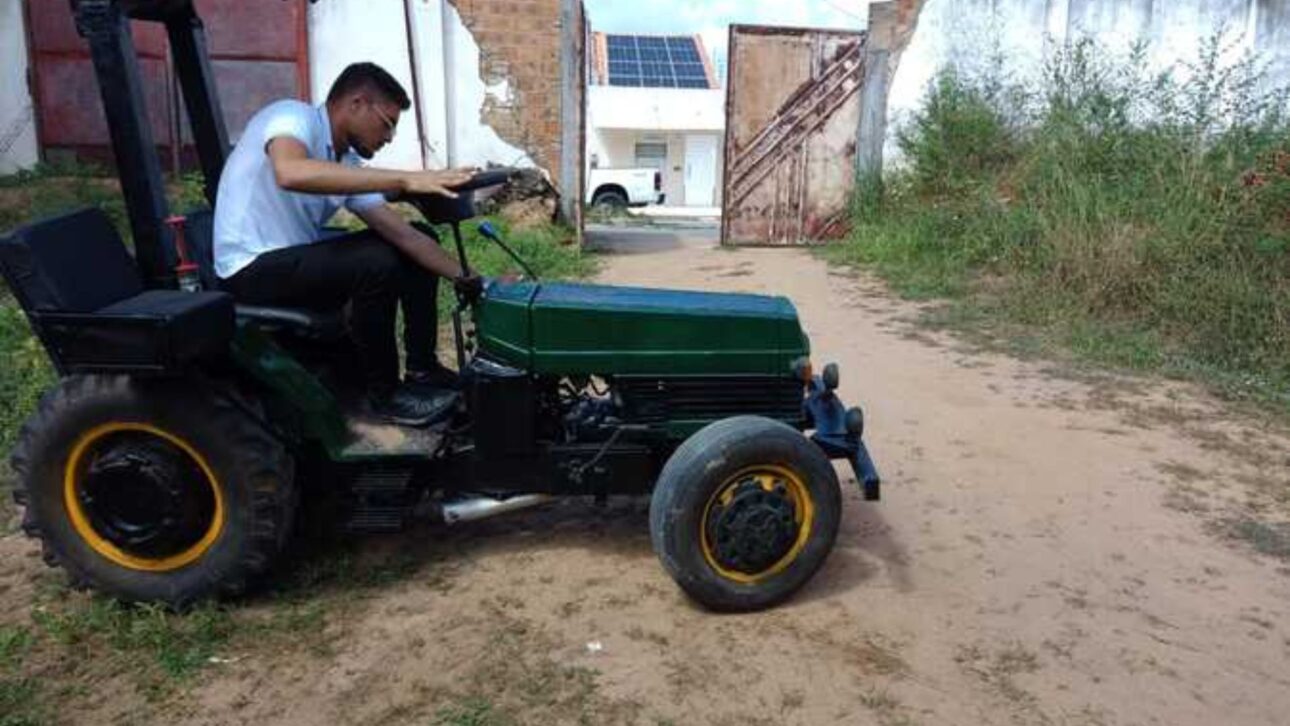
Henrique Ferreira dos Santos, a young man from Ribeira do Pombal in Bahia, developed a tractor from a combination of reused parts, including a motorcycle engine and a Chevette differential.
The project, the result of his passion for mechanics since childhood, is capable of performing small agricultural tasks and transporting light loads.
The initiative, built with reused materials, highlights the creativity and practical knowledge of the student, who relied on research and observation to assemble the prototype.
-
Spain surprises the world by erecting 62 artificial dunes, mixing sand with natural remains of posidonia, and causing the structure to lose only 1.4% of its volume in 1 year.

-
With 16 Bulava missiles, improvements in acoustic stealth, and a design focused on silent patrols, Russia’s nuclear submarine was born to ensure Moscow’s invisible retaliation and has become one of the pillars of its maritime strength.

-
‘Populous’ city in Rio among the worst in Brazil in national ranking and exposes silent development crisis.

-
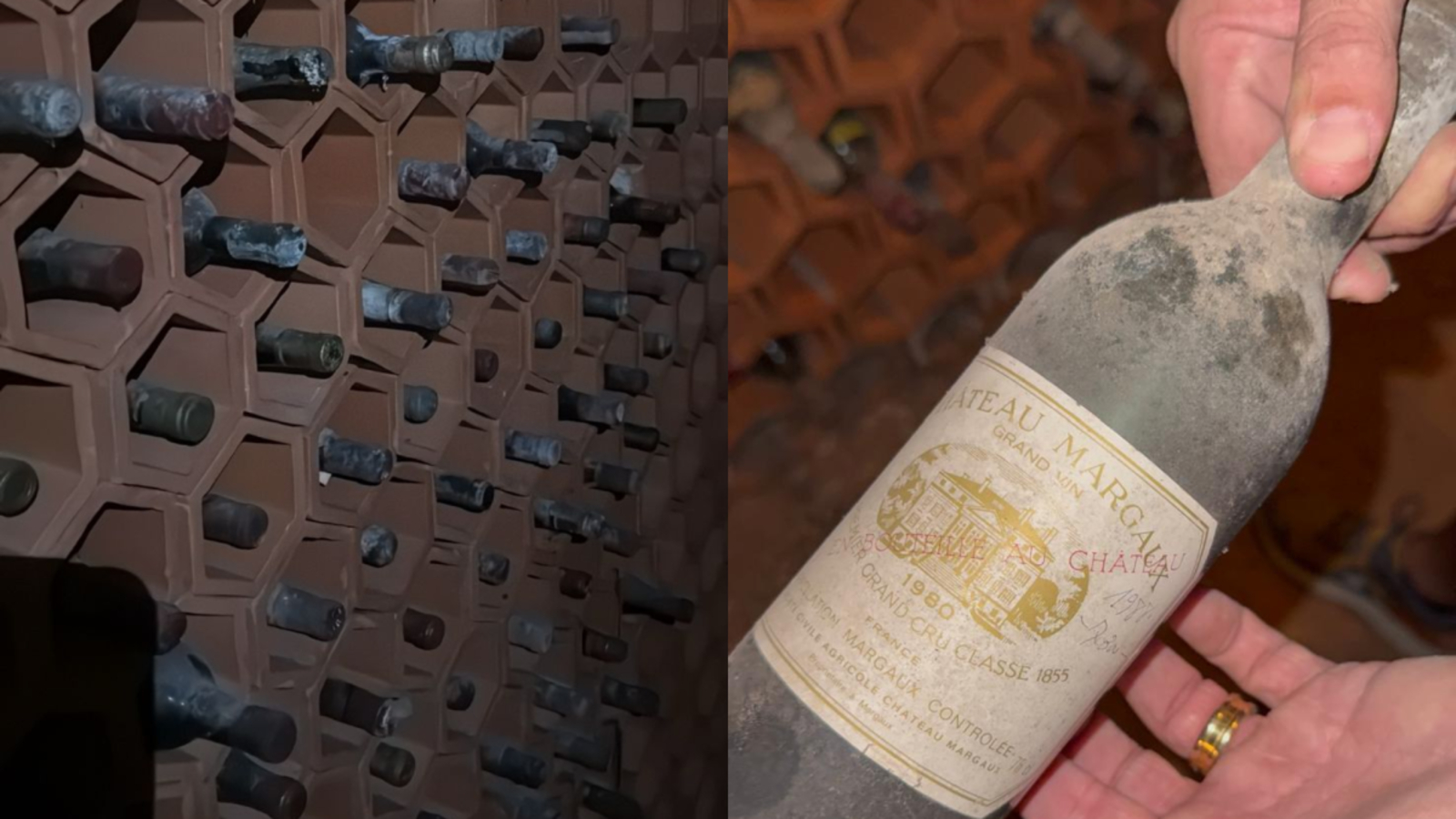
Couple buys house in the South Zone of São Paulo, opens a hidden door in the garage, and finds a secret wine cellar with dozens of old wines forgotten since the 1970s.

Interest in Mechanics Since Childhood
Since childhood, Henrique has shown interest in understanding how machines and vehicles work.
“I used to take apart and put together my toy cars because I was always curious about how things work,” he reported.
Additionally, he took a basic automotive mechanics course, but he claims that a large part of his learning was self-taught.
According to the young man, “today, I can fix cell phones, washing machines, sound systems, computers, televisions, motorcycles, and even cars. I learned all of this on my own.”
Reuse of Parts in Innovative Project
The construction of the tractor involved the use of various reused components.
Among them is the differential of a used Chevette, a key part that allows the wheels to turn at different speeds to avoid damage and loss of traction during turns.
Additionally, fiberglass, a motor tank from a machine used in flour houses, electric wires, and tires from both agricultural machinery and cars were incorporated.
The main structure of the tractor was made of iron, and the reused seat was taken from an old tractor.
Impact on Education and Studies
Henrique’s interest in mechanics also reflected in his school performance.
He explains that the motivation to learn more in subjects like Mathematics, Physics, and Chemistry increased with the aim of applying this knowledge in future projects.
“I started to seek more knowledge in subjects like Mathematics, Physics, and Chemistry, as they contain important content that can be applied in other inventions,” he stated.
Besides the tractor, the young man already plans new prototypes, such as a mini-truck, and wishes to finish his studies to enroll in Mechanical and Automotive Engineering college.
Regional Context and Relevance of the Project
Henrique’s initiative illustrates a path of practical learning and direct application of academic knowledge, especially in a municipality in the interior of Bahia, where access to resources and technology can be limited.
Ribeira do Pombal, a city with a little over 40 thousand inhabitants according to the Brazilian Institute of Geography and Statistics (IBGE), has an economy mainly based on agriculture and local commerce, making inventions like Henrique’s relevant for regional development.
Sustainability and Economy in Agriculture
Besides the technical aspect, the reuse of used parts reflects a sustainable and economical practice.
In Brazil, the reuse of agricultural and automotive components is a viable alternative for small producers and entrepreneurs who do not have resources to acquire new machines.
The tractor built by Henrique can help reduce costs and increase the autonomy of rural workers in small properties.
Motorcycle Engine in Agricultural Machines
The project’s differential also lies in the fact that the engine used is a motorcycle engine, demonstrating versatility and innovation in adapting components for alternative uses.
Motorcycle engines are compact, cost-effective, and have relatively simple maintenance, characteristics that make this choice practical for small-scale projects, especially in rural areas.
Growth of Mechanics and Engineering in Brazil
In Brazil, the field of automotive mechanics and engineering has been growing in importance, not only due to industrial development but also because of the appreciation of local initiatives that combine technical education and sustainability.
According to data from the Ministry of Education, the number of enrollments in technical and engineering courses has increased in recent years, which may favor the emergence of projects similar to Henrique’s.
Importance of Technical and Practical Education
The construction of the tractor also demonstrates how an interest in mechanics can stimulate academic performance and open doors to professional careers.
Henrique exemplifies this relationship by seeking to deepen his studies to enhance his knowledge and undertake new projects.
This connection between formal education and technical practice is essential to prepare professionals for the real challenges of the market.
The prototype created by Henrique already shows potential to assist small farmers and rural workers seeking more accessible alternatives to mechanize their activities.
However, the young man emphasizes that he intends to continue evolving with his inventions.
“I am already thinking about creating a mini-truck. Furthermore, I want to complete my studies, further improve, and attend college for Mechanical and Automotive Engineering,” he stated.







Seja o primeiro a reagir!